Glenview Epoxy Flooring brings more than two decades in the trade to epoxy flooring in Bellwood, and on this page we take up a floor most coating companies never think about: the one under a hard-chrome plating line. In that room the floor plan is not ours to invent. A federal housekeeping table has already said where drips go, how fast a spill must be handled and how often the floor gets washed.
That changes how a coating job starts. Instead of asking which color or flake a customer likes, we begin by asking which zone a given square foot belongs to, what lands on it and how it will be cleaned. A tank line, its walkways, a chemical storage area and a grinding room can each want a different answer.
What follows walks through the floor-related lines of that rule, what they imply for a resin system, and where a coating stops being the right tool. We describe the rule as it is published. How any particular shop meets it is a matter for that shop and its regulators, not for us.
A 24-hour hard-chrome shop and the rule behind its floor
A plating line that never closes
Bellwood has a working example of the kind of floor we mean. Tru Coat Plating has been at 130 N. Mannheim Road since 1966, after starting in Stone Park in 1961, and describes a 14,000-square-foot shop with seven chrome plating tanks, polishers and centerless grinders. It lists hard chrome, flash chrome and production chrome, with production runs in the hundreds and thousands of parts daily.
The shop also says it is open 24 hours a day. For a floor contractor that one detail matters as much as the tank count, because a floor that never sees an empty room has to be planned in sections and cured in short windows. We have no relationship with the shop and have not seen its floors; we name it because it shows plainly what a plating floor on Mannheim Road is asked to do.
What 40 CFR 63.342 says about the floor
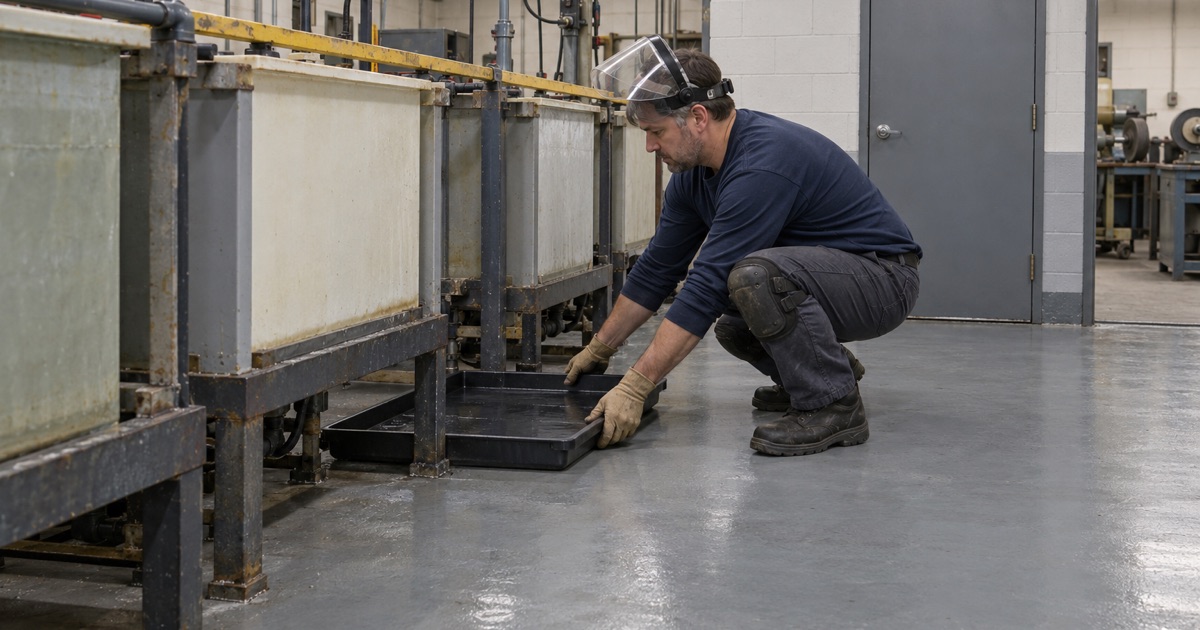
The federal chromium electroplating rule, 40 CFR 63.342, carries a housekeeping table, Table 2, that a shop works into its operation and maintenance plan. Several of its lines concern the floor even though the word coating never appears. Hexavalent chromium substances are kept in closed containers in an enclosed storage area, dragout is caught in drip trays or contained and returned or treated, and a splash guard goes wherever parts are sprayed over a tank.
Three more lines decide most of the layout. Spills of hexavalent chromium substances are cleaned up or contained within one hour, and material sitting in a drip tray, pan or sump is not counted as a spill. The open floor and walkways around the tanks are cleaned at least every 7 days the tanks are used or every 40 hours of tank operation, whichever is later, and buffing, grinding and polishing in the same room are kept behind a physical barrier.
Read together, those lines describe a room in zones. There is a dragout path between tank and rinse, an open floor and walkway band around the line, a storage area, and a grinding and polishing area behind the barrier. We plan the floor the same way, zone by zone, rather than quoting one coating wall to wall.
Looking for epoxy-flooring closer to Forest Park? See Forest Park Epoxy-Flooring.
Dragout paths, drip trays and the one-hour spill clock
The stretch between the tank and the rinse
Dragout is the solution that clings to parts and racks as they leave a tank. The rule’s answer is a drip tray that returns that solution to the tank, or drippings that are contained and then returned or collected and treated. On the floor, that means the dragout path should stay dry and visibly clean, because the tray, not the slab, is doing the catching.
That gives a simple test at the walkthrough. If a stripe of floor between tank and rinse is routinely wet, something upstream needs attention, and a new finish would only hide it for a while. We would rather point that out before pricing than install a coating over a symptom.
What a coating is not
We say this plainly in every proposal for a plating room: a floor coating is not a drip tray, not spill containment and not a tank lining. Those are process equipment, chosen by the shop for the chemistry it runs, and nothing we install takes their place. Our work is the walking and working surface around them.
Keeping that line clear also keeps expectations honest. A well-bonded resin floor makes a spill easier to see and quicker to clean up inside the one-hour window, because there is no porous concrete for liquid to soak into. It does not change who is responsible for the spill or how the shop handles it.
Wet processes and dry standing places
OSHA’s walking-working surface rule, 29 CFR 1910.22(a)(2), adds a second layer. Where wet processes are used, drainage is maintained and, to the extent feasible, dry standing places such as platforms, false floors and mats are provided. Around a tank line, that usually means operators stand on a platform or mat, so the coated floor beneath has to be easy to clean under and around those fixtures.
A tank-line floor built for weekly wet cleaning
The weekly cleaning schedule is where a coating earns or loses its place. The rule allows HEPA vacuuming, damp-cloth wiping, wet mopping, a rinse collected into the shop’s wastewater, another approved method, or a non-toxic chemical dust suppressant. Where a shop chooses wet mopping or a collected rinse, the floor gets wet on purpose every week for its entire service life.
Joints, cracks and residue
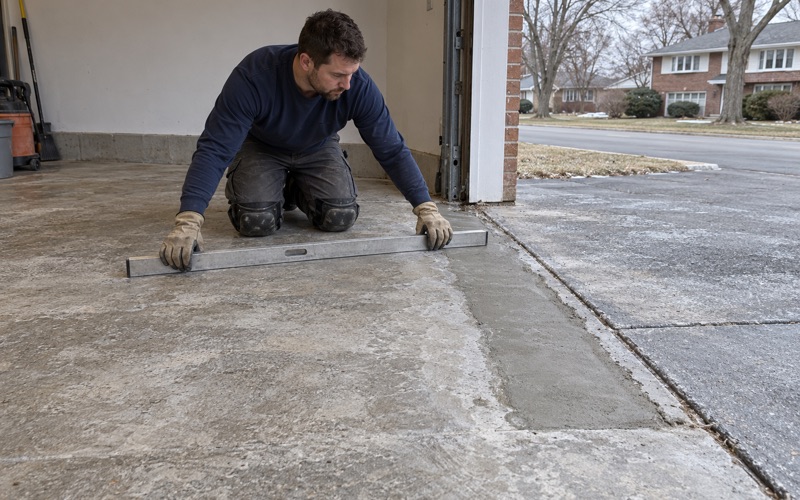
A floor washed that often is judged by where residue can hide. Open saw cuts, spalled edges, cracks and worn patches of an old coating all hold material that a mop slides right over. Before we price a tank-line floor we map every crack, spall and failing coating, and we say so when a section of slab needs repair or replacement before anything goes on it.
Joints are a design decision, not an afterthought. Some are filled and coated over, some need to stay as working joints with a flexible filler, and a coved detail at walls and equipment bases keeps mop water from wicking into the edge. The proposal shows which treatment each joint gets.
Choosing the system for the walkway band
For the band around a tank line we lean toward thicker builds, such as a 100% solids epoxy base or a urethane cement where the room runs warm and wet, under a topcoat chosen for repeated wet cleaning. We read the manufacturer’s chemical exposure data against what the shop tells us it handles, and where the data does not support the exposure, we say so. Texture is set by the broadcast and topcoat we specify, kept fine enough that a mop still clears it.
The proposal names the product line, the number of coats and the finished thickness. That lets a plant manager check the installed floor against the quote, zone by zone, instead of taking a brochure’s word for it.
Getting a bond on an old slab
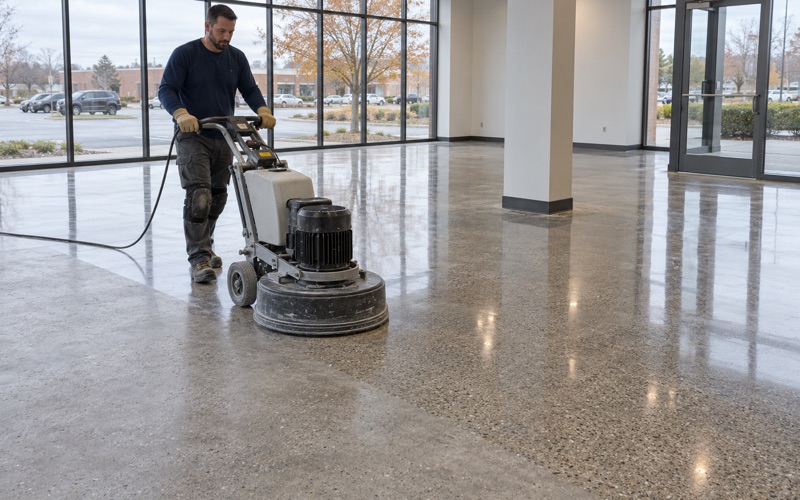
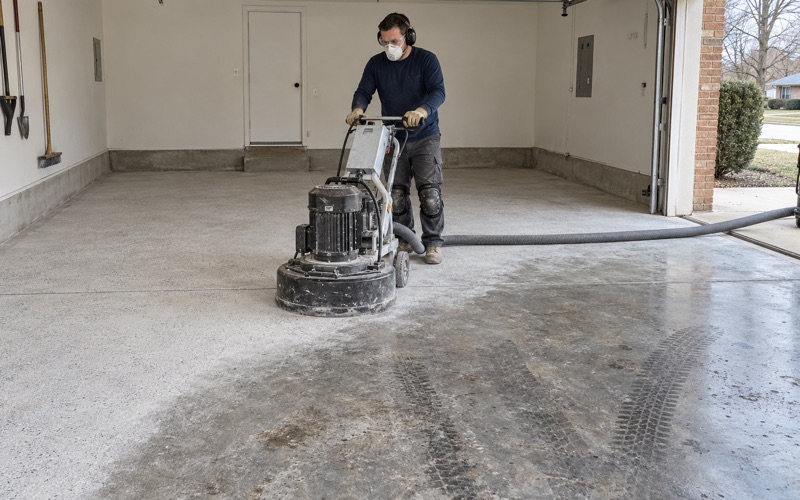
Plating floors are rarely new concrete, and a slab that has absorbed years of process water and machine oil is a poor bonding surface. We open every slab with a diamond grinder or a shot blaster to the ICRI surface profile the primer calls for, never with an acid etch. Grinding dust is captured at the machine by vacuum rather than washed toward a drain, and since the rule also asks that housekeeping waste be stored and disposed of without fugitive dust, the shop decides how that collected dust is handled.
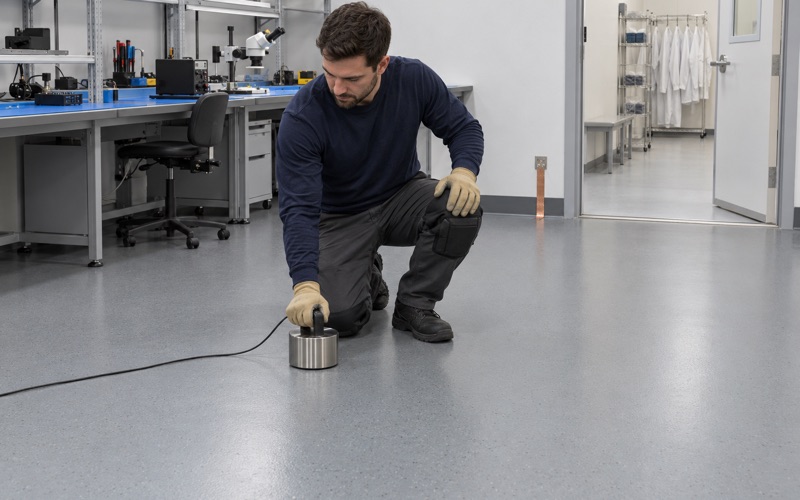
A moisture test, using ASTM F2170 relative humidity probes or ASTM F1869 calcium chloride kits, is written into the scope before the price is final. Moisture is also the first warranty exclusion we name, before the job is sold. A slab that keeps emitting vapor can lift any coating regardless of product, and that conversation belongs at the start.
Keeping the grinding room separate, and working around the clock
Grit and compound behind the barrier
The rule separates buffing, grinding and polishing from plating with a physical barrier, and gives plastic strip curtains as an example. On the grinding side the floor sees something different from the tank line: abrasive grit, polishing compound and metal fines rather than plating solution. That side can take a different system, often with more texture and a harder topcoat for carts and foot traffic.
Where the finish changes at the barrier, we plan the transition so a strip curtain still hangs clear and no ridge forms for anyone to trip on. Grinders and polishing stands also leave coolant and compound around their bases. We coat up to a clean, defined edge rather than running finish under equipment that will never move.
Phasing a floor in a shop that never empties
A round-the-clock schedule means a floor is done in sections, not in one shutdown. We break the room into phases that follow the rule’s own layout, with the dragout path, the walkway band, storage and the grinding area handled separately, and agree with the shop on overnight and weekend windows. Each phase is cured by slab temperature and the dew point spread at the surface, not by the calendar.
Products are chosen inside the Illinois VOC limits for floor and industrial coatings in 35 Ill. Adm. Code Part 223, which bind the person applying them as well as the seller. That matters more in a room that cannot be emptied, because the crew on the next zone shares the same air as the one curing.
Who signs off
Before scheduling, we confirm with the Village of Bellwood Building Department whether the work needs a permit. The village reports its building code as the 2006 IBC, adopted in 2008, so a specification borrowed from a town on a newer edition gets checked rather than assumed. The shop’s air and waste obligations stay with the shop and its regulators, and we put in writing exactly what the floor is and is not meant to do.
- 20+ Years on Concrete
- Moisture Test in Every Scope
- Free Written Estimates