Glenview Epoxy Flooring brings more than 20 years of floor coating work to epoxy flooring in Bridgeview, and on a job scheduled between late fall and early spring the first decision we settle is not the color or the flake blend. It is what will heat the room while the resin cures. A coating laid over a well-prepared slab can still come out cloudy, tacky or greasy if the wrong heater runs beside it, and that defect is set in the first hours.
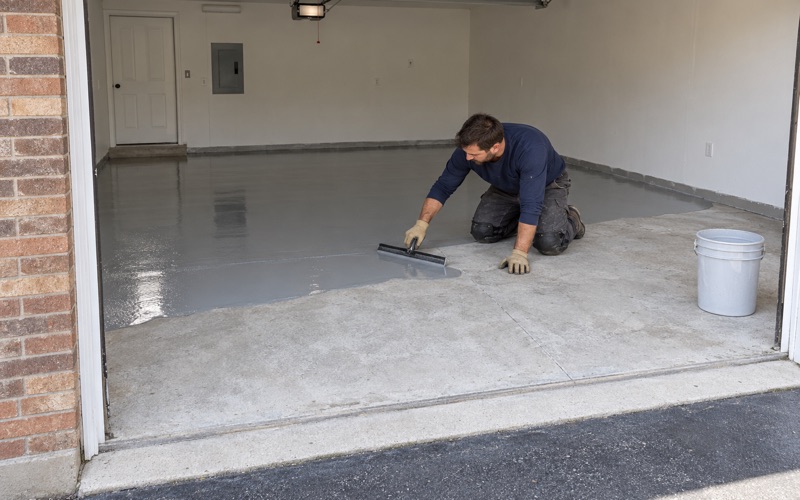
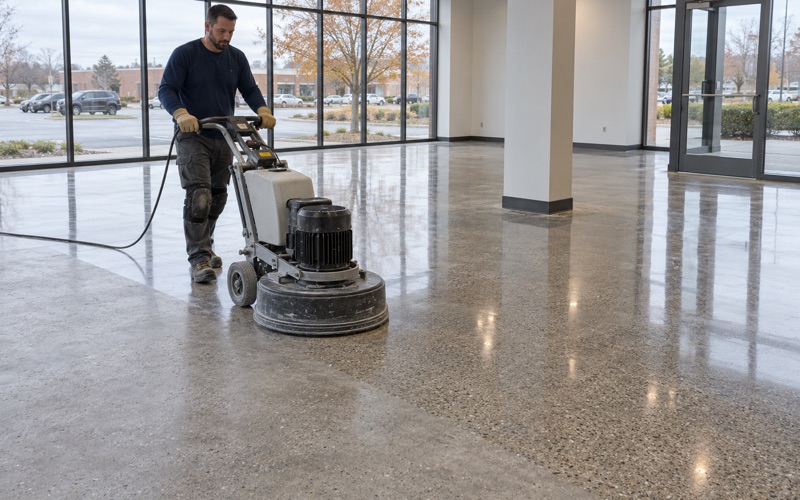
Every floor we coat starts the same way. The slab is opened with a diamond grinder or a shot blaster rather than acid, moisture is tested before the price is final, and cracks, spalls and old coatings are mapped so we can tell you plainly when concrete needs repair first. Our written proposal names the product line, the number of coats and the finished thickness.
In the cold months that proposal also names the heat source and how long it stays on. That line is what separates a winter quote from a summer one, and the rest of this page explains how we choose it.
Heater Rentals on Industrial Drive and the Floor Decision
A depot that stocks every kind of construction heat
Bridgeview sits about 15 miles southwest of the Chicago Loop, and a large share of the village is zoned for industry. At 9655 Industrial Drive, Carrier Rental Systems runs its Chicago depot out of a 28,985-square-foot maintenance building on 3.9 acres with 10 oversized drive-in doors, a property Realterm acquired in May 2026 and leases to Carrier. The depot lists itself as available 24/7 and rents chillers, boilers, generators, dehumidifiers and heaters throughout the Midwest.
Carrier’s heater rental page says the company ‘inventories electric, direct & indirect fired heaters’ and lists construction heating and moisture removal among the uses. We have no relationship with Carrier and have not checked which units the Bridgeview yard keeps on hand in a given week. We mention it because it shows what a winter floor job here can call on: all three kinds of heat are an ordinary rental, so nobody has to settle for the wrong one.
Why the heater belongs in the coating scope
Most owners think of a rented heater as site logistics, something the general contractor or the maintenance crew sorts out. On a floor job it is a coating decision, because the air around curing epoxy becomes part of the chemistry. When someone tells us a shop or warehouse bay will be heated for the install, we ask what with, where the exhaust goes and who keeps it running overnight.
Bridgeview’s industrial floors make that a practical question. A plant bay with a dock door cycling all day loses heat fast, and a rented unit is often the only way to hold the room through a cure. A homeowner with an unheated detached garage faces the same choice on a smaller scale.
Permits and who signs off
When a floor job is part of larger work that needs a permit, the Village of Bridgeview Building Department at 7500 S. Oketo Avenue asks for drawings, the contractor’s license, a $10,000 surety bond and a certificate of insurance before it issues one. Illinois licenses no general, flooring or coatings contractor, so the village license and bond are the binding credential here. If a temporary electric heater needs new wiring, the village applies the current City of Chicago Electrical Code, and the electrician must hold a City of Chicago license.
Looking for epoxy-flooring closer to Burr Ridge? See Epoxy-Flooring Services in Burr Ridge.
Direct-Fired, Indirect-Fired and Electric Heat
Direct-fired units: salamanders and torpedoes
A direct-fired heater burns propane or kerosene and blows the hot combustion gases straight into the room. Salamander and torpedo heaters are the familiar examples, popular because they are cheap, portable and throw a lot of heat. Everything the flame produces, water vapor and carbon dioxide included, ends up in the air the floor is curing in.
Sherwin-Williams, in its resin flooring guidance, is direct about it: ‘a fuel burning heater such as a salamander or torpedo heaters are not recommended.’ The reason it gives is that the method heats the area but also introduces moisture and carbon dioxide. We do not run one beside a floor we are coating, and we ask that nobody else on site runs one in that space during the cure.
Indirect-fired heat
An indirect-fired heater still burns fuel, but the flame sits inside a heat exchanger. Clean air passes over the exchanger and is ducted into the room, while the combustion products are vented outside through a flue. That separation is the whole point, because the room gets heat without the moisture and carbon dioxide that come with an open flame.
For a large space, such as a warehouse aisle or a high-ceilinged shop bay, vented indirect-fired heat is usually the practical answer. The unit sits outside or at an opening, the duct runs in, and the exhaust is pointed away from doors and air intakes so it does not drift back into the room.
Electric heat and dehumidifiers
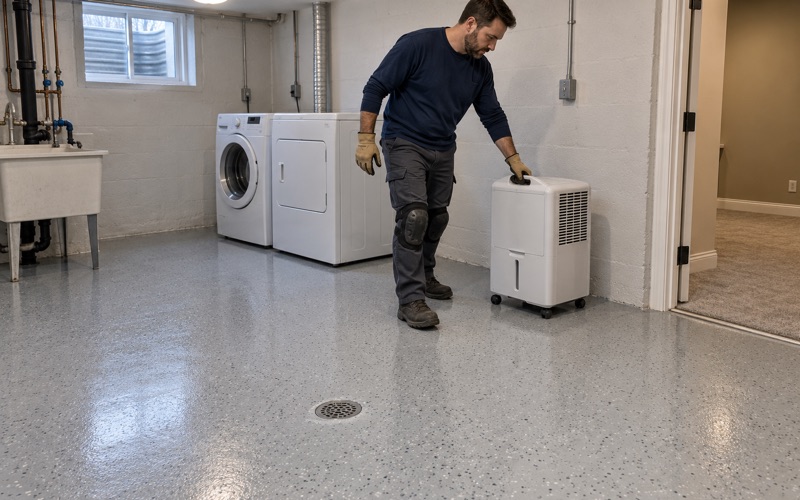
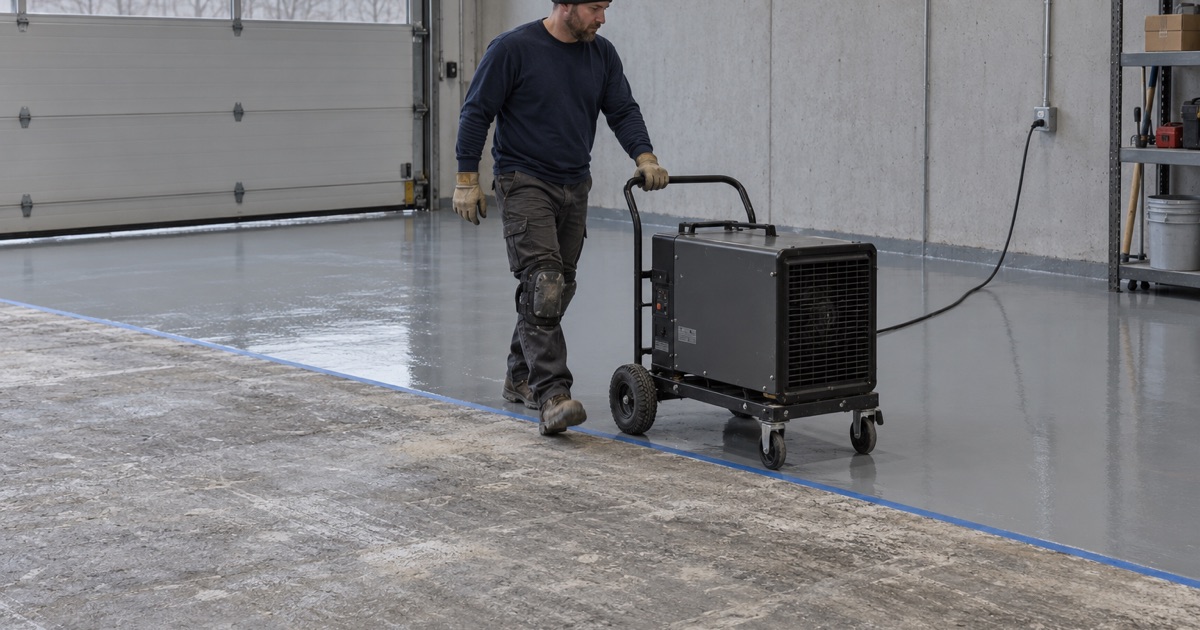
Electric heaters produce no combustion products at all, which makes them the simplest choice for a garage, a basement or a small commercial room. Their limit is power, since a large electric unit needs a circuit that can carry it and a residential garage panel may not. Where moisture in the air is the concern, a rented dehumidifier beside the heater does what heat alone cannot, and rental units come in both desiccant and refrigerant types.
Amine Blush: What Combustion Heat Does to Curing Epoxy
The chemistry in plain terms
Sherwin-Williams describes amine blush as a reaction between water, carbon dioxide and the amine component of an epoxy coating. Epoxy cures when its amine hardener reacts with the resin. If the surface meets enough moisture and carbon dioxide before that reaction finishes, part of the amine reacts with them instead and leaves a film on top.
That film shows up as a waxy, greasy or cloudy surface, sometimes with white haze or sticky patches. It is most associated with application at low temperature, high humidity or both, which is the very condition a heated winter job is trying to escape. A direct-fired heater fixes the temperature and then supplies the two ingredients blush needs.
Why it matters beyond the look
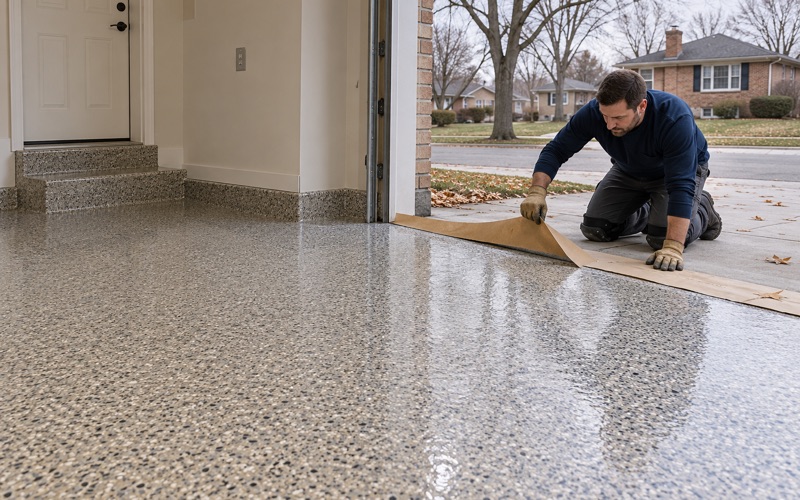
A blushed surface is more than a cosmetic flaw. The next coat, whether a second epoxy layer or a polyaspartic topcoat, is laid over a film it does not bond to well, and a topcoat that cannot grip may later lift under hot tires or forklift traffic. Blush can also dull a clear coat and bury a vinyl flake or quartz broadcast under a hazy layer.
We treat blush as a cure defect, which means preventing it is our job. Before a job is sold we explain what a coating warranty leaves out, starting with moisture coming up through the slab, but a film caused by the wrong heater is not something we hand back to the owner.
Where the risk is highest
The danger grows in a closed room. A garage with the door down, a basement, or a shop bay sealed against the wind holds every bit of combustion moisture a direct-fired unit puts out. Large open warehouses dilute it somewhat, but a bay with its dock doors shut for warmth is a closed room for practical purposes.
Holding Heat Through the Cure, Then Washing Off Any Blush
Heat stays on until the floor is cured
The most common winter mistake is heating the room for the install and shutting the heater off when the crew leaves. Epoxy keeps reacting for hours after it is rolled out, and a slab that cools overnight slows that reaction while stray moisture has more time to reach the surface. We schedule heat to run through the cure, not just the working day.
Our cure schedules follow the slab temperature, read at the surface, rather than the calendar or a thermostat on the wall. Concrete holds cold long after the air warms, so a room that feels comfortable can still sit on a slab too cold to cure properly. Where we cannot hold temperature, as in an unheated garage in deep winter, we tell the owner to wait for spring rather than gamble the floor.
Planning heat around a working building
In a plant or warehouse, holding heat for a day or two means planning around operations. We phase commercial floors around operating hours and use overnight and weekend windows, and in winter that plan includes where the heater sits, where its power or exhaust goes, and which dock doors stay shut. A door left open for one delivery can pull a bay’s temperature down quickly.
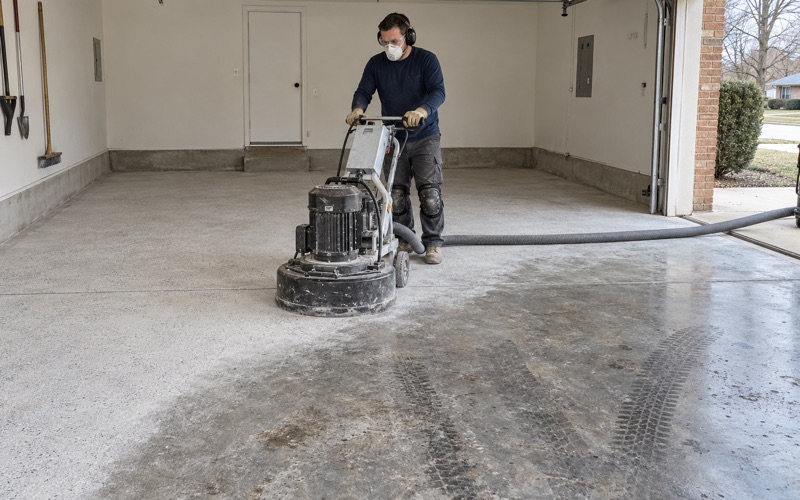
Grinding comes before any of that, and the dust is captured at the machine with a vacuum rather than swept or rinsed toward a floor drain. A warm, dry, clean slab going into the prime coat is what the heat plan exists to protect.
Washing off blush before any recoat
If a greasy or cloudy film does appear, it comes off before anything else goes on. Blush is water soluble, so solvents do little; the fix is a scrub with mild detergent in warm water, a clean rinse, a full dry and a retest of the surface. Sherwin-Williams also warns that abrading should be avoided until the blush is removed, since sanding a blushed surface can smear the film into the scratch pattern instead of lifting it.
Only once the surface tests clean and dry do we sand, if the recoat window calls for it, and apply the next coat. We note the cleanup in the job record, so the owner knows what happened and the second coat is never laid over an unresolved problem.
- 20+ Years on Concrete
- Moisture Test in Every Scope
- Free Written Estimates