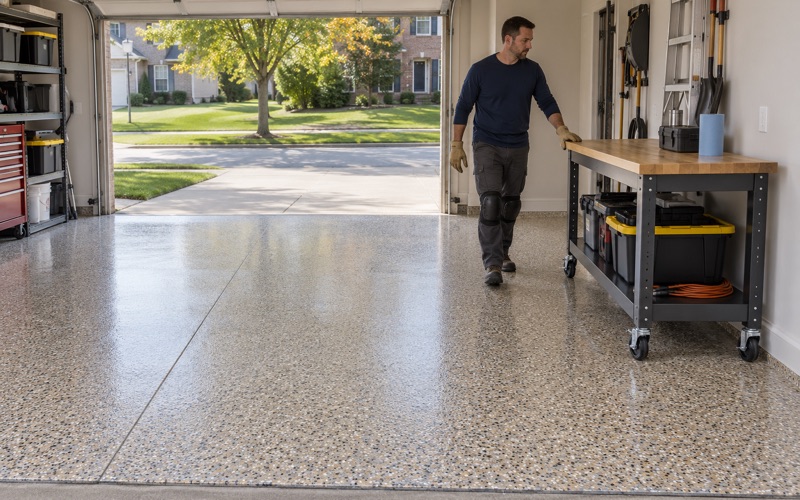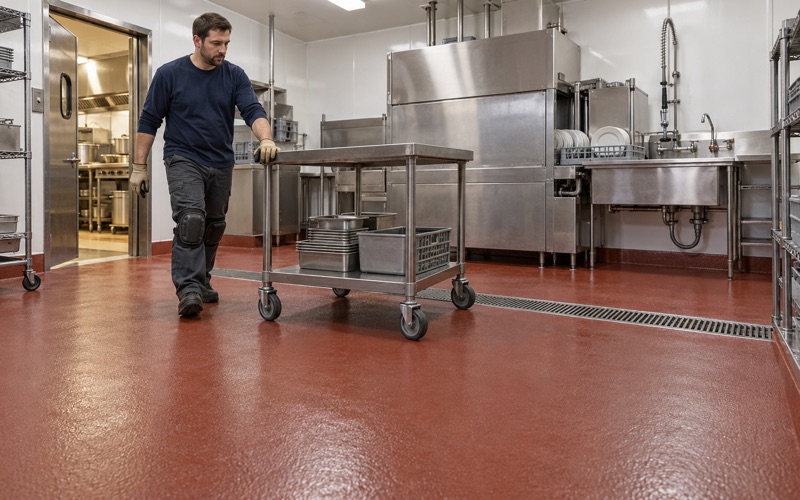
Glenview Epoxy Flooring has spent more than 20 years putting down epoxy flooring in Burr Ridge garages, basements and commercial spaces, and lately a growing share of the questions we hear are about a game rather than a car. Homeowners want a coated floor that can carry pickleball lines for drills, and they want those lines to read the way they do on a real court. That turns out to be a question about color as much as coating.
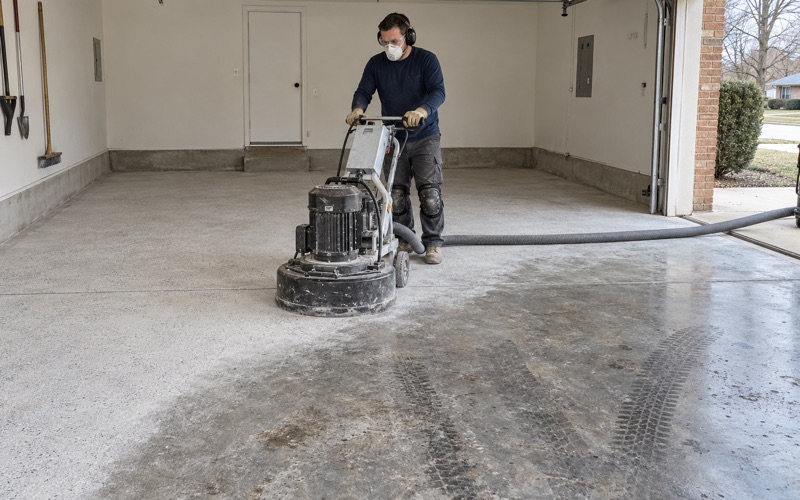
Our work starts the same way whatever ends up painted on top. We open the slab with a diamond grinder or a shot blaster, never an acid etch, and a moisture test is part of the written scope before a price becomes final. The proposal names the product line, the number of coats and the finished thickness, so you can hold the floor up against the quote when we are done.
What changes for a game floor is the order of decisions. The field color, the broadcast and the line plan are settled together, before the first coat goes down, because a choice made for looks alone can make the lines disappear.
Indoor Pickleball and What the Rulebook Asks of a Line
Where Burr Ridge plays
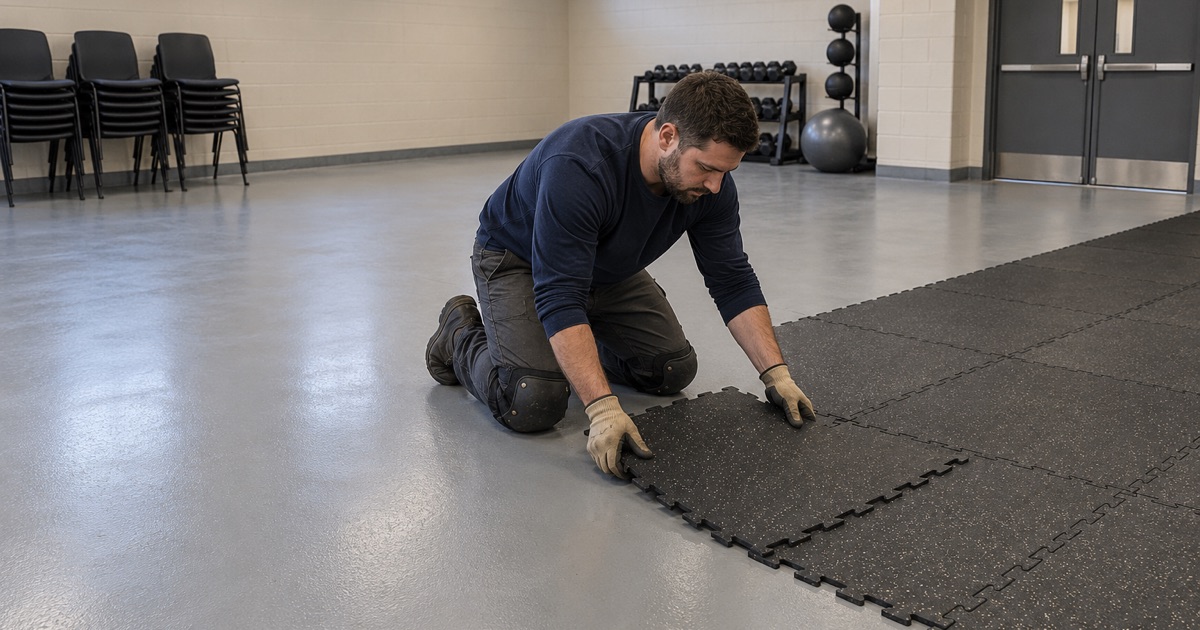
Pickleball in Burr Ridge has moved indoors. Life Time Burr Ridge, the athletic club in Burr Ridge Corporate Park, books court time through its app and runs open play by skill level, lessons, mixers, leagues and junior play starting at age 4. A caption in the club’s own gallery describes three indoor pickleball courts in a brightly lit gymnasium, and court directories list them as dedicated courts with permanent lines and nets.
Life Time’s Sport and Racquet club on Madison Street, the former Five Seasons Country Club, went further during its renovation and converted two tennis barns into dedicated pickleball courts. Players who learn the game on floors like those come home knowing exactly what a good line looks like. They notice quickly when a garage stripe does not measure up.
Those club courts are a cushioned sports surface, built with Laykold and a generous amount of gel to ease the load on knees, hips and back. That is a purpose-built court system, not a garage coating, and we had no part in building or maintaining it. What a coated home floor can borrow from those courts is the logic of the lines, not the surface.
The two-inch rule
The USA Pickleball rulebook, in rule 2.A.2, says all lines should be 2 inches wide and the same color, clearly contrasting with the color of the playing surface. It names no particular color, and its wording is “should” rather than a mandate. The test it sets is contrast: a player tracking a ball at speed has to see where the line is without hunting for it.
Rule 2.A.1 sets the court itself at 20 feet wide and 44 feet long for both singles and doubles. Rule 2.A.3 sets a minimum playing surface of 30 by 60 feet, with 34 by 64 feet recommended for new construction and tournament play. The extra room around the court is where players chase wide balls and backpedal for lobs, and those two numbers decide most of what a home floor can and cannot become.
Looking for epoxy-flooring closer to Winnetka? See Epoxy-Flooring in Winnetka.
Why a Flake Broadcast Hides a Court
What chips do to a stripe
A vinyl flake broadcast is the most popular finish we install on garage floors, and for good reason. Colored chips scattered into the wet base coat hide dust, tire marks and small blemishes, and they give the floor a finished, stone-like look. That same camouflage is exactly what works against a court line.
A dense multicolor broadcast breaks a painted stripe into a field of competing specks. Where the flake carries the same tones as the line, the edge blurs and the stripe seems to waver as you move. A 2-inch line that looks crisp while you stand still can vanish from peripheral vision during a fast exchange at the non-volley zone.
Testing contrast before choosing a blend
We lay out sample boards with a line taped across each candidate blend, and we look at them from standing height under the light the room actually has. A sparse light flake under a dark line, or a sparse dark flake under a white line, sometimes works. A full-coverage broadcast in mixed tones rarely passes, however handsome it looks on the sample chart.
If you want flake for the rest of the garage, a common compromise is a solid field in the zone where the lines will go and flake everywhere else. The border between the two becomes a deliberate design line rather than an accident. That decision has to be made before the base coat goes down, because it sets where each material is placed and how the seam between them is finished.
Field Color First, Lines Under the Topcoat
Choosing the field
On a coated floor the base color is picked with the lines in mind, not the other way around. A solid field in a mid-to-dark tone gives a light line something to stand against, and a pale field does the same for a dark line. We decide the line color and the field color as a pair, and we test the pair on a sample before committing the whole slab.
Sheen matters as well as hue. A high-gloss clear coat over a light field can throw back glare from overhead fixtures and wash out a light line at certain angles, while a satin finish tends to keep the contrast steadier. We talk through the room’s lighting before choosing the gloss level.
Taping and laying the lines
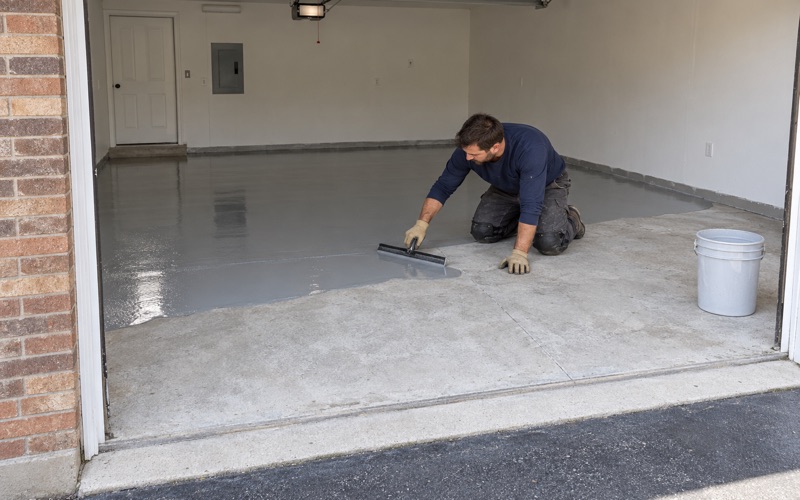
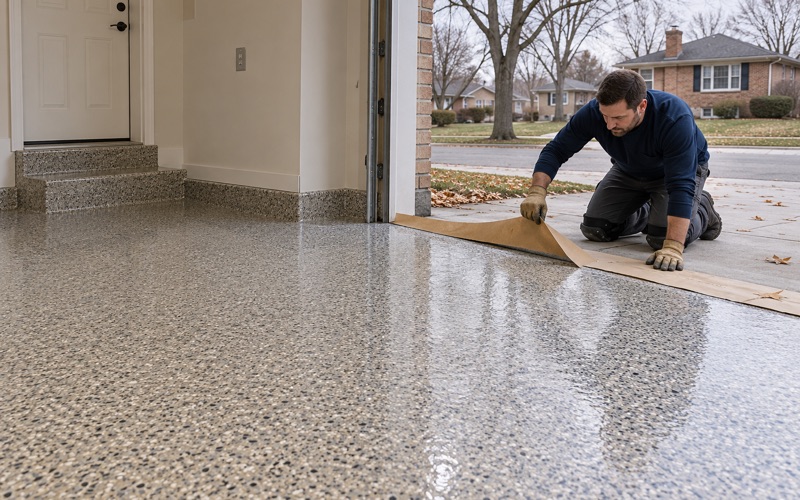
Lines go down after the color coats have cured enough to tape and before the clear topcoat. We measure and snap the layout, mask both edges of every stripe at 2 inches wide, and apply the line color in thin coats so the edges stay sharp. Pulling the tape at the right moment matters, because tape left too long on fresh coating can lift a ragged edge.
Then the clear coat goes over everything, lines included. A polyaspartic or polyurea topcoat protects the stripes the same way it protects the field, so shoe soles, foot traffic and a rolling ball cart wear the clear layer instead of the paint. Lines painted on top of a finished floor sit exposed and start to scuff along the baseline and the non-volley edge, where players plant and push off.
Every layer has to bond to the one beneath it. We watch for amine blush on epoxy coats in cool, damp conditions, and we follow the slab temperature and the dew point spread at the surface rather than the clock. An unheated garage in deep winter is told to wait, because a line laid into a coat that has not cured properly is a line that peels.
Getting the slab right underneath
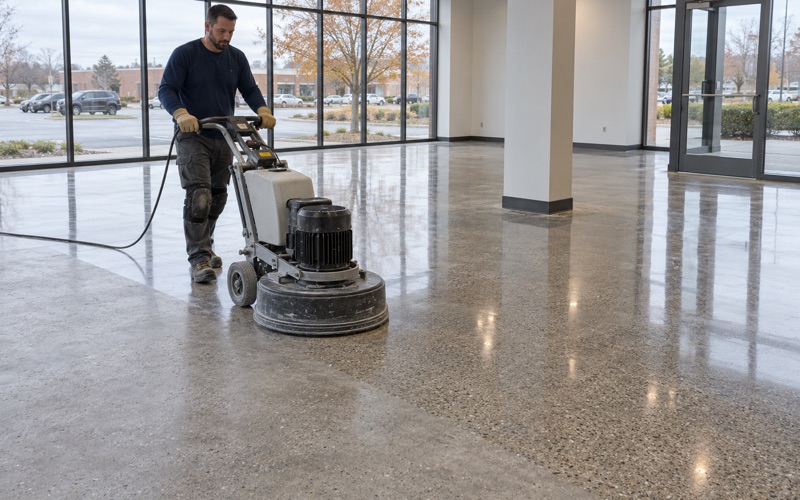
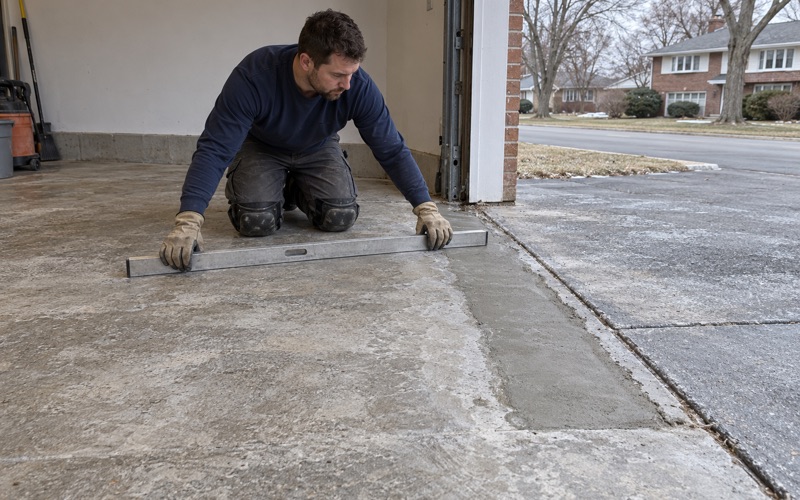
None of the color work survives a weak bond. Every slab we coat is opened to a measured ICRI concrete surface profile, and grinding dust is captured at the machine with a vacuum instead of being rinsed toward a floor drain. Cracks, spalls and old coatings are mapped first, and if a slab needs repair or replacement before it should carry a game floor, we say so before you sign.
Practice Lines on a Burr Ridge Garage or Basement Floor
Why a full court rarely fits
A full pickleball court with its minimum 30-by-60-foot playing area is bigger than an ordinary home garage, and most basements are broken up by columns, stairs and mechanical rooms long before they reach that size. Painting a full court into a space that cannot hold its run-off area produces sidelines that point straight into a wall. A player who chases a wide ball there finds the wall before the line.
What fits is a practice layout. A single non-volley zone line with a centerline, a short-court drill box, or a target lane for dinking against a rebound net gives a player the reference lines that matter most for drills. Layouts like these sit comfortably on a two-car garage floor and still leave room to park when practice is over.
Burr Ridge homes and their slabs
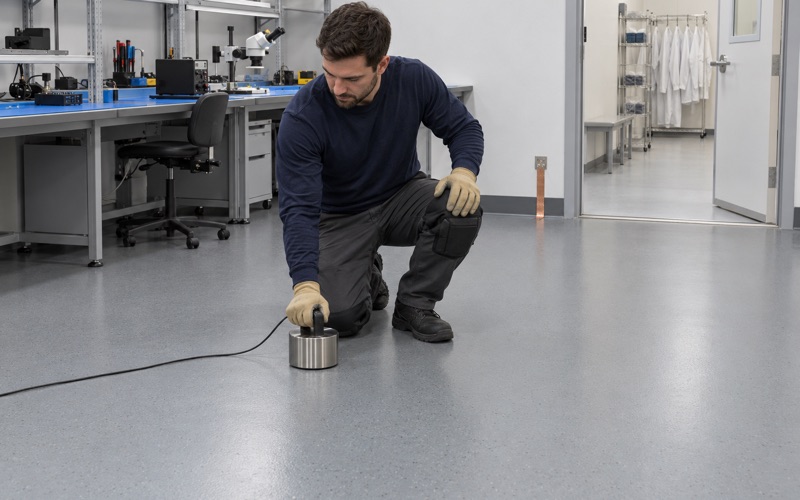
In Burr Ridge, 61.6 percent of the housing was built between 1980 and 2009, and 94.0 percent of homes are owner-occupied, so the floors we see are mostly attached garages and basements in houses their owners plan to keep. Whether a slab of that era sits over a vapor retarder is recorded nowhere at the neighborhood level, so we test rather than assume. A plastic sheet test under ASTM D4263 gives a first read, and calcium chloride testing under ASTM F1869 or in-situ relative humidity probes under ASTM F2170 tell us whether a 100% solids epoxy can go straight down or needs a moisture-mitigation primer first.
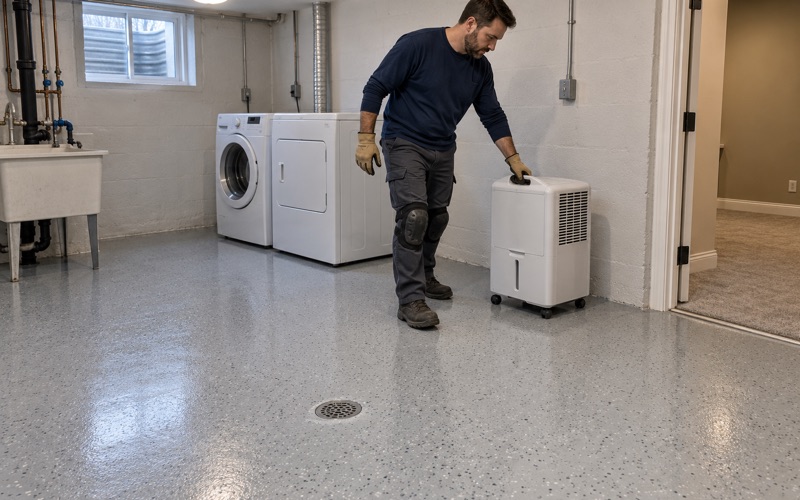
Basements are read for past water before anything else, because a coating does not stop seepage or sewer backup. Moisture is also the first exclusion we name when we explain what a coating warranty leaves out, and we cover it before the job is sold, not after a line starts to lift.
Garage floors that still take winter
A garage practice court still has to work as a garage through the cold months. The system we choose has to hold up to the brine and rock salt that ride in on tires, and to hot tire pickup when a car pulls in straight off the road. That is one more reason the lines belong under the clear coat, where the salt meets the topcoat rather than the paint.
The village side of a coating job is usually simple. Burr Ridge’s building permit page lists finish work such as painting among the items that need no permit, while new garages, patios and work that impacts foundations do, so if a project grows into slab replacement we check the permit question before the job goes on the calendar. Home jobs over the state threshold get a written contract and the Illinois Home Repair: Know Your Consumer Rights pamphlet before any grinding starts.
- 20+ Years on Concrete
- Moisture Test in Every Scope
- Free Written Estimates