
Glenview Epoxy Flooring handles concrete floor repair in Glenview, IL, serving surrounding cities including Winnetka, Prospect Heights, Deerfield, Lincolnwood and Norridge. In 20+ years of coating floors, we have found that most slabs need some repair first, and that skipping it is one of the fastest ways to lose a new coating.
We map every crack, spall and old coating before the price is final, then repair what can be repaired and say plainly when a slab should be replaced instead. That honesty sometimes means a smaller job for us, but a coating laid over a failing slab only outlines the damage, and the owner pays twice.
Cracks in Concrete Floors
Hairline and Shrinkage Cracks
Almost every slab develops shrinkage cracks as it cures, and garages and basements in older Glenview houses tend to carry decades of them. Hairline cracks are opened slightly with a crack-chasing blade so the repair material has room to bond, then filled with a rigid epoxy or a fast-setting polyurea and ground flush. Once coated, these repairs usually disappear under a flake broadcast and stay sound for the life of the floor.
Wider and Moving Cracks
Wider cracks, and cracks that open and close with the seasons, need a semi-rigid or flexible filler rather than a rigid one, or they will crack again right beside the repair. We look for signs of movement, such as one side sitting higher than the other or a crack that has reopened after an earlier patch. A crack that is still moving may show through a coating eventually, and we explain that before deciding how to finish the floor.
Spalls, Pitting and Salt Damage
Spalled Edges and Broken Joints
Spalls are chips and breaks along cracks, joints and slab edges, often caused by impact or by water freezing in a damaged area. We cut back the loose concrete to sound material, clean the area and rebuild it with an epoxy mortar or a polymer-modified repair compound. The rebuilt edges are ground flush so they read as part of the slab rather than a lump under the coating.
Road Salt Pitting and Scaling
Calcium chloride and rock salt brine soak into bare garage concrete every winter, and freeze-thaw cycles then break the surface away in flakes and pits. Many older garage floors show it most where the cars sit. We grind off the scaled surface layer, fill the remaining pits and skim the worst areas, then seal the slab under a coating so the salt stays on top from then on.
Joints, Settling and Slab Replacement
Control Joints and Expansion Joints
Control joints are cut into slabs so cracks form along a straight line rather than at random. When a joint has crumbled at its edges or filled with debris, we clean it out, rebuild the shoulders and fill it with a flexible joint filler, or leave it open and coated as a design line. In warehouses, joints get a semi-rigid filler so forklift wheels roll over them without chipping the edges.
Settled and Heaved Sections
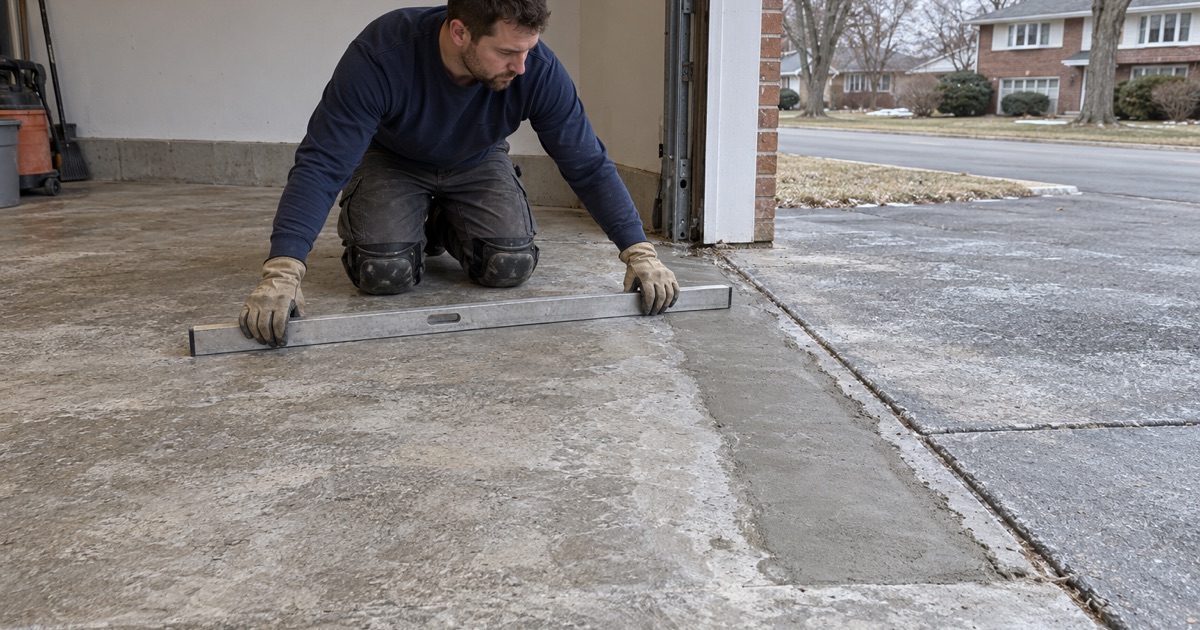
A slab section that has sunk or heaved leaves a trip edge and a gap where water and salt collect. Small height differences can be ground down and feathered with a leveling compound. Large ones usually mean the base underneath has failed, and grinding or patching the surface will not stop the slab from moving again, so we tell you that before planning a coating.
When Replacement Beats Repair
Some floors are past repair: slabs broken into rocking sections, badly heaved by frost, or so soft and scaled that the surface crumbles underfoot. In those cases we recommend replacement, which in Glenview goes through the village’s concrete review rather than the flooring exemption, and we can coat the new slab once it has cured and passed a moisture test.
Repairs Before a Coating
Matching Repairs to the Coating System
The repair material has to suit the coating that goes over it. Epoxy and polyurea fillers bond tightly to epoxy and polyaspartic systems, cure fast enough to coat the same day and grind cleanly. Cementitious patches work well under polished concrete and some overlays, but they need longer to cure and a moisture check before they are coated. We choose the repair with the finished floor in mind.
Moisture and Water Behind the Damage
Some cracks and spalls are a symptom of water rather than wear. A crack that is damp to the touch, efflorescence along a joint or a spall near a basement wall points to moisture moving through the slab. We test those areas, fix the repair properly and recommend a moisture-mitigation primer or a drainage fix where the readings call for one, instead of patching over a problem that will return.
Basement Slab Repairs
Around Sump Pits, Drains and Posts
Basement slabs often break first around sump pits, floor drains and steel support posts, where the concrete was poured thin or cut to fit and where water collects. We rebuild cracked pit rims and broken drain surrounds so lids and grates sit flat again, keeping every pump and cleanout serviceable. Around posts, cracked collars are cut back and refilled so the repair does not trap water against the steel.
Old Repairs That Have Failed
Many basement floors carry earlier patches that have loosened, cracked or turned powdery with age. A failed patch has to come out entirely, because a new coating bonded to it will lift the moment the patch lets go. We sound every old repair with a hammer, remove the hollow ones and rebuild them with material suited to the coating that will follow.
- 20+ Years on Concrete
- Moisture Test in Every Scope
- Free Written Estimates