
Glenview Epoxy Flooring provides concrete grinding in Glenview, IL, serving surrounding cities including Winnetka, Prospect Heights, Deerfield, Lincolnwood and Norridge. Over 20+ years of floor work we have learned that grinding is where a coating’s life is decided, so we treat surface preparation as its own skilled job rather than a quick pass before the real work begins.
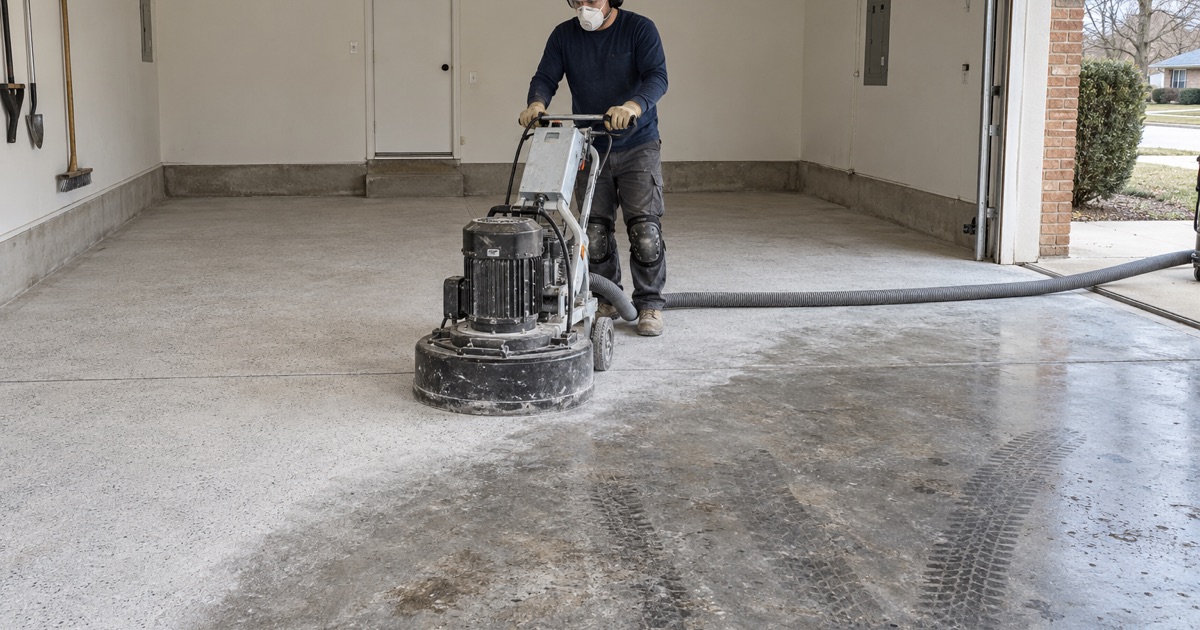
Every floor we coat is opened with a diamond grinder or a shot blaster, never an acid etch. We also grind slabs for owners who plan a different floor on top, or who simply want old paint, glue and coatings gone, and we capture the dust at the machine so the rest of the house or building stays clean.
Surface Profile and Why It Matters
Reading ICRI Concrete Surface Profiles
The International Concrete Repair Institute grades prepared concrete on a scale of surface profiles from CSP 1, nearly smooth, to CSP 10, heavily roughened. Thin sealers need a light profile, while thicker epoxy systems and urethane cement need a deeper one to anchor into. We match the profile to the product data sheet for the system going down, and we check our work against ICRI comparison chips rather than guessing by feel.
What Goes Wrong on an Unprepared Slab
A coating rolled onto a slab that was only swept or acid etched bonds to whatever is on the surface: laitance, curing compound, old sealer, oil or dust. When hot tires, foot traffic or vapor pressure pull on the coating, that weak layer lets go and takes the coating with it. Grinding removes those layers and exposes sound concrete, so the coating grips the slab itself instead of a film sitting on top of it.
Diamond Grinding and Shot Blasting
Diamond Grinding for Garages and Basements
Most residential slabs are prepared with a planetary or walk-behind diamond grinder fitted with metal-bond tooling. It handles the edges of a garage, the corners of a basement and the tight areas around sump pits, posts and stairs well, and it leaves a consistent profile across the whole floor. Edges and corners the large machine cannot reach are finished with a handheld grinder, also shrouded and vacuumed, so the perimeter is prepared as well as the middle.
Shot Blasting for Large Commercial Floors
On warehouses, loading areas and large commercial floors, a shot blaster can prepare the slab faster than a grinder. It throws steel shot at the surface, knocks off weak material and recycles the shot through a built-in vacuum, leaving a rougher profile that suits thicker industrial systems. We choose between grinding and blasting by the slab, the system specified and the space, and often use both on the same job.
Removing Old Coatings and Adhesives
Paint, Sealer and Failed Epoxy
Older garage and basement floors in Glenview often carry porch paint, acrylic sealer or a peeling kit coating applied years ago. Those layers have to come off completely, because a new coating will only stay as well bonded as the old one beneath it. We grind or strip them down to sound concrete and test any old coating that seems tight before deciding whether it can stay.
Tile Glue, Thin-Set and Mastic
Basements that once held tile or carpet often have thin-set mortar, carpet glue or black mastic left on the slab. Thin-set and modern glues grind off with the right tooling, while old black mastic from the mid-century era should be tested for asbestos before anyone grinds it. We recommend that test and follow the result, rather than putting dust from an unknown adhesive into the air of a home.
Flattening, Repairs and Dust Control
High Spots, Lippage and Old Trowel Marks
Grinding takes down high spots, lips at control joints and ridges left by old trowel work, which matters most under self-leveling and metallic coatings that magnify every bump. Low areas are filled after grinding with a patching or leveling compound, then ground flush. A slab that has heaved or sunk well beyond what grinding and patching can correct gets an honest recommendation to replace it.
Dust Capture, Not Wash-Down
Grinding concrete produces fine silica dust, so every grinder we run is shrouded and connected to an industrial vacuum with high-efficiency filtration. Dust is captured at the machine rather than swept, blown or rinsed toward a floor drain or a storm inlet. In an attached garage or a basement we also seal doors into the living space, so the only sign of the grinding inside the house is the noise.
Preparing Slabs for Other Floors
Not every ground slab gets coated. Polished concrete starts with the same grinding stages, and installers of tile, luxury vinyl plank and carpet often need a flat, clean slab free of old adhesive. We grind to the profile and flatness the next material calls for, and we leave the floor vacuumed and ready for the next trade to start.
Grinding Glenview Slabs
Salt-Scaled Garage Floors
Years of calcium chloride and rock salt brine leave many garage slabs scaled and pitted along the tire paths, with a soft, crumbly surface layer that no coating can hold onto. Grinding cuts through that damaged layer to firm concrete underneath, and the deeper pits are then filled and ground flush. How far the scaling goes tells us whether the slab can be coated at all, and we share that read before the price is set.
Testing the Slab Once It Is Open
A freshly ground slab is the best moment to judge it. With the old coatings gone we can see every crack, patch and damp area clearly, and moisture tests read the concrete itself rather than a sealer on top of it. On many older Glenview garages and basements, poured before vapor retarders were required, that reading decides whether the coating needs a moisture-mitigation primer, and the result goes into the written scope.
- 20+ Years on Concrete
- Moisture Test in Every Scope
- Free Written Estimates