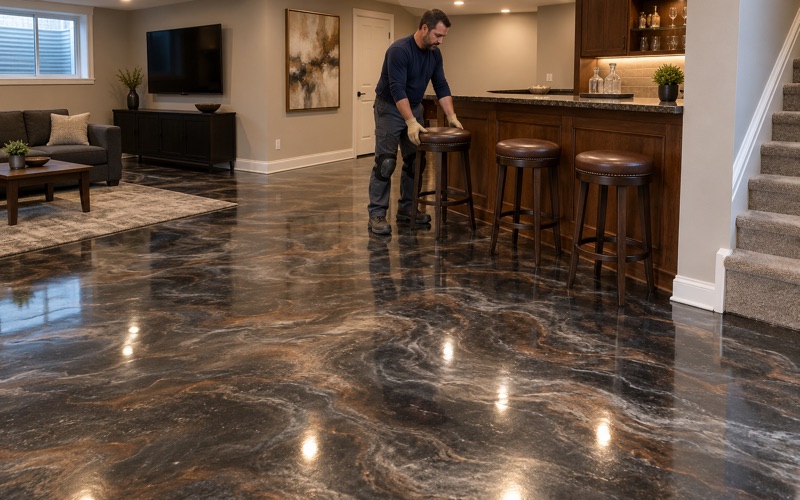
Glenview Epoxy Flooring has spent more than 20 years putting epoxy flooring in Forest Park and across the near-west suburbs, and the floors we think hardest about here are the ones that sit beside a game. A recreation floor has two jobs: it has to survive heavy foot traffic and spills, and it has to stay out of the way of the activity next to it. Some finishes fail the second job without anyone noticing, because they shed something onto the shoes that walk across them.
That is why we start a recreation or hospitality job by asking what the floor will be cleaned with and what it should never carry. A resin floor that looks right with nothing on it but a neutral cleaner is a different specification from one that needs wax to look finished. The difference matters most where people slide, roll or set a ball down a few steps from where they were just standing.
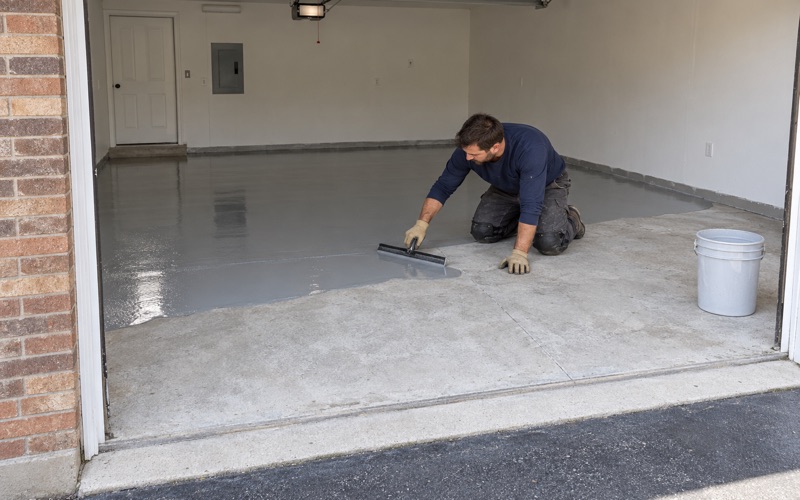
We work the same way on every slab. It is opened mechanically, tested for moisture before the price is final, and quoted by product line, coat count and finished thickness, so the floor you get can be checked against the paper you signed.
Eighty-five years on Circle Avenue, and why the floor beside the lanes matters
Circle Lanes at 7244 Circle Avenue was founded on June 7, 1941, by Eddie Anderson Sr., and the Forest Park Review marked its 85th anniversary in May 2026. Its history reads like a running list of floor decisions. In 1986 the ball return went underground and synthetic lanes were laid over the original maple, automatic scoring followed in 2011, the synthetic lanes were updated in 2024, and the billiards flooring was recently redone.
The newest change is a snack bar, added in 2026. Management keeps a deliberately old-time feel, and league nights still run Tuesday and Wednesday at 7:00 p.m. We have no relationship with the center and have not seen its concourse or snack-bar floors, so nothing here describes them. What the anniversary does show is a building where the surface beside the lanes keeps changing while the game stays the same.
The approach is not the only floor that counts
In a bowling center, the approach is the short run of surface where a bowler takes the last steps and slides into the release. Lane makers treat it as a precision surface, because the slide depends on what is on the sole of the shoe. Every square foot between the shoe counter, the settees, the snack bar and the approach is where that sole picks things up.
So the floor around the lanes is part of the game, even though nobody bowls on it. A finish that stays put under traffic leaves the approach alone. A finish that transfers, softens or smears does not, and its effect shows up several feet away from where it was applied.
Why a new snack bar changes the map
Adding food service puts drinks, candy and greasy fingers on the same walking route as slide-soled shoes. The strip of floor between a counter and the approaches becomes the busiest spill zone in the building. Where that strip ends and the approach begins is exactly where a floor choice either helps the lanes or works against them.
Looking for epoxy-flooring closer to Lake Zurich? See Epoxy-Flooring in Lake Zurich.
Wax, carpet treatments and soda: what rides onto a slide sole
Brunswick’s Manual Lane Maintenance guide, a lane maker’s care manual dated January 2016, spells out how contamination reaches the approach. It says contaminants can be transferred to the approach surface by the bowler’s shoes or by the bowling ball itself. It also asks that bowlers wear non-marking shoes, which tells you how much attention a manufacturer pays to what touches that surface.
The not-so-obvious sources
The same guide names sources most owners would never suspect: floor wax transferred from floor tiles, and carpet treatments such as ScotchGuard. A waxed tile concourse looks clean and still leaves a film on every sole that crosses it. A treated carpet does the same with a different chemistry, and neither is visible on the approach until the slide feels wrong.
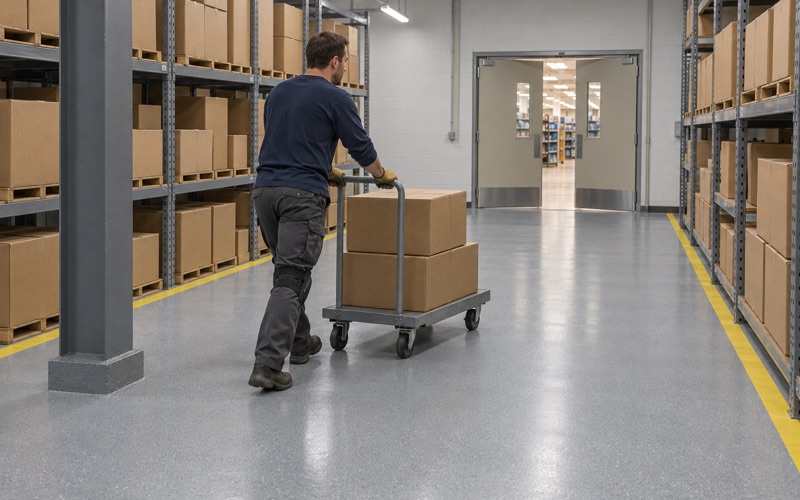
That is the case for a concourse floor chosen for what it does not shed. A properly cured 100% solids epoxy body under a polyaspartic or urethane topcoat has no sacrificial layer that needs renewing. Nothing sits on top of it that a shoe can carry away, which takes one contamination source off the list entirely.
Sticky spills and the daily routine
The Brunswick guide’s daily approach care is a dust mop first, then spot-cleaning of shoe scuffs, spills and lane oil with the approach cleaner. It singles out a sticky spill such as dried soda or candy, cleaned first with lane cleaner and then cleared of residue. It also warns against abrasive powders on shoes or approaches, and says lane mops must never be used on the approach because they reduce its sliding characteristics.
Read together, those instructions point at the surrounding floor. If the concourse is easy to spot-clean right where a cup tips over, the soda never gets walked down the line. A seamless resin surface with coved edges at the counter base keeps a spill on top of the floor, where a damp mop and a neutral cleaner can lift it in one pass.
Humidity is a floor condition too
The guide asks for relative humidity kept constant and no higher than 50 percent, with 45 percent plus or minus 5 as the ideal, because temperature swings can condense water on the approach. That same physics governs how we cure a coating. We schedule by slab temperature and the dew point spread at the slab surface rather than the calendar, because a resin laid in damp air can develop amine blush, a waxy film that is the last thing a bowling floor needs.
A concourse floor that is cleaned, never dressed
The specification we write for a recreation concourse or snack-bar floor starts from the cleaning plan. It should look finished with nothing on it, take a neutral cleaner without dulling, and never call for wax, a restorer or a spray dressing. If a proposed system only looks right after it has been dressed, we say so and recommend a different one.
Opening and testing the slab
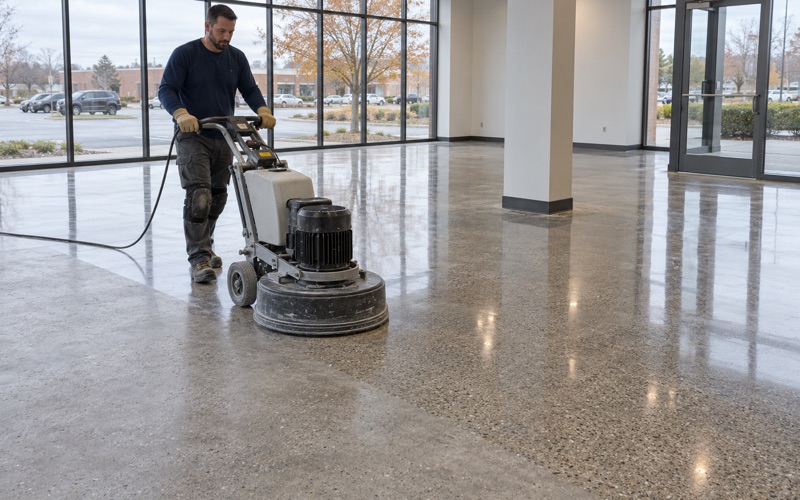
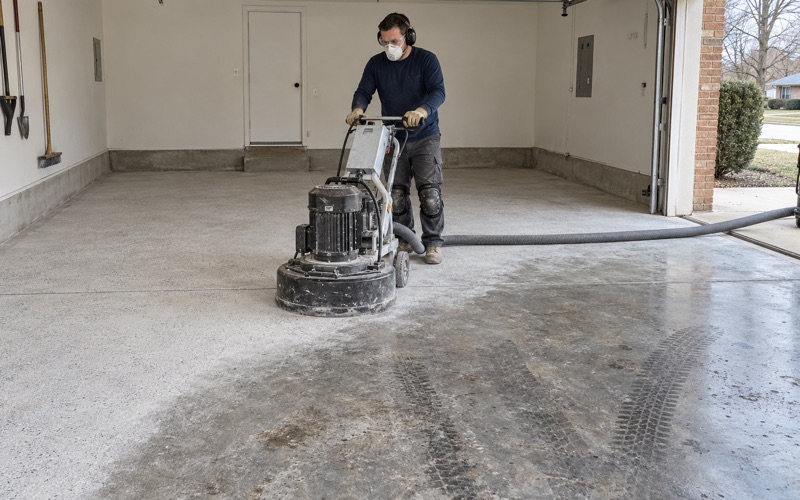
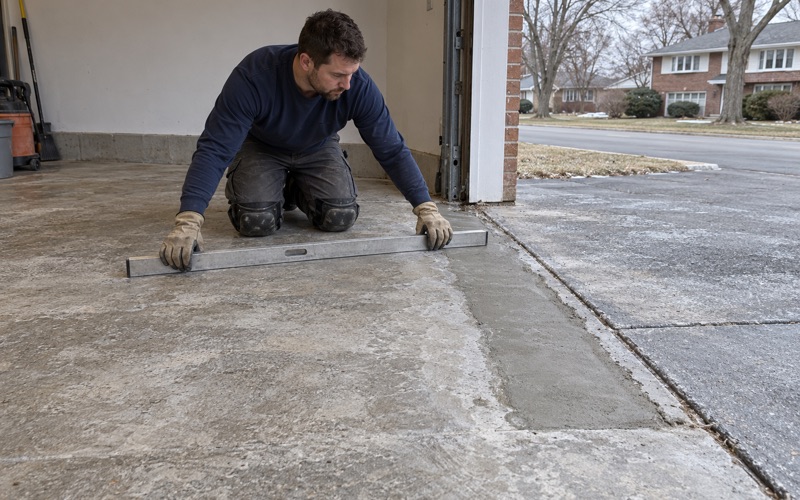
Every slab we coat is opened with a diamond grinder or a shot blaster to a measured ICRI concrete surface profile, never an acid etch, so the primer has something real to grip. The grinder runs with a vacuum attached at the machine, so the dust is captured instead of being rinsed toward a floor drain. On an older commercial building, we map cracks, spalls and any old coating first, and tell the owner plainly when a section needs repair before it should be coated.
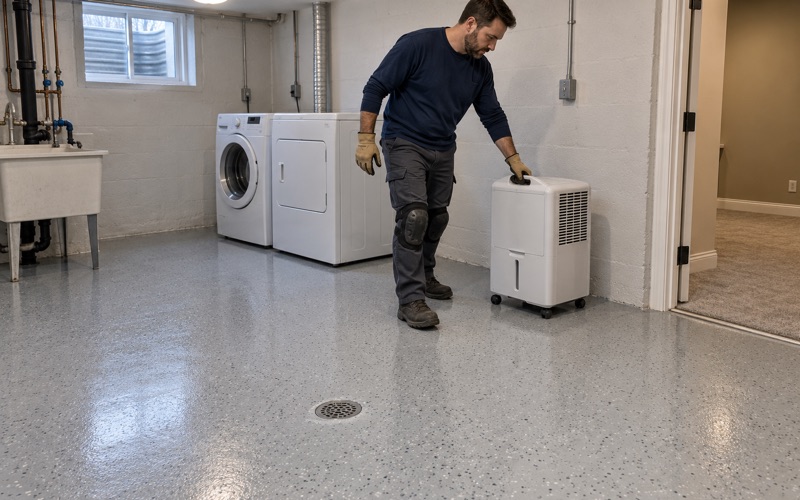
Moisture testing is part of the written scope, not an upsell. Depending on the slab, that means ASTM F2170 in-situ relative humidity probes, an ASTM F1869 calcium chloride test, or a quick ASTM D4263 plastic sheet check to flag a problem early. Where readings run high, a moisture-mitigation primer goes in before the build coats, and the proposal says which product and why.
Building the system
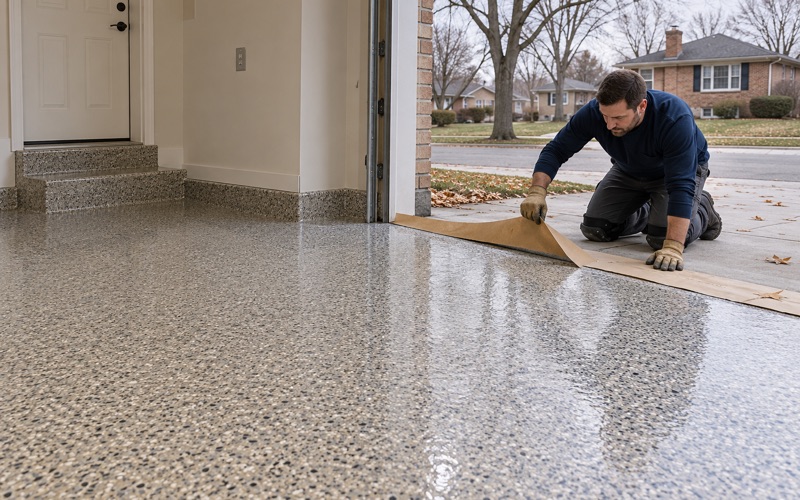
For a concourse, we usually recommend a 100% solids epoxy body coat with a fine quartz aggregate broadcast, locked in under a polyaspartic or urethane topcoat. The texture comes from the broadcast and topcoat we name in the proposal, so the finish can be checked rather than taken on faith. Behind a snack-bar counter, where hot water and sanitizer are used daily, urethane cement is often the better body, and a coved base keeps the wall line cleanable.
Food counters in suburban Cook County answer to the Cook County Department of Public Health, and the Village of Forest Park’s own Health and Safety Department administers local code alongside it. The FDA Food Code calls for floors that are smooth and easily cleanable, with an exception for antislip finishes used for safety, and for coved, closed floor and wall junctures where floors are not flushed with water. We build to that pattern and leave inspection questions to the inspectors.
Working around league nights
A bowling center or bar cannot close for a week. We phase concourse work in sections, schedule the loudest grinding outside operating hours, and use fast-return polyaspartic topcoats where a space has to reopen the next day. Products are chosen inside the Illinois VOC limits for floor coatings, which matters in an occupied building with its own ventilation.
Game rooms, bars and billiards spaces in Forest Park buildings
The same logic carries into smaller rooms. A home game room with a pool table, a basement bar with a dartboard, or a back room behind a Madison Street business all collect drinks, chalk and foot traffic. A resin floor that is mopped with a neutral cleaner and left alone ages better than one that needs a fresh coat of wax every few months.
Reading a basement first
Before we quote a basement game room, we look for signs of past water: tide lines, efflorescence, stained baseboards, a sump pit or an ejector pump. A coating does not stop seepage or backup, and we say that before anything is signed. Our warranty language names moisture vapor transmission and hydrostatic pressure as the first exclusions, so nobody learns about them after a wet spring.
We also never sell a floor coating as radon reduction. In Illinois that is separate mitigation work under the state’s radon program, and a coated slab is not a substitute for it. If a homeowner raises radon, we point them to that process rather than folding it into our quote.
Choosing a finish for a room that is played in
A vinyl flake broadcast hides chalk dust and scuffs well in a game room, while a quartz broadcast gives a bar area more texture underfoot. Either goes under a clear topcoat that cleans with water and a neutral cleaner. For a homeowner who wants the floor bright, we recommend a gloss topcoat from the start rather than a dressing added later, because the dressing is the part that ends up on the soles of everyone’s shoes.
Paperwork before the grinder starts
Home jobs above the state threshold get a written contract and the Illinois Home Repair: Know Your Consumer Rights pamphlet before any grinding begins. Permit and code questions go to the Village of Forest Park’s Building Department before the job is scheduled, not after the crew arrives. On a commercial space, that check also covers who on the property side signs off on the work and when the room can go back into use.
- 20+ Years on Concrete
- Moisture Test in Every Scope
- Free Written Estimates