
Glenview Epoxy Flooring installs industrial epoxy flooring in Glenview, IL, serving surrounding cities including Winnetka, Prospect Heights, Deerfield, Lincolnwood and Norridge. In 20+ years of floor work, industrial slabs have taught us that the coating is only as good as the preparation, the joint work and the thickness specified for the loads it will carry.
Warehouses, light manufacturing plants and loading areas put floors through forklifts, pallet jacks, racking, dropped parts and chemical spills, often across two or three shifts a day. We prepare those slabs with shot blasters and grinders, repair joints and spalls, and build high-solids epoxy systems specified for the traffic and chemicals in your space, with the product line, coat count and finished thickness written into the proposal.
Industrial Floor Preparation
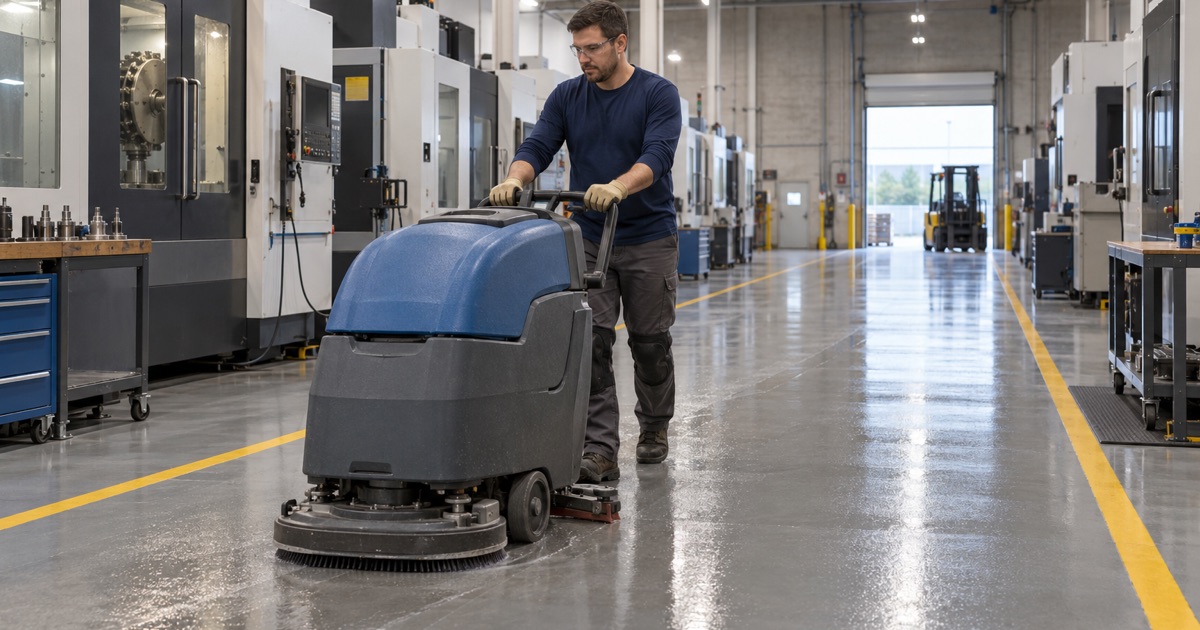
Shot Blasting and Grinding Large Slabs
Large industrial floors are usually prepared with ride-on or walk-behind shot blasters, which remove weak surface material and contamination and leave a rough profile that thicker systems need. Edges, corners and areas around racking and columns are finished with diamond grinders. All of it runs into industrial vacuums, so dust is captured at the machine rather than spread across stored inventory or rinsed toward floor drains.
Removing Oil, Old Coatings and Contamination
Industrial slabs often carry years of oil, hydraulic fluid and failed coatings. Oil that has soaked deep into the concrete can keep bleeding back up and break the bond of a new coating, so heavily contaminated areas are degreased, ground deeper or treated with a primer made for oil-soaked concrete. Old coatings are removed completely rather than coated over, because a new floor cannot hold any better than the layer beneath it.
Joint and Spall Repair for Forklift Traffic
Forklift and pallet jack wheels are hard and narrow, and every joint they cross takes an impact. Broken joint shoulders are cut back and rebuilt with epoxy mortar, and joints in traffic aisles are filled with a semi-rigid filler that supports the wheels so the edges stop chipping. Spalls and potholes are rebuilt flush, so the coating goes over a continuous, sound surface.
Industrial Epoxy Systems
High-Build and Slurry Epoxy Systems
For busy aisles and production areas, we install high-build epoxy systems applied in thicker coats, or slurry and broadcast systems that build thickness with aggregate. These systems take forklift traffic, dropped parts and rolling loads far better than a thin-film coating. The thickness is chosen from the loads and abuse in each zone, and we can vary the system across one building to match.
Chemical-Resistant and Novolac Epoxies
Where floors see strong acids, solvents or aggressive cleaners, a standard epoxy can soften or stain. Novolac epoxies offer much higher chemical resistance and suit battery charging areas, chemical storage and some processing rooms. We review the specific chemicals in your facility and choose a system rated for them, rather than relying on a general claim of chemical resistance.
Moisture Testing on Industrial Slabs
Industrial slabs are often poured directly on grade, and some older buildings have no vapor retarder under the floor. We test with ASTM F1869 calcium chloride kits or ASTM F2170 relative humidity probes at locations across the floor, and a high reading leads to a moisture-mitigation primer or a different system. Moisture from below is the first exclusion on nearly every industrial coating warranty, so we measure it before the floor is priced.
Safety, Markings and Operations
Line Striping and Safety Zones
Industrial floors carry forklift aisles, pedestrian walkways, hazard zones and equipment outlines. We build those markings into the coating system in contrasting colors, so they wear with the floor rather than peeling like tape or wearing off like paint. A light-colored floor also reflects more light, which improves visibility across large warehouses.
Slip Resistance for Wet and Oily Areas
Wet loading docks, wash areas and zones where oil or coolant collects need more grip than a smooth coating gives. We specify slip resistance by the broadcast and topcoat used, with aggregate broadcast into the system where the floor gets wet. Texture is balanced against cleanability, since too rough a floor holds dirt and is hard to scrub.
Phasing Around Shifts and Inventory
Most industrial floors cannot shut down for long. We divide the floor into zones, coordinate inventory and racking moves, and work overnight and through weekends to keep the operation running. Faster-curing systems can return a zone to service by the next shift, while thicker systems may need a longer closure that we plan around your schedule.
Industrial Work in Glenview
Warehouse and Logistics Space
Glenview’s industrial and logistics footprint is growing, including the former Allstate campus being redeveloped as a 3.2-million-square-foot logistics campus. New and existing warehouse space across the area needs floors that handle constant forklift traffic and racking loads, and new slabs need to be tested before they are coated, because fresh concrete can hold a lot of moisture.
VOC Limits and Air Quality Rules
Illinois limits the VOC content of industrial maintenance and floor coatings under 35 Ill. Adm. Code Part 223, and the national rule in 40 CFR 59 Subpart D also applies. Glenview sits in the Chicago ozone nonattainment area, so we choose compliant products for every industrial job, ventilate enclosed work areas and can provide product data sheets for your environmental records.
- 20+ Years on Concrete
- Moisture Test in Every Scope
- Free Written Estimates