Glenview Epoxy Flooring has spent more than 20 years on resin floors, and our epoxy-flooring work in Justice starts with a question most coating quotes skip: what actually happens on this floor every working day. A garage takes tires and brine, a truck bay takes fluids and jacks, and a fabrication room takes whatever drips off its benches. The floor system, the texture and the cleaning plan all follow from that answer.
On this page we look closely at one kind of room where the answer is unusual: a lab that laminates devices with an acrylic resin. The chemistry at the bench changes how the room is ventilated, how spills are handled and when the floor itself can be worked on. Those three things shape a coating decision more than color or gloss ever will.
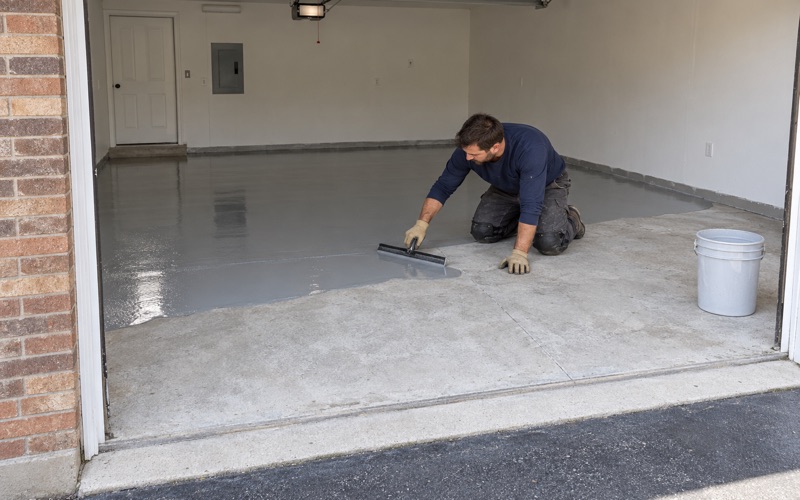
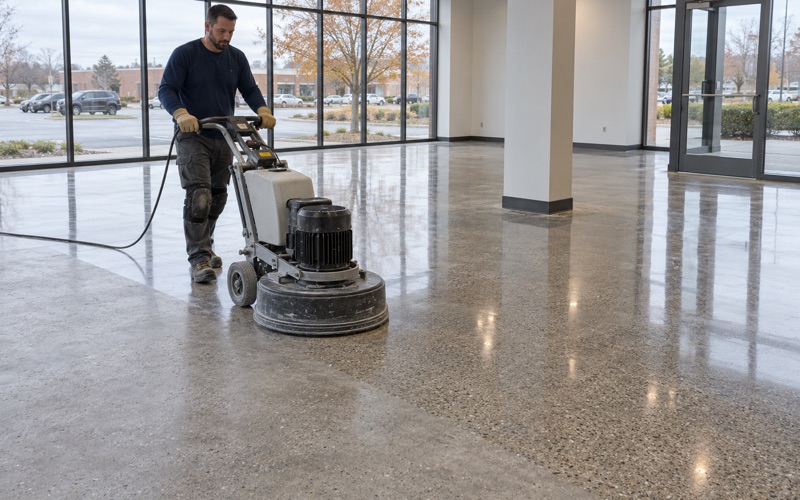
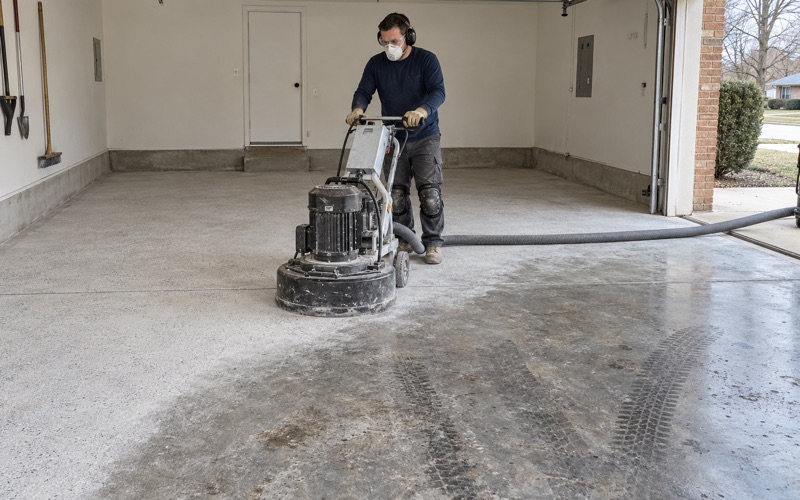
The groundwork is the same on every job. We open the slab with a diamond grinder or shot blaster rather than an acid etch, test it for moisture before the price is final, and write the product line, coat count and finished thickness into the proposal so the floor can be measured against it.
A Fabrication Lab Inside a Justice Clinic
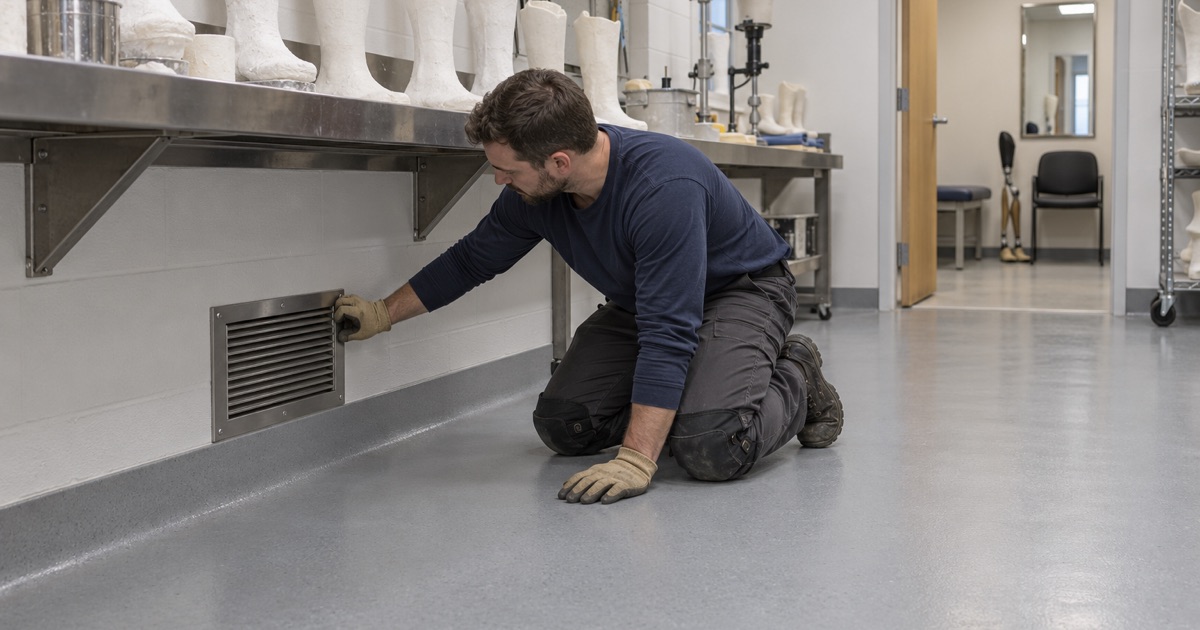
Justice is a village of small shops and service businesses rather than large plants, and one of them works with a chemistry most floor contractors rarely meet. Quantum Prosthetics & Orthotics, an accredited patient care facility at 9050 W. 81st Street, Suite 300, advertises for a Lead Fabrication Technician at its Justice clinic. That tells us devices are built on site there, not only fitted.
We have no relationship with the clinic, and we have not seen its lab, its resins or its floor. What we can describe is the general shape of a room like it, because the materials of orthotic and prosthetic fabrication are published by the companies that make them.
What lamination resin is made of
One widely used example is Otto Bock’s C-ORTHOCRYL lamination resin, sold for carbon fabric procedures and reserved for industrial and professional use. Its safety data sheet describes a solution of acrylic polymers in methyl methacrylate, with the monomer making up 40 to 70 percent of the product. It is classed as a Category 2 flammable liquid and a skin sensitizer, with a flash point of 50 degrees F.
That flash point sits below the temperature of an ordinary heated room. The same sheet warns that explosive mixtures with air may form even at room temperature and that the resin should be watched for exothermic reactions with peroxides. Which resin any particular Justice lab uses is not something we know, but a bench built around a product like this one changes what the floor beneath it has to accommodate.
Why the bench defines the floor
In most commercial rooms the floor question is traffic, impact or a cleaning chemical. In a lamination room it is what falls off the bench and where the vapor goes. A coating can be chosen to clean up well after resin work, but it cannot change how the resin behaves, so the room’s own procedures come first and the floor is selected to support them.
Looking for epoxy-flooring closer to Cary? See Cary Epoxy-Flooring.
Vapor That Settles at the Floor
The C-ORTHOCRYL sheet states plainly that concentrated vapors are heavier than air. Vapor from an open container or a fresh layup does not rise toward a ceiling fan; it slides off the bench and collects low, along the floor and into corners and floor-level cavities. The floor plane is where the risk sits.
Exhaust at ground level
For that reason the manufacturer’s handling section calls for room air exhaust at ground level. Pickup near the floor draws the heavier vapor out before it can pool, which is a different design from a ceiling return or a range hood. A lab that already exhausts low has made the right choice for its resin, and anything done to the floor should leave those intakes clear and working.
When we plan floor work in a room like this, we map the exhaust openings before we map anything else. Coving, a raised thickness at the wall or a stored drum pushed against a grille can choke a low intake. Keeping the floor finish clear of those openings is part of the scope, not an afterthought.
What a coating does not do
A resin floor is not a vapor barrier and it is not a fire barrier, and we will not describe one that way. It does not reduce the flammability of lamination resin or keep vapor from collecting. Ventilation, ignition control and the lab’s own procedures do that work.
What a well-chosen floor can do is narrower and still useful. A sealed, nonporous surface does not wick spilled resin into the concrete, does not hold old drips in open pores, and gives the people cleaning it a smooth plane to work across. That is the case for coating a lab floor at all.
Spills and Cured Drips on a Sealed Floor
The resin’s safety data sheet sets out spill handling that bears directly on the floor. Sources of ignition are kept away, and the product is not allowed to enter ground water, surface water or drains. Smaller amounts are soaked up with absorbent materials such as sand, siliceous earth, or an acid or universal binder, and the sheet calls for explosion-proof equipment and non-sparking tools.
Absorbent first, never a hose
On a sealed floor that procedure works cleanly. A dry binder sits on top of a nonporous surface instead of being driven into it, and it can be swept up and contained without water carrying resin toward a drain. A bare or poorly sealed slab behaves the opposite way: liquid resin wicks into the pores and cures there, leaving a stain that no amount of sweeping lifts.
Scraping cured beads
Not every drip is caught wet. Resin that falls during a layup and is missed tends to cure into a hard bead or puddle stuck to the floor. On a smooth sealed surface those beads are scraped off mechanically, and the floor underneath is left intact.
The tempting alternative is to dissolve them with more solvent, which puts fresh flammable vapor right back onto the floor plane the exhaust is trying to clear. A floor that releases cured resin to a scraper keeps cleanup mechanical. We talk this through with the people who run the room, since they know where the drips land.
Texture and topcoat near the bench
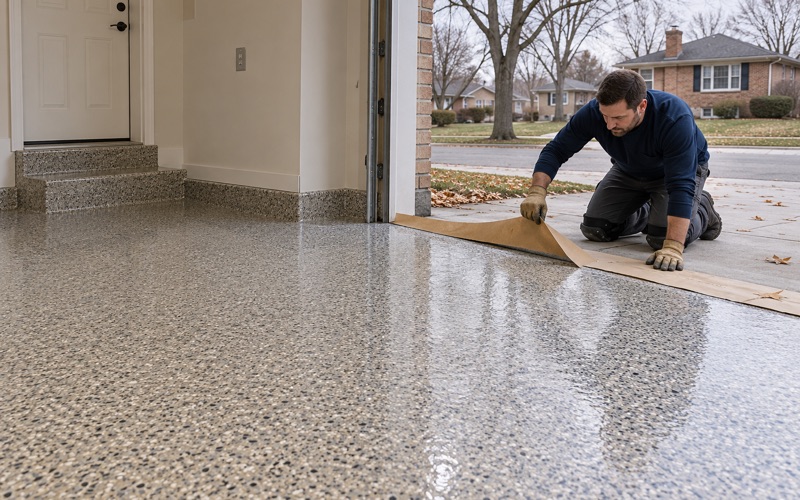
A lab floor still needs traction, especially where someone stands at a bench for hours. Slip resistance comes from the broadcast and the topcoat we specify, not from a slogan, and in a resin room it is a balance. A heavy quartz aggregate grips well but gives cured drips more to hold on to, so the zone right at the bench often gets a finer texture than the walkway behind it.
Resurfacing a Lab Floor That Uses the Same Chemistry
The hardest scheduling question in a lamination room is the floor work itself. Many fast-cure floor systems are methacrylates, the same monomer family as the resin on the bench, with the same strong odor. Even an epoxy or polyaspartic system brings its own fumes, grinding dust and cure time into a room that already depends on clean, controlled air.
Lamination stops first
Our rule for a room like this is simple: lamination stops before the floor is opened, and it stays stopped until the new coating has cured. Resin containers come out of the room, the space is aired out, and the ground-level exhaust keeps running. No grinder or coating work happens beside an open container of lamination resin.
Clinics rarely close for a week, so we phase the work around operating hours. Overnight and weekend windows let a fabrication room be prepared, coated and cured while patient areas keep their normal schedule, and the cure timing follows slab temperature and dew point rather than the calendar.
Prep, moisture and the written scope
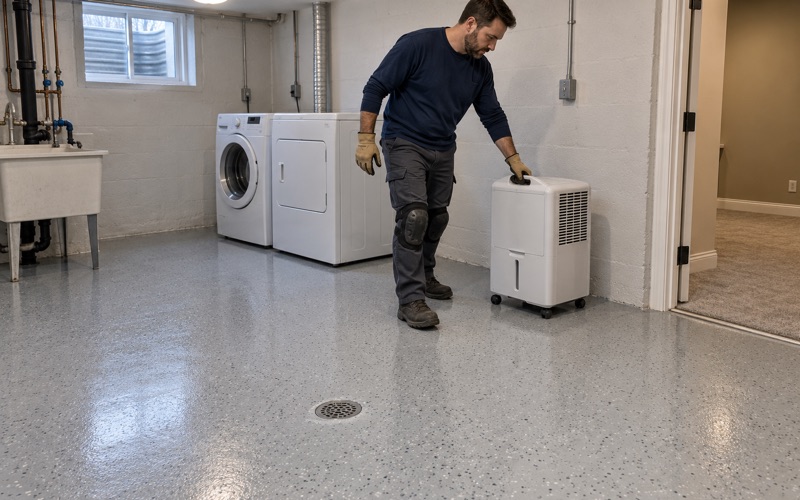
The slab is ground with dust captured at the machine by a vacuum, not rinsed toward a floor drain. We map cracks, spalls and any old coating before quoting, and if the concrete needs repair first we say so. Moisture testing to ASTM F1869 or ASTM F2170 goes into the written scope, because moisture is the first thing a coating warranty excludes and we explain that before the job is sold.
Products are chosen within the Illinois VOC limits for floor and industrial coatings, which bind whoever applies them. That matters more than usual in a room whose air is already being managed for a different chemical.
Working in the village
The Village of Justice Building Department, at 8748 W. 82nd Place, runs a Contractor’s Work Permit Program. Contractors working under a permit must be registered with the village and bonded, with a $10,000 permit bond for all but sewer contractors, on a licensing year from February 1 to January 31. Concrete work is a listed permit item, so any slab repair ahead of a coating is confirmed with the department before we schedule it.
- 20+ Years on Concrete
- Moisture Test in Every Scope
- Free Written Estimates