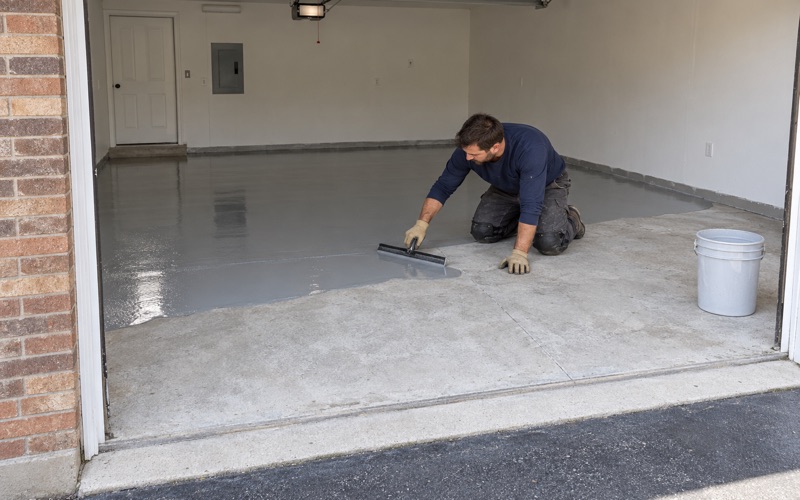
Glenview Epoxy Flooring has spent more than 20 years installing epoxy flooring in La Grange Park and the near-west suburbs, and on an older building our first step is reading, not grinding. Many concrete floors sit under one or two generations of resilient tile and the adhesive that held it down. What those layers are made of decides how the slab can be opened, so we find out before we write a price for the prep.
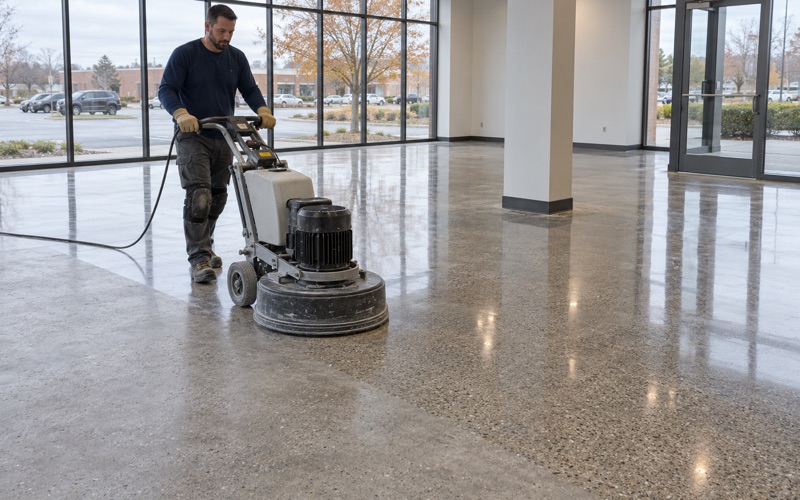
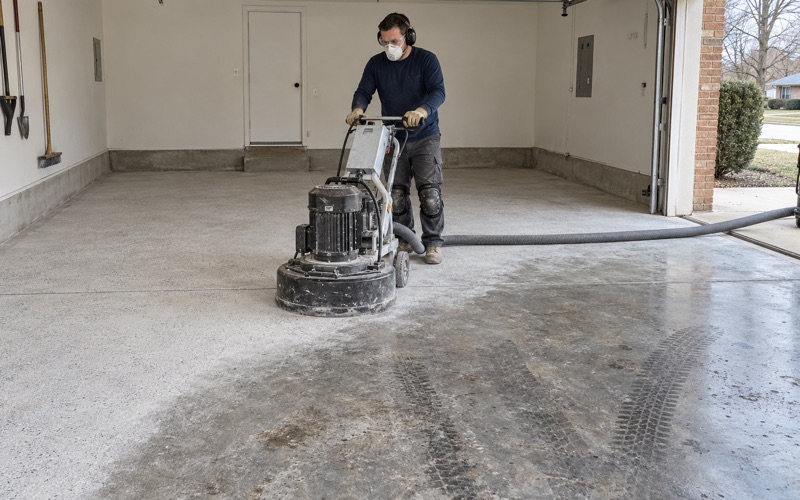
That order matters because every floor we coat is opened mechanically. We use a diamond grinder or a shot blaster, never an acid etch, so the coating bonds to a real surface profile instead of a washed one. Those machines are exactly what nobody should run across an old tile layer of unknown makeup.
So the record comes first, then a sample where the record is silent, then the method. The rest of this page walks through how that works in a public school and in a 1950s house, and what changes about the coating itself once the slab is bare.
Barnsdale Road School, Renew D102 and the School’s Asbestos Plan
What Renew D102 is changing at Barnsdale
Barnsdale Road School, at 920 Barnsdale Road in Proviso Township, Cook County, was built in 1958 and serves the district’s prekindergarten and kindergarten students. Under Renew D102, the LaGrange School District 102 plan recapped for its Board of Education in December 2024, Barnsdale is getting four new early-childhood classrooms, and the district administration is moving into the building. The district has broken ground on the program and gives fall 2027 as the target for finishing it.
We have no role in that project and have not seen its floor scope. We use it here because it is the clearest local example of a common situation: new rooms joining a school building that is close to seventy years old, with offices moving into space built for something else. Any floor work that touches existing rooms in a building like that starts in the same place.
Every school keeps an asbestos management plan
The federal school asbestos rule under AHERA, 40 CFR 763.93, required every local education agency to have an asbestos management plan for each of its schools by October 12, 1988. The district must keep that plan current with operations and maintenance work, periodic surveillance, inspections, reinspections and response actions. A newly acquired or leased building has to be added to the plan before it is used as a school.
The plan is kept in the district’s administrative office, and an updated copy sits in each school’s own office. The public may see it without cost or restriction, and parent, teacher and employee groups are told in writing at least once each school year that it is available. The provision that matters most to a floor contractor is plainer still: workers may inspect the plan before work begins in any area of a school building, and access must be given within 5 working days of a request.
Looking for epoxy-flooring closer to Brookfield? See Epoxy-Flooring Services in Brookfield.
Reading the Record Before the Grinder Starts
What the plan says about floor tile and mastic
A management plan is organized around materials and where they are. For flooring, it shows where resilient tile and its mastic were sampled or assumed to contain asbestos, and what response actions have been taken since. One room may show tile removed years ago, another tile left in place and managed, and a newer room may not appear in the original survey at all.
That record is the reason we never choose a prep method from how a floor looks. Two tile patterns that look identical can have opposite histories, and a clean-looking slab can still carry a skim of old adhesive. We read the entries for the specific rooms in the scope, not a building summary, before we decide how the slab will be opened.
Sampling, wet methods and abatement first
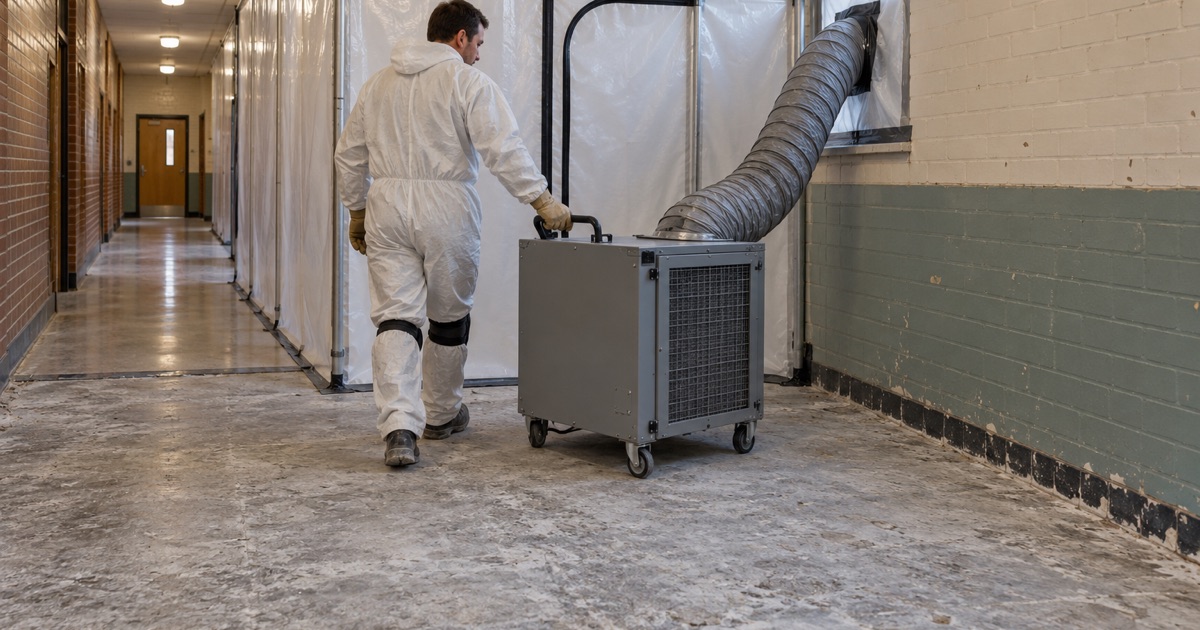
Where the plan identifies or assumes asbestos in the tile or mastic, that material is handled under OSHA’s asbestos rules for construction work, 29 CFR 1926.1101, by a qualified abatement contractor working to the owner’s own design. We are not that contractor, and an epoxy coat is never a substitute for removal or a way to seal material in place. Our work starts after the abatement is finished and the area is released.
Where the plan is silent on a room, the next step is sampling by a qualified party, not a test pass with a grinder. If removal is called for, it comes before surface prep, and the wet methods and controlled work areas belong to that stage rather than to ours. Once the slab is clear, we open it by diamond grinding or shot blasting with the dust captured at the machine by a vacuum, never rinsed toward a floor drain.
Sequencing work in an occupied school
A school with children in it rarely closes a whole wing for a floor. The usual order is abatement, release of the area, mechanical prep, moisture testing and then coating, each inside a defined work zone the occupied rooms do not share. We set cure windows by slab temperature and dew point rather than a calendar date, so a coated room is not handed back before it can take traffic.
Older Homes in La Grange Park: Test Before You Grind
La Grange Park’s housing comes largely from one decade. Of the village’s 5,629 housing units, 2,547 were built between 1950 and 1959, or 45.2 percent, and most owners live in detached houses. In a basement or lower level from that period, the floor under carpet or newer plank can still be original resilient tile on its first adhesive.
Why the look of the tile tells you nothing
A homeowner cannot tell from color or size whether an old tile or its adhesive contains asbestos, and neither can we. The only answer is a lab result on a sample taken by someone qualified to take it. If the result is positive, removal is a job for an abatement contractor, and we come back once the slab is clear.
If the result is negative, we can grind through the old adhesive and into sound concrete in the same visit that opens the slab. Either way, the test comes before any machine touches the floor, because a grinder is what turns a stable layer into dust.
Moisture, water history and the written scope
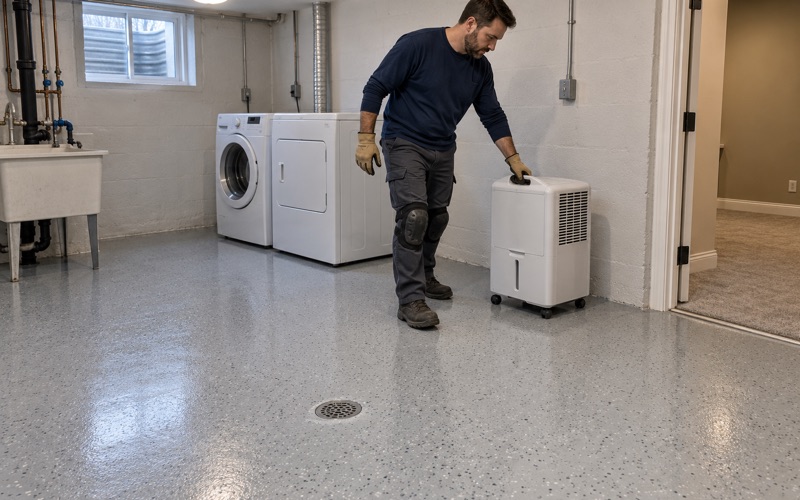
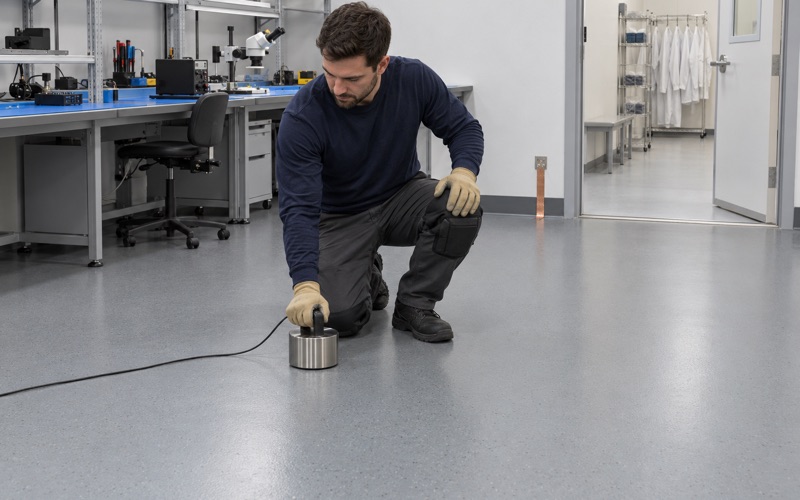
Once a basement slab is bare, we test it for moisture as part of the written scope before the price is final, using ASTM F2170 in-situ relative humidity probes or ASTM F1869 calcium chloride testing. A slab with a damp history may need a moisture-mitigation primer, and we explain up front that moisture is the first exclusion on most coating warranties. We also read the floor for signs of past water, because a coating does not stop sewer backup or seepage.
The village’s Sewer Backup Prevention Program reimburses part of the cost of a backflow valve or an overhead sewer, and the concrete floor replacement tied to that work is an eligible cost. If that plumbing is planned, it should happen before the coating, since the trench will cut through whatever is on the floor.
Contracts and permits for home jobs
Home jobs over the state threshold get a written contract and the Illinois Home Repair: Know Your Consumer Rights pamphlet before any grinding starts. La Grange Park’s Building and Inspectional Services department lists painting or surface coating, and replacement of existing flooring, among work exempt from permit. Slab repair, a new apron or anything beyond the existing floor is a separate question, and we ask it before we schedule.
Choosing the Coating Once the Slab Is Clear
Classrooms, offices and rooms for young children
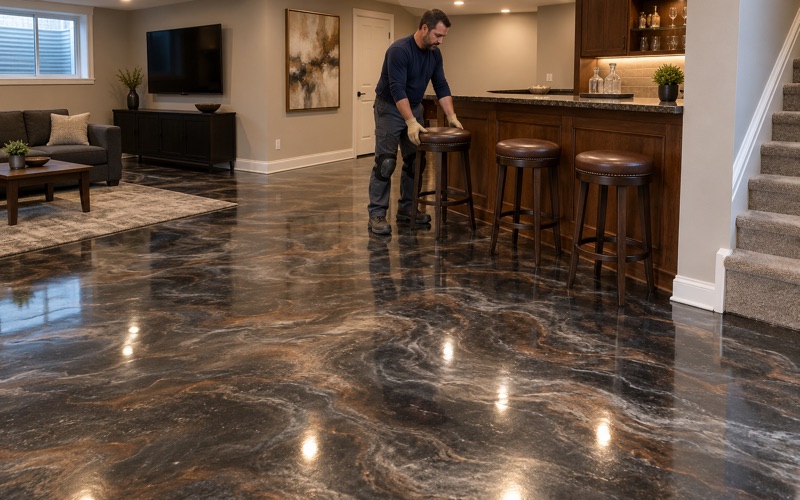
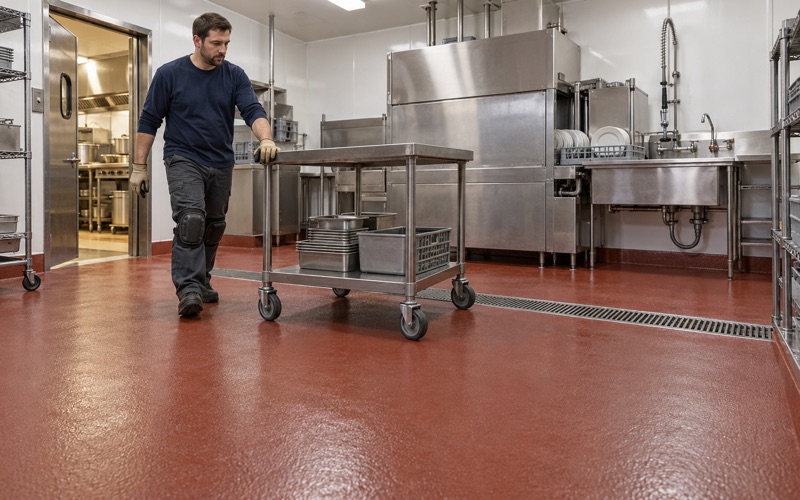
Rooms for young children are mopped constantly and sat on, crawled on and spilled on all day. For that kind of room we lean toward a seamless 100% solids epoxy base with a polyaspartic or urethane topcoat, finished with a fine broadcast where slip resistance is needed. The texture comes from the specific broadcast and topcoat named in the proposal, not from a slogan.
Offices moving into an older school or civic building usually want something quieter underfoot and easier to keep. A densified, polished slab can suit corridors, with a coated floor in storage and copy rooms that see spills and carts. We phase that work around operating hours, using evenings and weekends when a space cannot close.
Garages and lower levels in 1950s houses
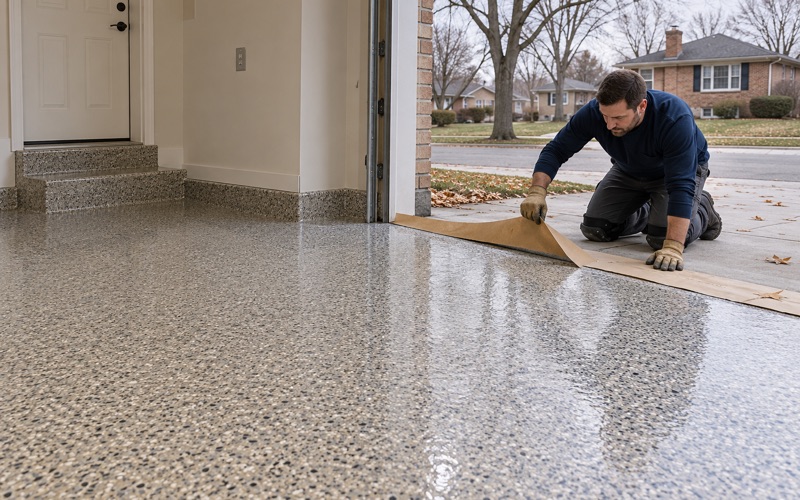
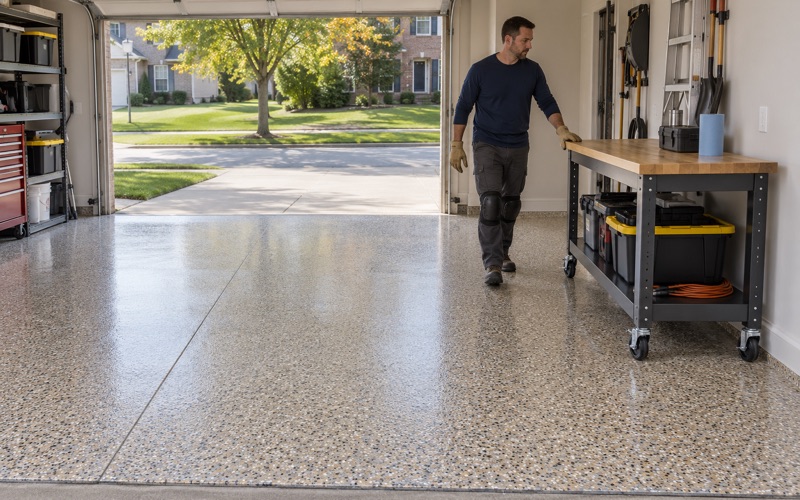
Garage floors take the brine and rock salt that ride in on tires all winter, so we build them with a topcoat chosen for that exposure over the base coat, with a vinyl flake or quartz aggregate broadcast. In an unheated garage in deep winter, we tell the owner to wait, because the slab temperature and the dew point spread at its surface have to cooperate before a coating cures properly. Basement floors get the same moisture testing described above, whatever the finish.
What the proposal spells out
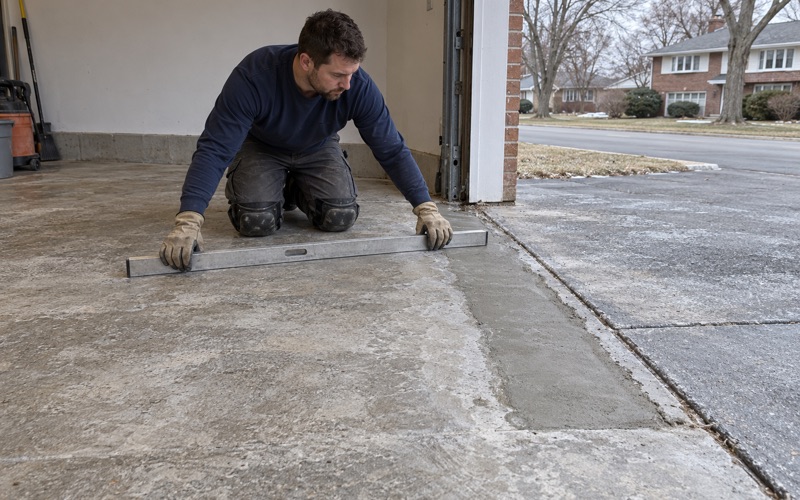
Every proposal names the product line, the number of coats and the finished thickness, so the floor can be checked against the quote. We map cracks, spalls and old coatings first and say plainly when a slab needs repair or replacement before it should be coated. Products are chosen inside the Illinois VOC limits for floor coatings, which bind whoever applies them, and the same record-first habit that governs a school floor governs a garage.
- 20+ Years on Concrete
- Moisture Test in Every Scope
- Free Written Estimates