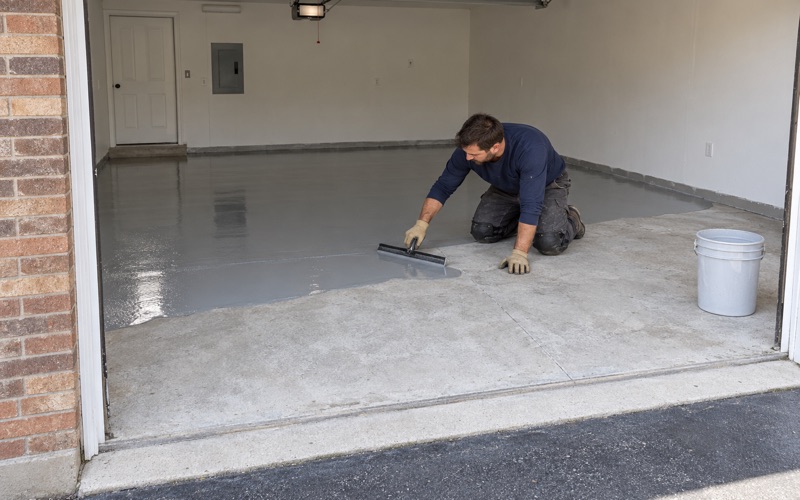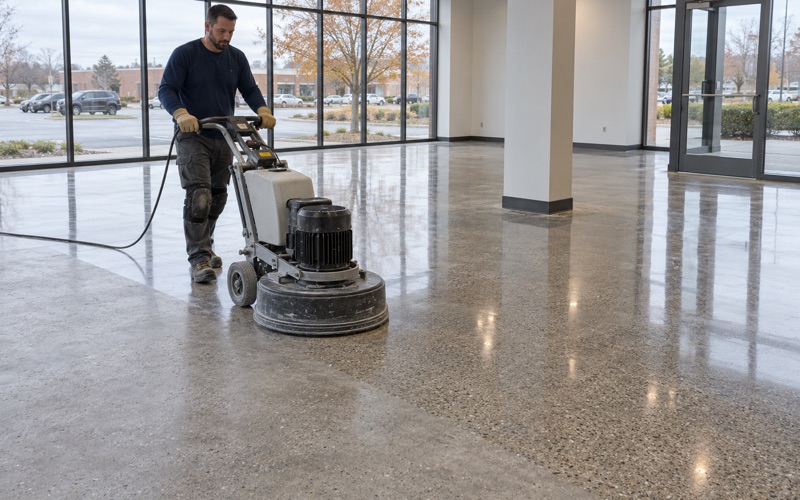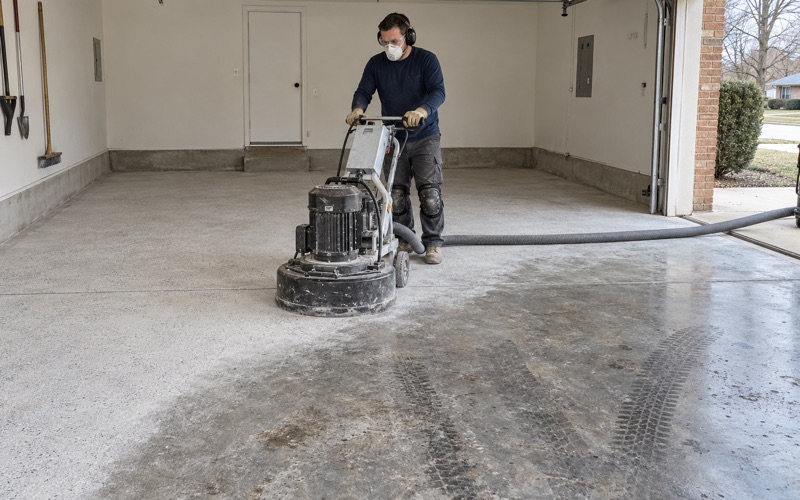
Glenview Epoxy Flooring has spent more than 20 years on epoxy flooring in Lake Zurich and across the northwest suburbs, and the part of the job we take most seriously is the part nobody sees once the floor is finished. A coating is only as good as the concrete it grabs. We open every slab with a diamond grinder or a shot blaster rather than an acid wash, so the system has a real profile to hold on to.
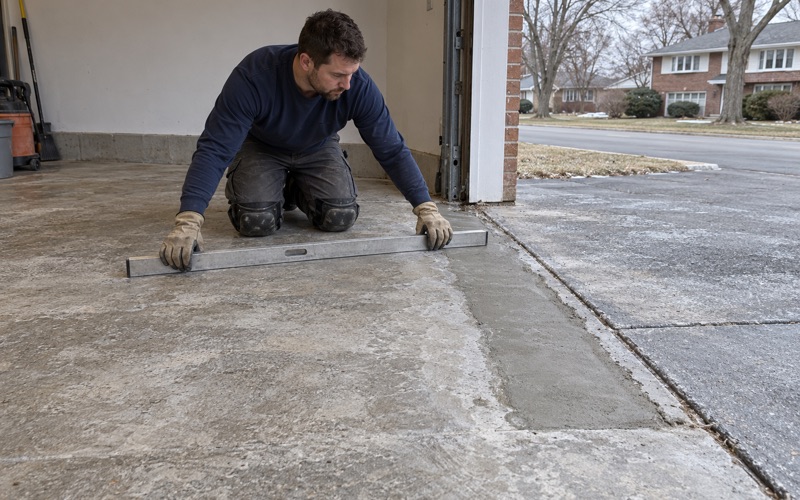
Before a price is final, our written scope includes a moisture test and a map of the cracks, spalls and old coatings on the floor. When a slab needs repair or replacement before it should be coated, the proposal says so, rather than leaving you to find out when the first coat lifts. That proposal also names the product line, the number of coats and the finished thickness, so you can check the floor against the paper.
This page is about one situation in particular: a concrete floor that has been through a fire. A garage or shop slab can look sound once the soot is scrubbed off and still carry a weakened top layer, and that top layer is exactly where a coating bonds. Here is how we read a fire-exposed floor and what we test before anything goes on it.
The Paulus Park Barn Fire and What Heat Leaves in a Slab
The night the Barn burned
Shortly after 8:00 p.m. on Saturday, November 2, 2019, fire broke out at the Paulus Park Barn at 200 S. Rand Road, the building that housed the administrative offices of the Lake Zurich Park and Recreation Department. Lake Zurich Fire Rescue was dispatched at about 8:25 p.m., found heavy flames and brought the fire under control quickly. No one was inside and no one was hurt, but the offices were seriously damaged and the exterior showed significant visible damage.
The next day’s indoor farmers market and the following week’s programs at the Barn were canceled, and every account we read listed the cause as under investigation. Village surveys the next summer leaned toward rebuilding and expanding the building, and the village still lists The Barn as the home of Park and Recreation. We never saw the Barn’s floor and none of the reporting describes it, so we draw no conclusion about that particular slab.
Why a fire is also a floor question
What the Barn does show is how quickly a familiar building becomes a fire scene, and every garage, workshop and storage building in the village carries the same possibility. When the smoke clears, the walls and the roof get the attention. The slab underneath took the heat too, and concrete keeps a record of that heat in ways that are easy to miss.
What heat does to concrete you cannot see
Concrete heated past roughly 300 degrees C, about 572 degrees F, can lose a meaningful share of its strength in a surface layer. In laboratory work published in Engineering Journal in 2017, slabs at 300 degrees C showed strength reductions in the range of 15 to 40 percent, and 55 to 70 percent at 550 degrees C. After 60 to 90 minutes of fire exposure the researchers found a damaged layer about 1-1/4 to 1-3/4 inches deep, while 30 minutes showed no severe effect. Those were limestone-aggregate test slabs rather than any local floor, but the mechanism is why we never treat a burned room’s slab as ordinary concrete.
Looking for epoxy-flooring closer to Barrington? See Epoxy-Flooring Services in Barrington.
Pink, Crazed or Just Sooty: Reading a Fire-Exposed Floor
Color tells you about temperature
The same research describes concrete changing color as it heats: pink between about 300 and 600 degrees C, then white or gray near 900 to 1,000 degrees C. Pink discoloration under the soot is a sign the surface reached the range where strength loss begins. A slab that cleans up gray and uniform is encouraging, but color alone does not clear it for coating.
Crazing, cracking and spalling
Next we look for crazing, the fine web of surface cracks, along with larger cracks and spalled patches. Free moisture inside concrete evaporates at 100 to 200 degrees C, and that can pop pieces off the surface during a fire. We mark each of these on a floor plan, the same way we map cracks and old coatings on any slab, so the repair scope is written down before the price is.
Why soot hides the problem
Soot and smoke staining make a floor look worse than it is in some spots and better than it is in others. A slab can wash up clean and still have a weak top inch, and a coating placed over that layer bonds to it and to nothing deeper. When the weak layer lets go, the coating comes up with it, however good the product was. A coating cannot put strength back into heat-damaged concrete; it only covers whatever sits underneath.
Sounding, Pull-Off Tests and Removing Weak Concrete
Sounding and the rebound hammer
Testing starts with sounding the slab, dragging a chain or tapping across the floor and listening for the hollow note of delaminated concrete. The published assessment method adds a Schmidt rebound hammer to compare surface hardness across the floor, along with ultrasonic pulse velocity. Readings from the burned area are checked against an untouched part of the same slab, which tells us how far the damage spreads.
The pull-off test
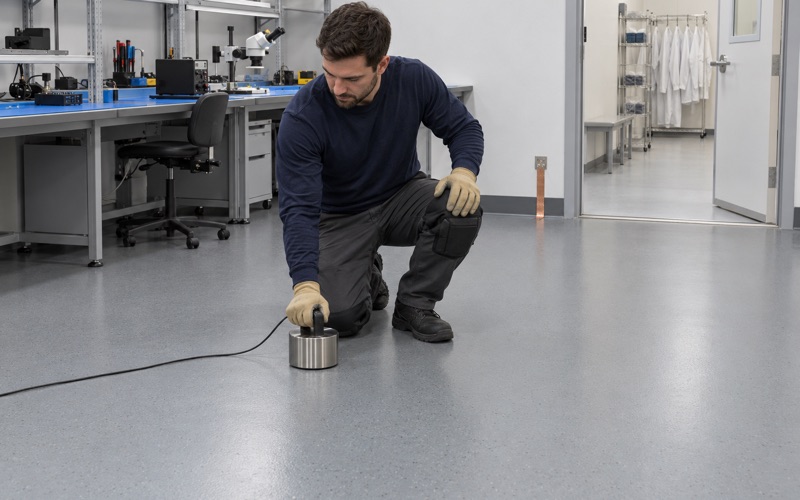
The pull-off test is the one that answers the coating question directly. A small metal disc is bonded to the prepared surface, cut around down into the concrete, and pulled straight up with a gauge until something breaks. If the break happens inside the concrete at a low reading, the surface is too weak to coat, no matter how it looks.
When results are borderline, a core drilled from the slab shows how deep the damaged layer goes. The research we draw on assesses fire damage in that same order, from visual signs to hammer readings, pull-off tests and cores. Each step narrows the guesswork before money is spent on a system.
Removing weak concrete before a coating
Where testing finds a weak layer, it comes off down to sound material, by diamond grinding or shot blasting for shallow damage and by deeper removal and a repair mortar where it runs further. We test again on the exposed surface before we price a system. If the damage goes far enough that the slab needs structural evaluation or replacement, we say that plainly and do not coat it. Grinding dust is captured at the machine with a vacuum, never rinsed toward a floor drain or a storm inlet.
Moisture after the hoses
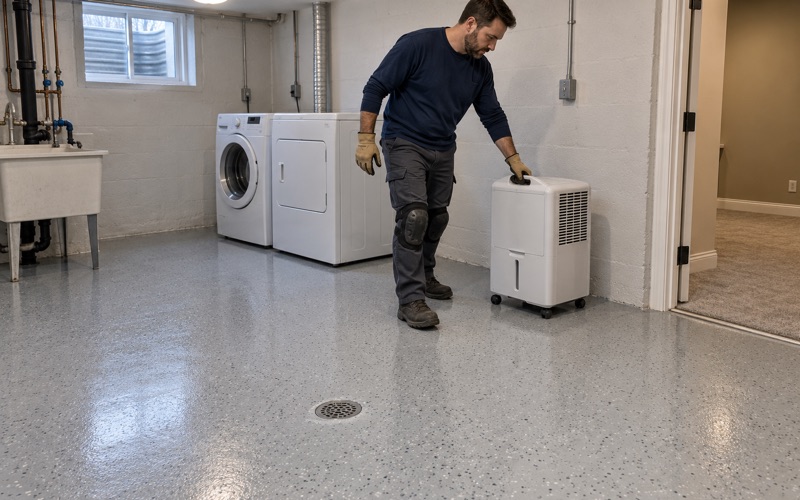
A slab that was under a fire hose can stay wet well below the surface, so the moisture test carries extra weight on these jobs. We run ASTM F2170 in-situ relative humidity probes or ASTM F1869 calcium chloride testing as part of the written scope. A floor that reads high needs drying time or a moisture-mitigation primer before any 100% solids epoxy goes down.
After a Garage Fire in a Lake Zurich Home
The garages we see here
Lake Zurich takes its name from the 232-acre glacial lake that lies completely inside the village, and most of its 7,588 housing units went up between 1970 and 1999, with the 1980s alone adding 2,393. A typical garage slab is thirty-five to fifty-five years old, old enough to have been sealed, painted or coated before, and young enough that its owner may be the original buyer. Single-family detached houses account for 5,730 of those units, so the garage floor is usually a homeowner’s own decision.
What we do after a garage fire
Once the space is safe to work in, we follow the same sequence as any fire-exposed floor: clean it, look for pink discoloration and crazing, sound the slab, and pull-off test where the heat was worst. A garage fire is often concentrated around a vehicle or a workbench, so the damage may sit in one bay while the rest of the slab tests fine. Any blistered or charred coating comes off first, because it hides the concrete we need to judge.
Choosing the system once the slab is sound
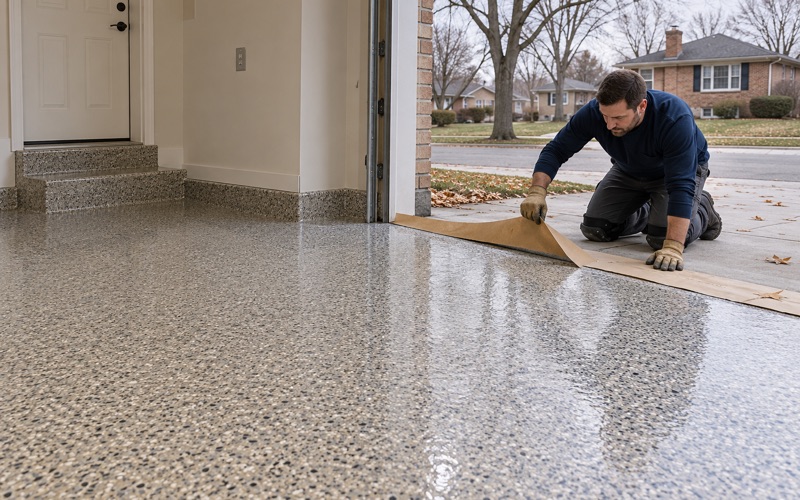
When the concrete tests sound, a garage system here is chosen to stand up to the brine and rock salt that ride in on tires all winter, typically a 100% solids epoxy base, a vinyl flake broadcast and a polyaspartic topcoat. The slip-resistant texture comes from the broadcast and topcoat we specify, not from a slogan. Cure schedules follow slab temperature and dew point, so an unheated garage in deep winter is told to wait. Before you sign, we walk through what the coating warranty leaves out, starting with moisture.
Contracts, permits and products
Home jobs over the state threshold get a written contract under the Illinois Home Repair and Remodeling Act, along with the Home Repair: Know Your Consumer Rights pamphlet, before any grinding starts. Commercial floor work that needs a permit goes through the Village of Lake Zurich Building and Zoning Division, and we confirm that before the job is scheduled. Every product we put down falls inside the Illinois VOC limits for floor and industrial coatings.
- 20+ Years on Concrete
- Moisture Test in Every Scope
- Free Written Estimates