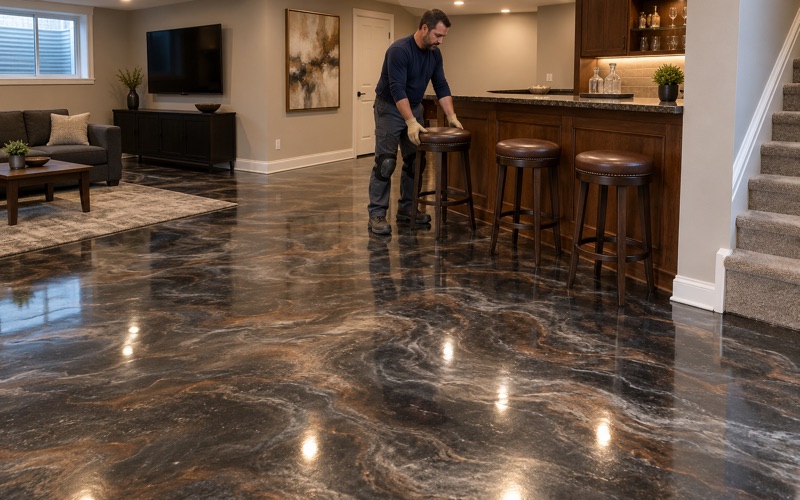
Glenview Epoxy Flooring has more than 20 years behind its epoxy flooring in Lincolnwood, and the first thing we tell a restaurant owner here is that one coating rarely suits a whole building. A dining room, a back office and a cooking line ask very different things of the concrete under them. Spreading the same thin film across all three is how a kitchen floor ends up peeling at its busiest station.
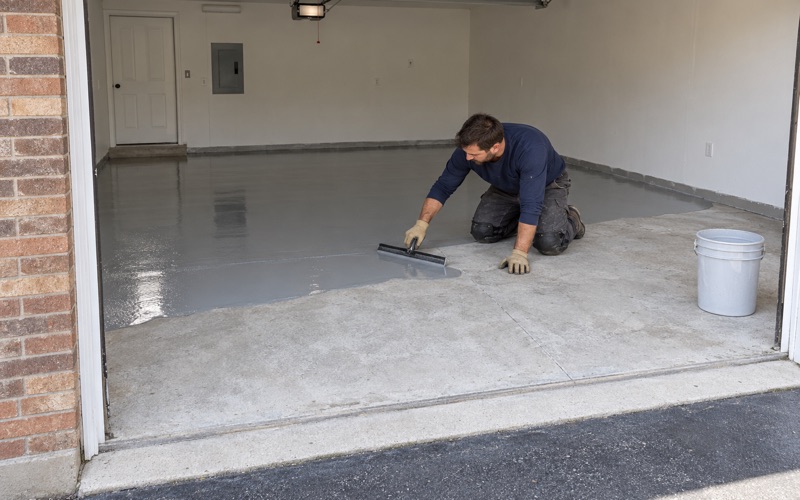
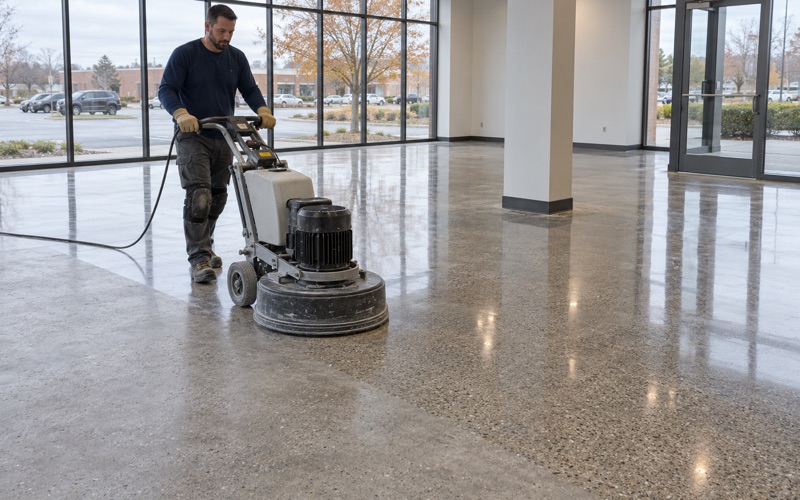
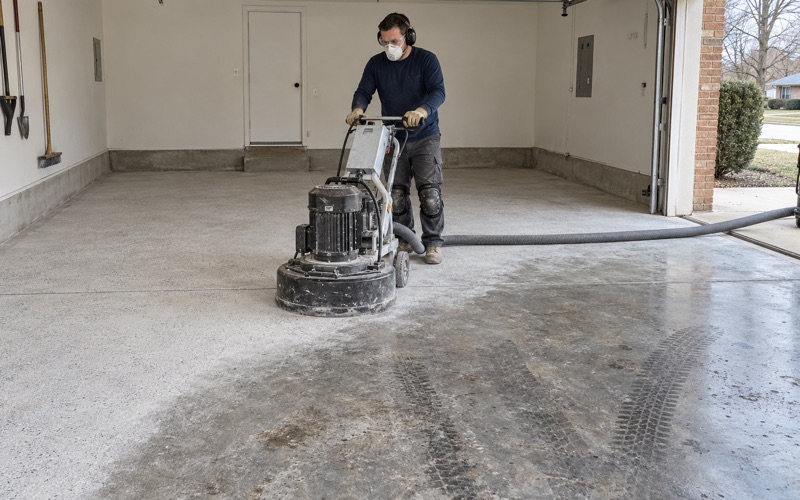
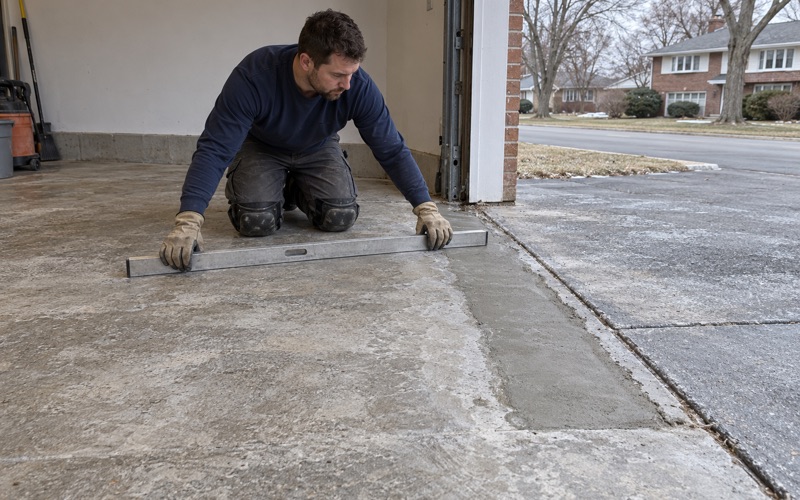
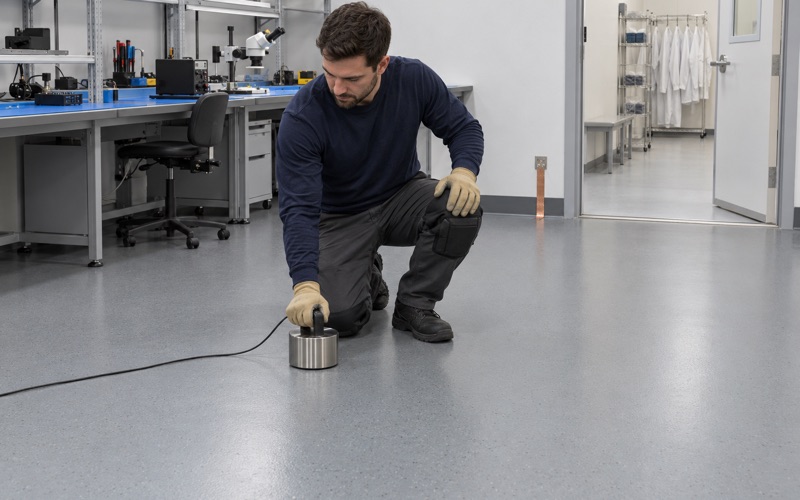
Every job begins the same way. We open the slab with a diamond grinder or a shot blaster instead of an acid etch, map the cracks, spalls and old coatings, and put a moisture test into the written scope before the price is settled. If the slab needs repair or replacement before anything should go on it, we say so at that point rather than after the first coat.
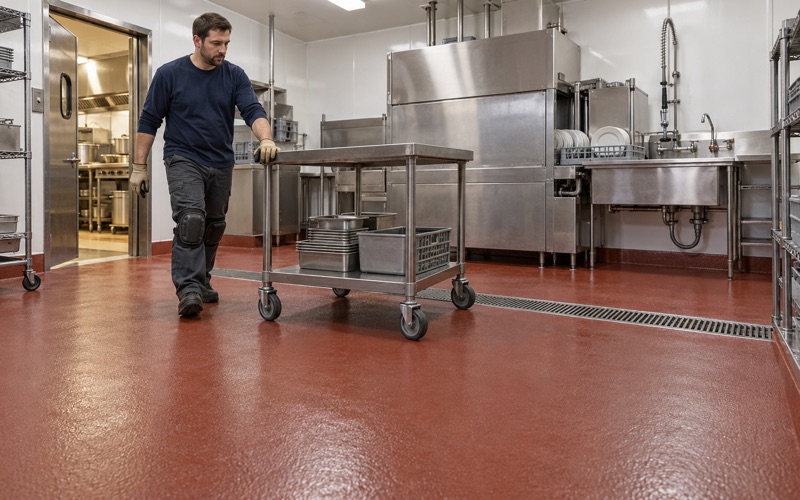
The proposal then names the product line, the number of coats and the finished thickness for each area, so you can hold the installed floor up against the paper. This page is mostly about the hardest area in any restaurant, the strip of floor where scalding water and ice melt land on the same concrete many times a shift, and why it gets a different system from the room around it.
A Touhy Avenue Kitchen and the Water That Hits Its Floor
A restaurant on the village’s principal-employer list
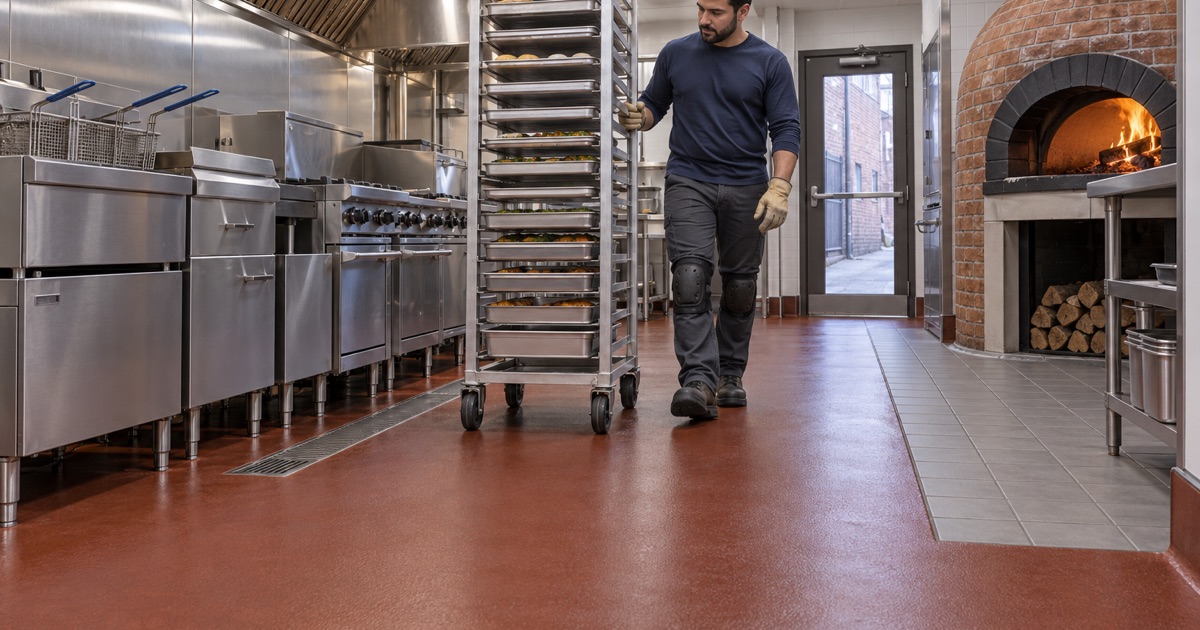
The Village of Lincolnwood’s annual comprehensive financial report for fiscal 2024 lists its ten largest employers, and a restaurant sits among them. Olive Garden, at 3303 W Touhy Avenue, appears ninth with 92 employees, after holding the same rank with 104 in 2015. The address sits inside the village in Niles Township, Cook County, and the restaurant keeps a long service day, open from 11:00 a.m. to 10:00 p.m. by the chain’s own listing.
To be plain about it, Olive Garden is not our customer and we have never seen that kitchen floor. We use it because it is a well-known local example of a kind of kitchen work that punishes a floor in a specific way, and because a staff that size suggests a busy line.
Boil, chill, reheat, all day long
Current and former Olive Garden employees, quoted by Chowhound in 2025, describe a chain-wide routine rather than anything about the Lincolnwood kitchen in particular. The pasta is boiled every morning, cooled in an ice bath to keep it al dente, and then portions are reheated in boiling water throughout the day as orders come in.
Think about what reaches the floor in front of a station run that way. Boiling water splashes and drains, ice and chilled water spill when the bath is worked, and the same few square feet swing from one to the other again and again across a shift. Mop water and hot cleaning water add more swings at closing.
What thermal shock does to concrete and coatings
That rapid swing is thermal shock. When the top of a floor is suddenly heated or chilled, the surface tries to grow or shrink before the material underneath has caught up, and the stress concentrates at the boundary between them. On a coated slab, that boundary is the bond line between the coating and the concrete.
A coating and the concrete it sits on do not move at the same rate. Repeated enough times, the difference shows up as hairline cracks in the film, then lifted edges, then patches that let water get under the coating and spread the damage. The floor in front of a hot station is usually where a kitchen coating fails first.
Looking for epoxy-flooring closer to Norridge? See Epoxy-Flooring Services in Norridge.
Why a Thin Epoxy Film Is the Wrong Floor for a Cooking Line
A rigid film with very little body
A standard 100% solids epoxy is an excellent floor in a lot of rooms. It is hard, it cleans easily and it can carry a broadcast for grip. What it cannot do well is flex with concrete that is being heated and cooled in seconds, because a thin, stiff film has almost no mass of its own to spread that stress out.
Polyaspartic and polyurea topcoats bring better flexibility and fast turnaround, but they are still thin coatings. On a line that cycles from boiling water to ice, we treat any thin film as a maintenance item rather than a long-term floor, and we would rather say that before the job than after.
Hot water and steam cleaning on top of the cycling
Kitchen floors are not only splashed during service. They are scrubbed with hot water and degreasers, sometimes steam cleaned, and they sit wet for hours. Each of those adds its own heat and moisture load to a bond line that is already under stress from the cooking routine.
That combination is why a coating warranty for a commercial kitchen deserves a careful read. We go through what a warranty leaves out before the job is sold, and moisture vapor transmission and hydrostatic pressure from below are the first exclusions we name.
Edges and joints give way before the field does
A thin coating that is going to fail tends to start where it ends. The edge of the film at a doorway, at a wall or where it meets another floor finish is the one place it has nothing ahead of it to hold it down. Once water finds that edge, it travels under the coating.
Control joints are the other weak point. A thin film painted straight across a joint will crack along it the first time the slab moves, and that crack becomes a channel for hot water. A kitchen floor has to be built so that its edges and joints are deliberate details, not accidents.
Cementitious Urethane: Thickness, Profile and Anchor Grooves
Troweled at 1/4 inch or more
The material we specify for a cooking line is cementitious urethane, often called urethane cement. It is a mortar rather than a paint, troweled in a layer thick enough to have real body. One example, the Dudick Shock-Crete HD product data sheet from Carboline, describes a cementitious urethane flooring mortar troweled at 1/4 to 1/2 inch.
That same data sheet claims resistance to thermal shock and to steam cleaning, and lists breweries, beverage plants, food processing and meat packing plants among its typical uses. Those are the manufacturer’s figures and claims for its product, not a promise from us, and no floor is guaranteed against cracking. What the thickness does buy is a layer that can spread stress instead of concentrating it at a thin bond line.
ICRI CSP 5 or rougher before anything goes down
A heavy mortar is only as good as its grip on the slab. The Shock-Crete data sheet calls for surface preparation to ICRI CSP 5 or greater, a far rougher profile than a light grind for a garage coating. On the ICRI concrete surface profile scale of 1 to 10, that is the range shot blasting and aggressive mechanical prep produce.
This is one more reason we never acid etch. An etched slab has neither the profile nor the clean, sound surface a troweled urethane needs, and any old coating, grease or weak concrete left behind becomes the layer the new floor fails along.
Anchor grooves and honored joints at every termination
The data sheet is specific about the edges. Anchor grooves or keyed joints at least 1/4 inch wide and 1/4 inch deep must be cut into the slab at terminations and transitions, so the mortar locks into the concrete instead of ending on top of it. Every control joint in the slab must be honored and carried up through the new floor.
In practice that means saw-cutting a keyed edge wherever the urethane stops: at a doorway into the dining room, at the line where it meets a thinner coating, and around any area left uncoated. It is slow, unglamorous work, and it is the detail that keeps the edge of a kitchen floor from becoming the place water gets underneath.
Matching the Floor System to Each Zone, Kitchen to Garage
Dining rooms, offices and corridors
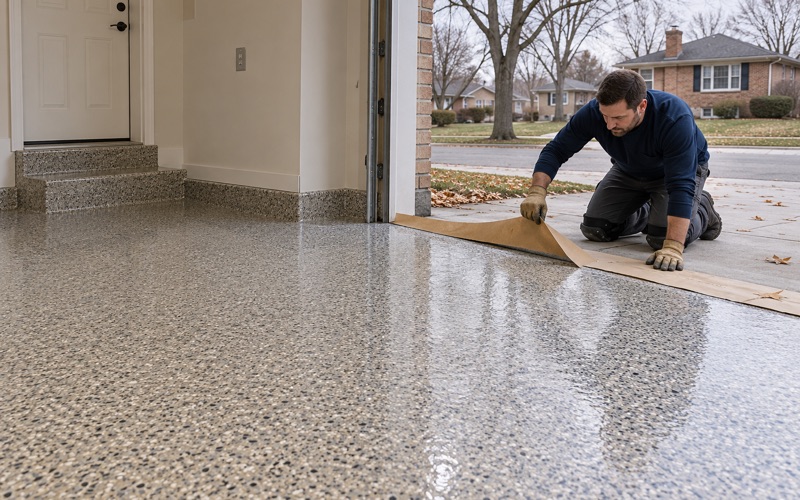
Outside the cooking line, a restaurant’s floors face foot traffic, chair legs and spills, not boiling water. A thinner system usually fits: a 100% solids epoxy base with a quartz aggregate or vinyl flake broadcast and a polyaspartic or urethane topcoat. Slip resistance comes from the broadcast and topcoat we specify, written into the proposal rather than promised as a slogan.
A restaurant open from late morning to late evening cannot simply close for a week. We phase clinic, office, restaurant and warehouse floors around operating hours, and we check the village’s rules on construction hours before we offer an overnight or weekend window, rather than assuming one is allowed.
Home floors in an older village
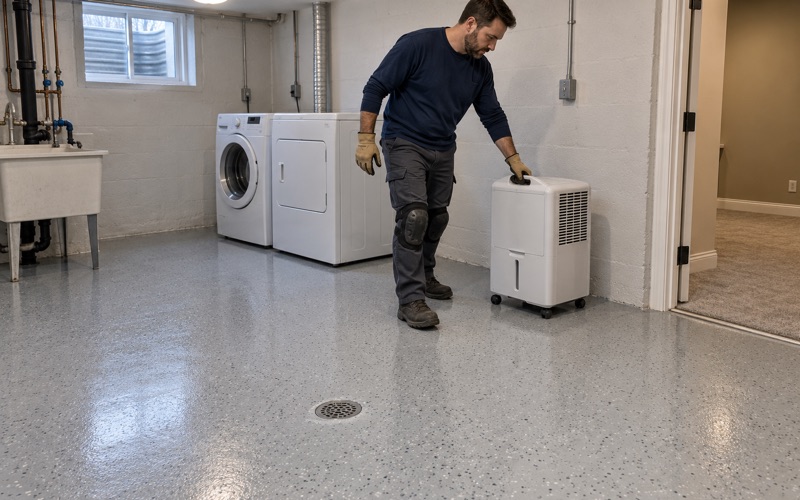
Lincolnwood’s housing is mostly midcentury. Census estimates put about half of its homes in the 1940 to 1959 range, with 39.7 percent built in the 1950s alone. Slabs that age predate under-slab vapor retarder practice and have often carried decades of paint or sealer, so a moisture test with ASTM F2170 in-situ relative humidity probes or ASTM F1869 calcium chloride kits is part of the job, not an upsell.
In a garage, we pick systems that stand up to the rock salt and brine that ride in on tires all winter, and we schedule cures by slab temperature and dew point, not by the calendar. An unheated garage in deep winter is told to wait. In a basement, we read the floor for past water first, because a coating does not stop seepage or sewer backup, and we never sell a floor coating as radon reduction.
Paperwork that comes before the grinder
For home jobs over the state threshold, you get a written contract and the Illinois Home Repair: Know Your Consumer Rights pamphlet before any grinding starts, as the Home Repair and Remodeling Act requires. Grinding dust is captured at the machine with a vacuum, never rinsed toward a floor drain or a storm inlet.
Products are chosen inside the Illinois VOC limits for floor and industrial coatings, which bind whoever applies them. Whether the floor is a garage in a 1950s ranch or the hot line of a busy kitchen, the proposal tells you which system goes where, how thick it will be and why.
- 20+ Years on Concrete
- Moisture Test in Every Scope
- Free Written Estimates