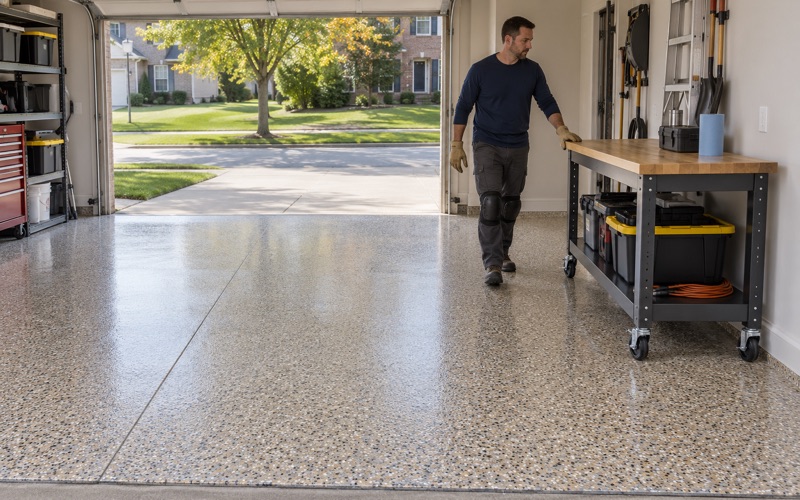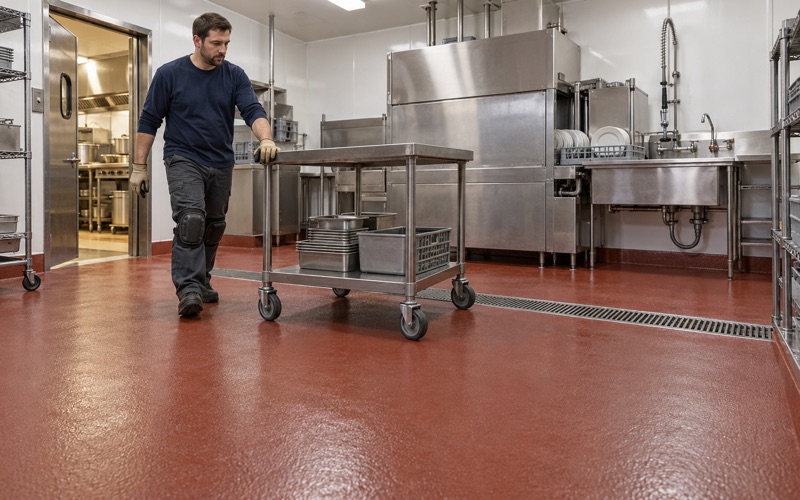
Glenview Epoxy Flooring has more than 20 years on concrete, and our work on epoxy-flooring in Northlake begins with a plain question about any distribution floor: what does it collect over a shift? A warehouse slab is judged less by how it looks on the day we leave than by how quickly it gives up its debris to a sweeper and how long its painted lines stay readable. Bare concrete is poor at both, and it gets worse every year it stays bare.
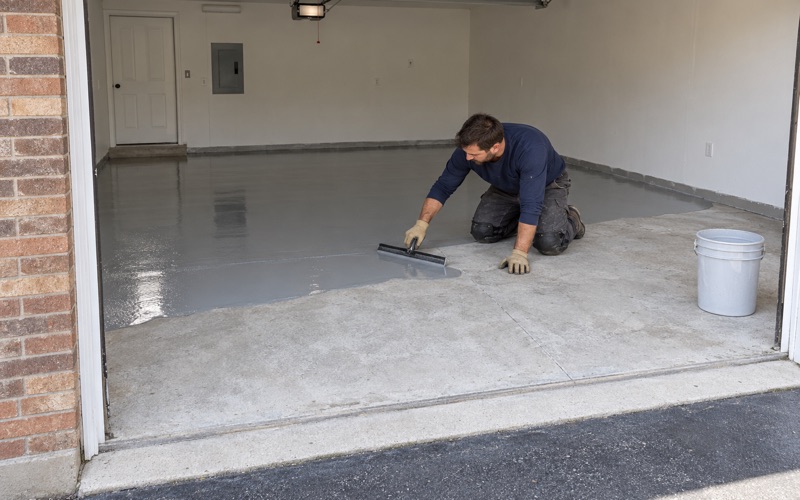
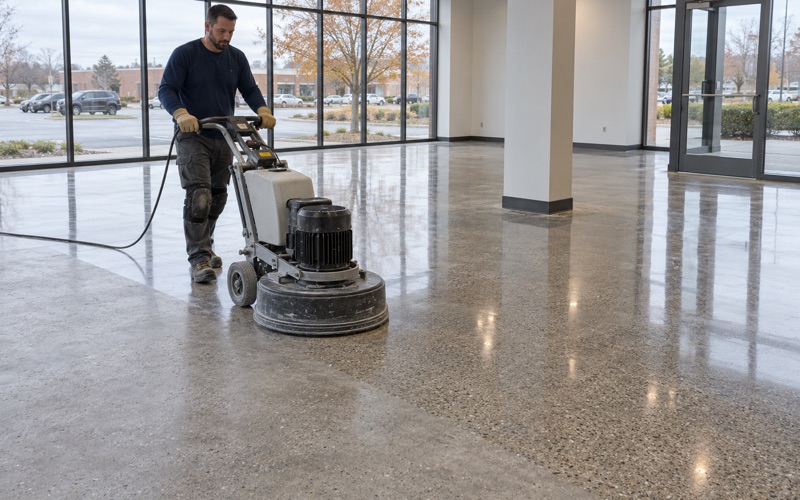
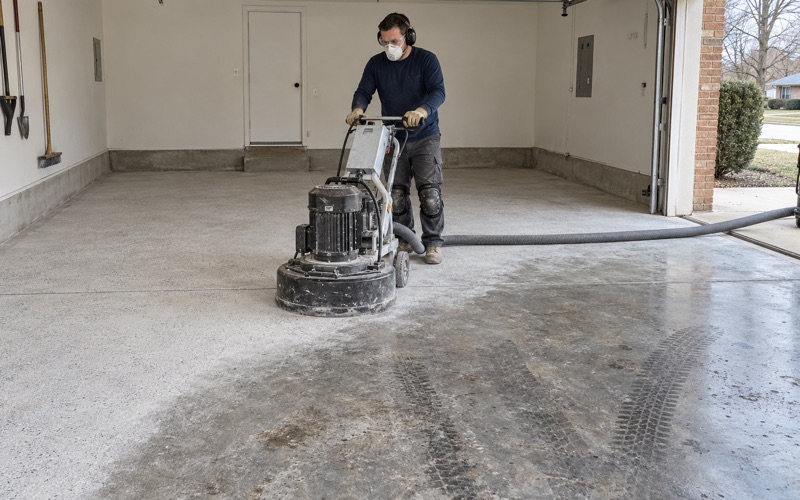
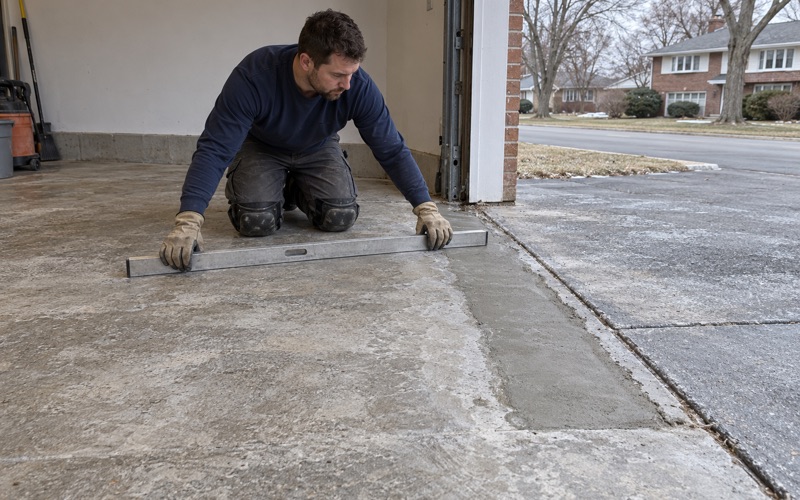
Our part of the answer starts below the coating. Each slab is opened mechanically, with a diamond grinder or a shot blaster, so the resin bonds to a measured profile rather than an acid-etched skin. Cracks, spalls and any earlier coating are mapped before pricing, and if the concrete needs repair or replacement before it should be coated, the proposal says so in writing.
That proposal also lists the product line, the number of coats and the finished thickness, so a facility manager can hold the installed floor up against the quote. A moisture test is a line item in the scope before the price is final. For a building that cannot close, we phase the work around operating hours, using overnight and weekend windows planned before the first pass of the grinder.
A Flooring Distributor on Northwest Avenue and the Next-Day Clock

Northlake takes its name from two streets, North Avenue and Lake Street, which intersect on the city’s west border. A good share of its industrial floor space sits along Northwest Avenue, in the Leyden Township part of the city, where one building after another is a distribution center of some kind. One of them makes a useful case study for the kind of floor this page is about.
The Chicago Distribution Center at 333 Northwest Ave
Empire Today, the shop-at-home carpet, flooring and window-treatment company, lists its Chicago Distribution Center at 333 Northwest Ave, Northlake, and labels it plainly as not a retail store. Directories give the same address as the company’s headquarters. We have no relationship with Empire Today, and we have not seen what is stocked, cut or staged inside that building or how its floor is finished.
We raise it because it describes a floor type Northlake has in quantity: a building whose product is itself flooring, moving through in rolls, cartons and pad bundles. Whatever a specific operator does inside, the general shape of that work is familiar to anyone who has coated a distribution floor. It is also the shape that decides which coating system makes sense.
What a next-day promise asks of a warehouse floor
Empire’s Chicago page says in-stock carpet and flooring can be installed as soon as the next day in select areas, crediting large warehouses with products ready to be installed. That is the company’s own marketing claim for in-stock styles, and we do not restate it as a guarantee or tie it to any one building’s volume. What it illustrates is a pattern common to next-day installation businesses everywhere.
A warehouse that supports next-day installation stages product on a short cycle, often overnight, for trucks or crews leaving in the morning. Rolls, pad and cartons sit in lanes for hours and then move out, and the lane is swept and refilled for the next day. A floor that holds dirt, hides its own markings or needs a long cleanup slows that cycle on the very shift with the least slack.
Looking for epoxy-flooring closer to River Forest? See Epoxy-Flooring in River Forest.
Lint, Offcuts, Cores and Film: The Debris a Flooring Warehouse Makes
Every warehouse makes some debris, but a flooring distribution floor makes a particular mix of it. In general practice the list runs to carpet fiber lint, pad crumbs, offcuts, cardboard cores, stretch film and strapping. Each behaves differently on concrete, and each is easier to clear from a sealed surface than from an open one.
Fiber lint and pad crumbs
Rolled carpet has traditionally been handled by pulling the storage roll with a forklift, unwinding a length, cutting it and rewinding the rest, much of it by hand. Wherever that kind of handling happens, loose fiber sheds onto the floor, and foam or rubber cushion leaves crumbs along the edges of every bundle. Lint is light enough to drift under racking and into corners, where it piles up rather than blowing away.
On bare concrete, fine fiber and dust work into the open pores and the surface never fully comes clean. A sweeper lifts the loose layer and leaves a gray film behind, and a scrubber pushes wet grime into the slab instead of picking it up. Over a few years the floor takes on a permanent dinginess that no amount of housekeeping removes.
Offcuts, cores, film and strapping
Offcuts and cardboard cores are bulky rather than fine, and their hazard is the obvious one: something on the floor to trip over or catch a pallet jack wheel. Stretch film and strapping are worse in a quieter way. Film lies flat and nearly invisible on a dusty floor, and loose strapping can snag a foot or wrap a caster.
None of this is a coating problem in itself, since debris falls on any floor. The difference a coating makes is in how fast a crew can find it and clear it. On a sealed floor with a uniform color, a stray length of film or a dropped core shows up against the surface, and a single pass of the sweeper takes the fine material with it.
OSHA’s Housekeeping and Marked-Aisle Rules on a Busy Floor
The federal general materials-handling rule, 29 CFR 1910.176, speaks directly to the debris and traffic described above. It is worth being precise about what it says, because it is easy to overstate. The rule governs aisles and housekeeping, not floor finishes, and no coating by itself makes a facility compliant.
Storage areas free of accumulation
Paragraph (c) of the rule says storage areas shall be kept free from accumulation of materials that constitute hazards from tripping, fire, explosion or pest harborage. Lint, offcuts, cardboard and film are exactly the kinds of materials that pile up into a tripping or fire load when cleaning falls behind. Meeting that paragraph is a housekeeping discipline the operator owns, every shift.
What a floor can do is make that discipline cheaper. A smooth, sealed surface lets a mechanical sweeper or an auto-scrubber clear fine debris in one pass instead of three. That turns housekeeping from a weekly project into something that fits inside a normal shift change.
Permanent aisles, appropriately marked
Paragraph (a) adds that where mechanical handling equipment is used, aisles need sufficient safe clearances and must be kept clear and in good repair. It then says permanent aisles and passageways shall be appropriately marked. On a staging floor, those marked aisles are what keep a forklift lane from quietly filling with tomorrow’s product.
Paint on bare concrete is the weak link here. Sweeper brushes and tires grind the lines away, and fine dust settles over what remains until the edge of an aisle is a guess. A line that has to be repainted every few months is a line that is often faded in the meantime.
A Sealed Floor That Sweeps Clean and Keeps Its Lines
For a dry flooring warehouse, the coating’s two jobs are clear from everything above: shed debris easily and hold its markings. The system we recommend follows from those jobs and from the traffic the floor carries. The details below are general practice for this kind of building, not a description of any particular operator’s floor.
Choosing the system
A high-build 100% solids epoxy body coat over a properly profiled slab gives a hard, continuous surface that does not dust and does not soak up scrubber water. Over it we typically place a polyaspartic or urethane topcoat chosen for abrasion resistance under forklift and pallet-jack traffic.
Texture is a tradeoff on this kind of floor. A heavy quartz aggregate broadcast improves footing but also gives lint something to cling to, so we specify slip resistance by the broadcast and topcoat used in each zone rather than as one blanket finish. Storage and staging lanes can stay smoother for sweeping, while walkways and any wet-cleaning areas get more grip.
Lines that survive the sweeper
Aisle lines and staging-zone markings last longest when they are part of the coating rather than paint on top of it. We lay the line color between the body coat and a clear topcoat, so sweeper brushes wear the topcoat instead of the marking itself. Staging zones, aisle edges and pedestrian paths can each take their own color, which helps a crew loading in the dark see where product belongs.
If the layout changes, a new line can be added and topcoated without stripping the floor. Recoating a worn topcoat in high-traffic lanes is a far smaller job than repainting every marking in the building. We discuss that maintenance interval with the owner before the job, along with what the coating warranty leaves out, and moisture is the first exclusion we name.
Testing, curing and keeping the warehouse running
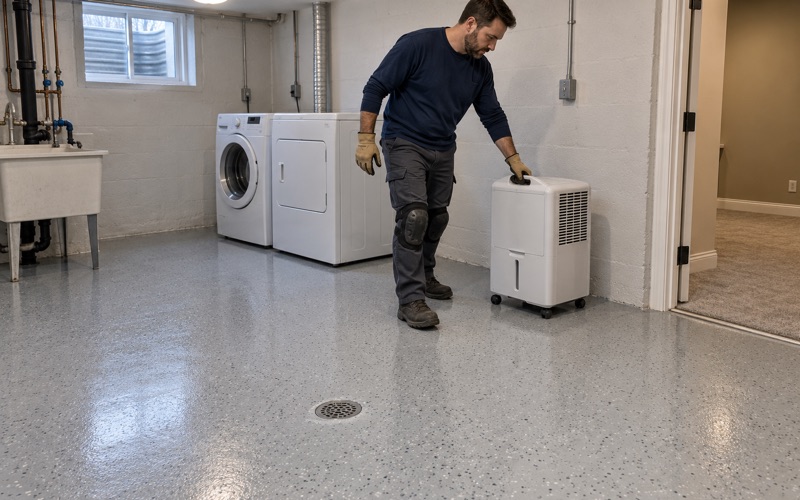
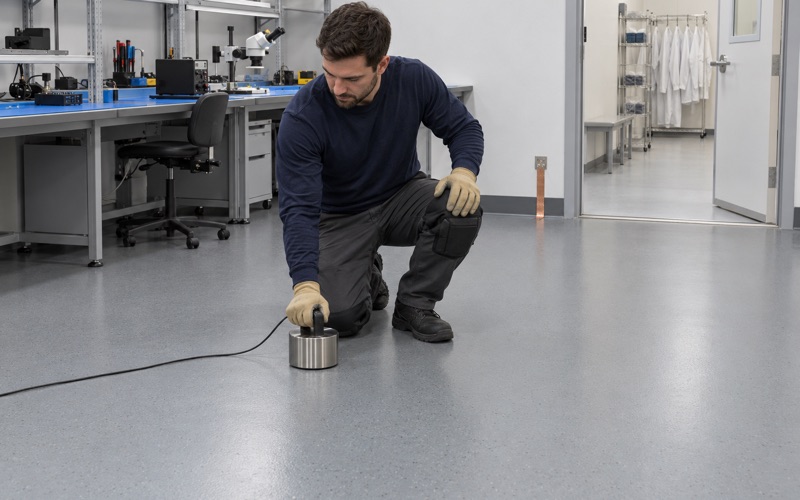
Before any coating is priced, the slab is tested for moisture, typically with ASTM F2170 in-situ relative humidity probes or ASTM F1869 calcium chloride testing. If readings run high, a moisture-mitigation primer goes into the scope rather than becoming a surprise after the floor fails. Cure schedules follow the slab temperature and the dew point spread at the surface, not the calendar, which matters in a large building with overhead doors opening all night.
Grinding dust is captured at the machine with a vacuum rather than swept or rinsed toward a floor drain. On an operating distribution floor, we work in sections so staging lanes can rotate, finishing one block before the next one empties. For a warehouse whose whole business runs on tomorrow morning’s trucks, that sequencing matters as much as the resin.
The City of Northlake Building Department requires every contractor and subcontractor to register, with a $100 annual license that runs one year from issuance, a $10,000 bond and a certificate of insurance naming the city. Fire protection here is provided by the Northlake Fire Protection District rather than a city department, so any commercial fire-code question goes to the district. We sort out which office handles a given question before a start date is set.
- 20+ Years on Concrete
- Moisture Test in Every Scope
- Free Written Estimates