
Glenview Epoxy Flooring grinds and finishes polished concrete floors in Glenview, IL, serving surrounding cities including Winnetka, Prospect Heights, Deerfield, Lincolnwood and Norridge. Our 20+ years on concrete have taught us that a polished floor is only as good as the slab underneath it, so every job starts with a test grind and a look at the concrete before we promise a finish.
Unlike a coating, polished concrete has nothing on top to peel or wear through. The slab itself is ground flat, hardened with a lithium silicate densifier and refined with progressively finer diamonds until it reflects light, which makes it a durable, low-maintenance floor for basements, offices, showrooms and warehouses.
That also means the slab has nowhere to hide. Cracks, patches and old glue lines show through a polish, so we map them first and tell you honestly whether your floor will polish well or would be better served by an epoxy coating.
How We Polish a Concrete Floor
Test Grinding and Slab Assessment
We start by grinding a small test area to see how hard the concrete is, how deep the aggregate sits and how the slab responds to the diamonds. That test tells us which tooling to use and how far the grind can go, and it lets you see a real sample of your own floor before the job is priced.
We also map cracks, spalls, old adhesive and patched areas during the assessment. Some of them can be filled and polished through, while others will always show, and we tell you which is which so the finished floor matches what you expected.
Grinding, Densifying and Polishing in Stages
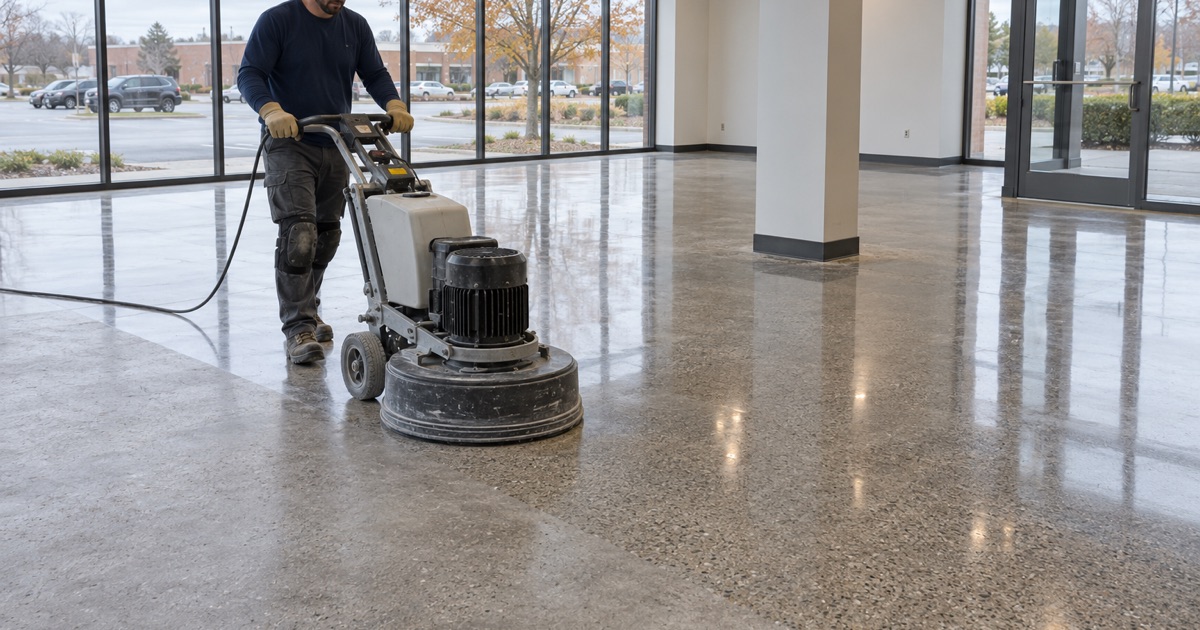
The first passes use coarse metal-bond diamonds to flatten the slab and remove the surface paste, coatings and stains. Each pass after that uses a finer diamond to remove the scratches left by the one before, so the surface gets progressively smoother rather than simply shinier.
Partway through the process we apply a lithium silicate densifier, which reacts with the concrete to harden the surface and reduce dusting. The final passes use resin-bond diamonds to bring the floor to the sheen you chose, and the dust is captured at the grinder by an industrial vacuum the whole way through.
Guard Coats and Final Burnishing
A penetrating guard is applied after the final polish to help the floor resist stains from oil, coffee and everyday spills. It is not a coating in the epoxy sense and does not build a film; it soaks in and is burnished in with a high-speed machine to bring the shine up.
The guard is what keeps a polished floor looking polished between cleanings. It wears over time in high-traffic areas and can be reapplied and burnished without regrinding the floor, which is part of what keeps the long-term cost of polished concrete low.
Choosing Aggregate Exposure and Sheen
Cream, Salt-and-Pepper and Exposed Aggregate
A light grind leaves the cream finish on top of the slab, showing very little stone and giving a smooth, even look. A medium grind exposes the fine sand and small stones just under the surface, the salt-and-pepper look popular in offices and lofts.
A deep grind cuts down into the large aggregate and shows the stones across the floor. How far a slab can go depends on how it was poured and finished, which the test grind tells us, so we never promise a level of exposure the concrete cannot give.
Matte, Satin and High-Gloss Finishes
The sheen of a polished floor is set by how fine the last diamond pass is and how it is burnished. A matte finish reads soft and hides wear, a satin finish gives a gentle reflection that suits most homes and offices, and a high gloss mirrors overhead lighting and makes a showroom feel bright.
Higher gloss shows dust and scuffs more readily, so we usually recommend satin for basements and busy entries. We can show you samples at different levels before choosing, because the same sheen looks very different under daylight and under shop lighting.
Dyes and Stains
Dyes and stains are applied between grinding passes to tint the concrete before it is densified. The color sinks into the surface instead of sitting on top, so it moves with the natural variation in the slab and looks like stained stone rather than paint.
Dyes can also mark out borders, logos or zones on a commercial floor. Because the color is in the concrete, it does not chip or peel, though it can fade under strong direct sunlight over the years.
Polished Concrete for Homes and Businesses
Basements and Finished Lower Levels
Many Glenview houses have full or partial basements, and a sound basement slab can be polished into a clean, durable floor for a family room, gym or workshop. Polishing leaves no coating to blister if the slab breathes, which is an advantage over some coatings on older slabs without a vapor retarder.
Polishing is not waterproofing, though. We still check basements for past water, efflorescence and cracking, and if the floor has a history of seepage or sewer backup we recommend fixing that first, because a polished slab offers no barrier to water coming through it.
Offices, Showrooms and Retail Floors
Polished concrete is common in offices, showrooms and retail spaces because it is bright, durable and easy to clean with an autoscrubber. Glenview’s corporate and retail base, from office campuses to the mix of shops and restaurants at The Glen, includes plenty of spaces where a polished slab fits the look and the traffic.
We work around business hours on commercial jobs, phasing the floor in sections or running overnight and weekend shifts. Dust is captured at the grinder rather than rinsed toward a drain, so the space can open each morning without a cleanup crew.
Warehouses and Light Industrial Slabs
Warehouse and light industrial floors take forklifts, pallet jacks and constant abrasion. Densifying and polishing a sound warehouse slab hardens the surface, cuts dusting and makes it easier to sweep and scrub, without a coating that forklift tires can wear through.
Joints and spalls are repaired with a semi-rigid filler so forklift wheels roll across them cleanly. Where a warehouse needs chemical resistance or bright safety coloring, we recommend an industrial epoxy instead, and we explain the trade-off before the job is priced.
Living With a Polished Floor
Daily Care and Cleaning
A polished floor needs regular dust mopping and a damp mop or autoscrubber with a pH-neutral cleaner. Grit is the main enemy, because it acts like sandpaper underfoot, so mats at entries and regular sweeping keep the shine longer.
Avoid acidic and citrus cleaners, vinegar and harsh degreasers, which etch the surface and dull the finish. Spills of wine, soda or juice should be wiped up quickly, because they can stain or etch a polished floor if left to sit.
Restoring the Shine Over Time
Even a well-maintained polished floor dulls in the busiest areas over the years. Rather than regrinding the whole floor, we can burnish it, reapply the guard and, if needed, touch up the final polish passes to bring the shine back.
That ability to restore the surface without stripping or recoating is one of the main reasons polished concrete costs less to own than most coated floors over its life, provided the slab underneath stays sound.
- 20+ Years on Concrete
- Moisture Test in Every Scope
- Free Written Estimates