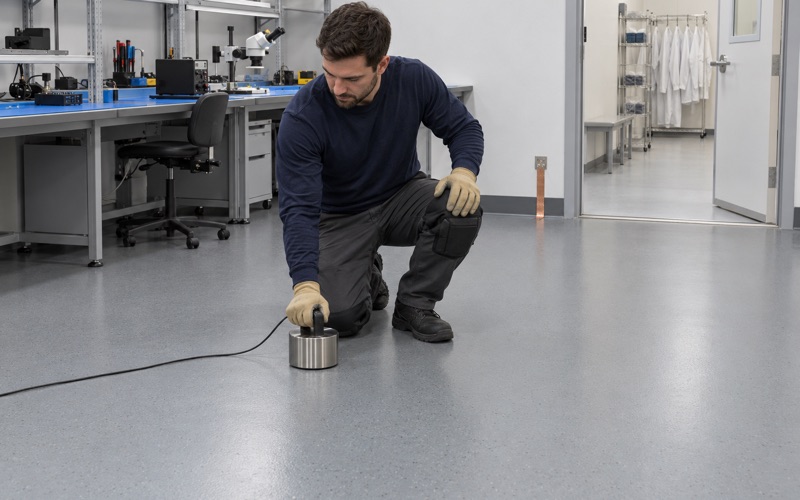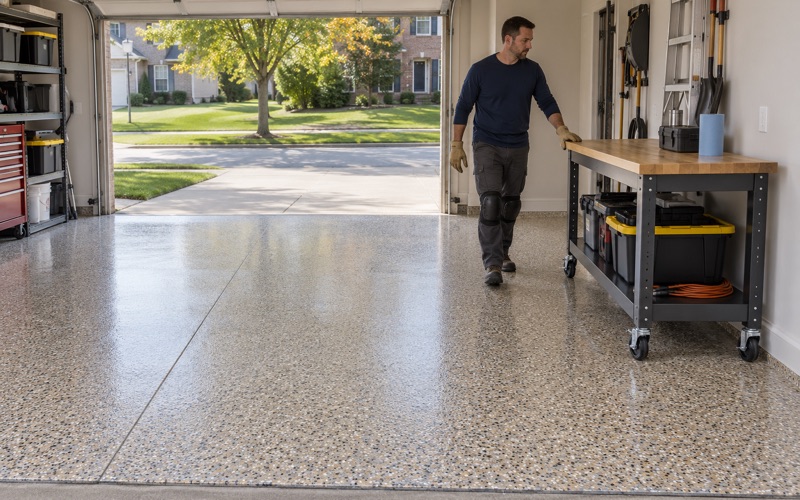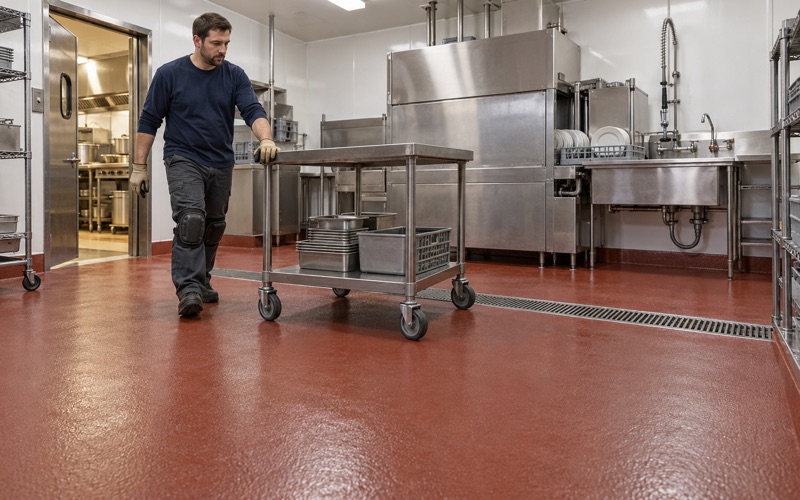
Glenview Epoxy Flooring has more than 20 years behind its epoxy flooring in River Forest, and the floors that test a coating plan hardest are the cold ones. Epoxy cures by chemical reaction, and a slab that sits too cold slows that reaction or stalls it before the film is finished. Cold slabs turn up in more places than people expect: a walk-in freezer, a chilled meat-cutting room, a detached garage in January, the basement corner where the chest freezer lives.
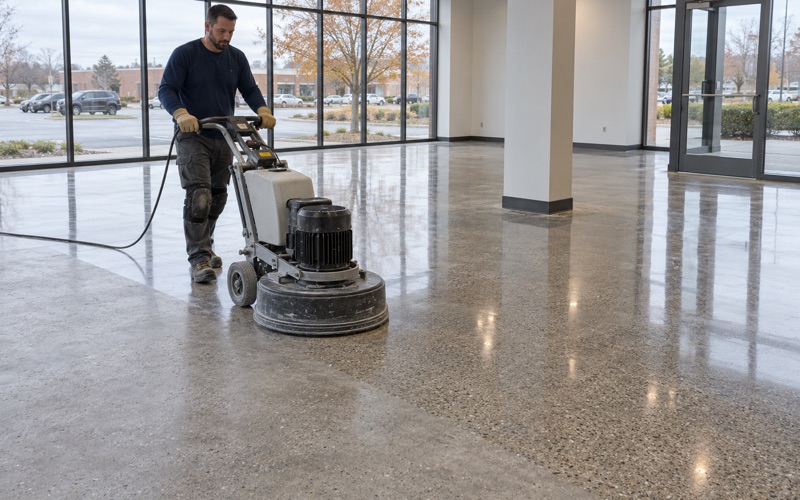
Our approach to each of those starts in the same place. The concrete is opened mechanically, by diamond grinding or shot blasting, never by acid, so the resin has a profile to bite into. A moisture test is written into the scope before the price is settled, and the proposal spells out the product line, how many coats go down and the finished thickness, so the floor you get can be measured against the paper.
When temperature is the obstacle, we schedule by the slab and the dew point at its surface rather than by a date. Sometimes that points to a cold-cure system built for a room that cannot be warmed. Sometimes it means telling an owner, plainly, that the right day is in April.
A 30-Year Lake Street Grocery and the Rooms That Stay Cold
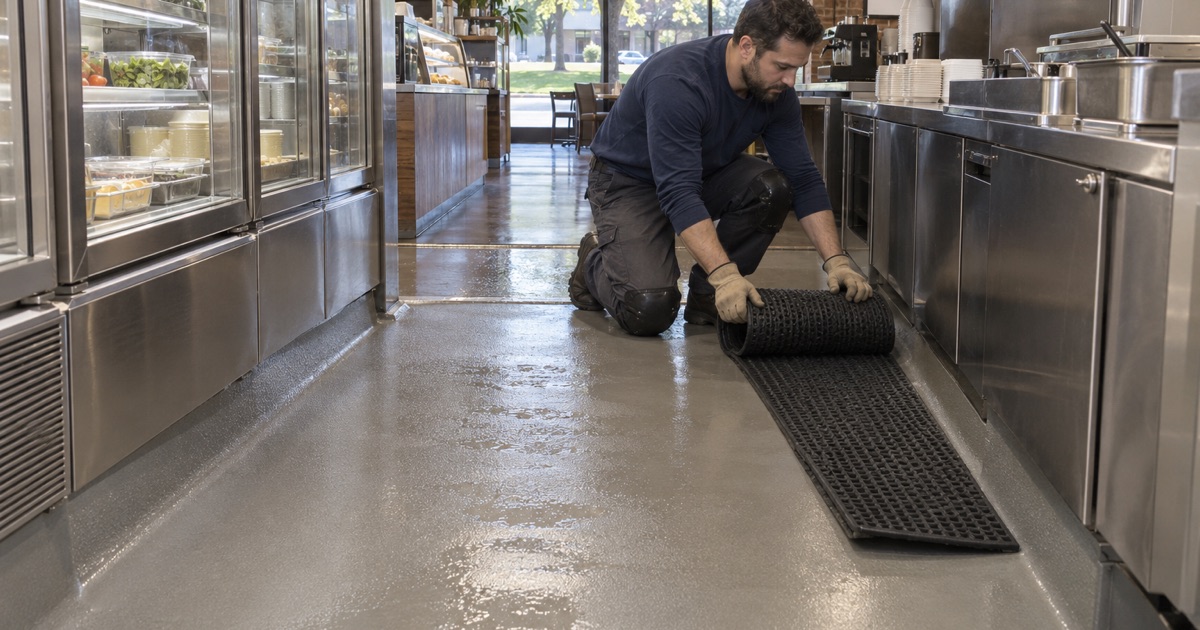
The clearest local example of a cold-floor problem is a grocery remodel, and River Forest has one on the record. Whole Foods Market at River Forest Town Center, 7245 Lake Street, marked its 30th year in 2024. That April, Mid-America Asset Management announced that the store was expanding into the adjacent former Rally House space, would undergo a full remodel of the market, and had signed a new 25-year long-term lease.
We are not part of that project, and we have not seen its cooler, freezer or prep-room floors. No work schedule was published, and neither was any statement on whether the store stays open while the work happens. What the public store page does show is why a remodel like this is hard on floors: the store is open daily from 8:00 a.m. to 10:00 p.m., and its Butcher’s Cut Room offers fresh cuts prepared in-store.
Coolers, freezers and a cutting room
Most of a grocery floor can be phased aisle by aisle at night. The cold rooms are different. A walk-in freezer or a chilled cutting room cannot simply be switched off and warmed for several days, because everything inside has to go somewhere else first, and the room then has to be pulled back down to temperature before it can be restocked.
That is the bind in any cold-room floor job. A conventional epoxy needs a warm slab, and the slab in a freezer is the last thing in the building that will ever be warm.
What a meat room floor has to handle
A cutting room adds washdown to the cold. Water, fats, sanitizer and cleaning chemicals hit the floor every day, so slip resistance has to come from a specified broadcast and topcoat rather than a promise. Where floors are cleaned by water flushing, the FDA Food Code (6-201.13) calls for coved, sealed junctures between floor and wall, and food establishments in suburban Cook County answer to the Cook County Department of Public Health.
Looking for epoxy-flooring closer to Bellwood? See Epoxy-Flooring Services in Bellwood.
Why Epoxy Waits for 50 Degrees
A standard 100% solids epoxy is a two-part system, and the reaction between resin and hardener depends on heat. Manufacturers publish a window for it. Sika’s product page for Sikafloor-264 ECF, a common epoxy floor coating, lists a substrate minimum of 50 degrees and a maximum of 85, with the slab at least 5 degrees above the measured dew point.
Even at that minimum the cure is slow. Sika’s data sheet for Sikafloor-264 puts foot traffic at roughly 24 hours and full cure at about 10 days when the slab sits at 50 degrees. A freezer floor is nowhere near that line, and a cooler floor usually is not either.
What happens below the line
Below the stated minimum, epoxy does not just take longer. The film can stay soft or tacky, the bond to the concrete can come in weaker than the system is rated for, and a cold, humid surface invites amine blush, a waxy film that keeps the next coat from bonding. Any of those failures can look fine on the day of install and show up later as peeling under traffic or cleaning.
The dew point problem in a cold room
Temperature is half of it. A slab well below the air around it pulls moisture out of that air, and every time a cooler door opens to a warmer back-of-house, the warm air meets a cold floor. That is why we measure the dew point spread at the slab surface, not just the room thermostat, before anything is mixed.
In a room that has to stay cold, the honest options are short. Either the room is emptied and warmed long enough for a conventional system to cure, or the floor gets a chemistry designed to cure at the temperature the room already runs.
Cold-Cure MMA: Food Out, Fans On, Freezer Running
Methyl methacrylate, or MMA, is the chemistry built for that second option. Sika describes Sikafloor Pronto RB-1823 CQ as an MMA self-leveling flooring system that can be installed at temperatures down to minus 20 degrees. Its published data says all components fully cure within one hour when properly installed, with a caveat that temperatures below freezing may take additional time.
The same product literature states there is no need to turn off a freezer for installation, and it lists freezers, coolers, cold warehousing, commercial kitchens and grocery stores among its uses. Those are the manufacturer’s figures, quoted as the maker states them. They are not a guarantee from us, and we do not hold any manufacturer applicator certification for that line.
The conditions that come with it
MMA is not a shortcut, and its own literature is direct about the terms. All foodstuffs must be removed from the area before work starts. The uncured resin is a flammable liquid, so explosion-safe ventilation is required during application, and airflow across the floor is called critical to curing in cold spaces.
MMA also carries a strong odor while it is going down, which is a work condition to plan for rather than something to wave away. In a store that sells food, that shapes when the work can happen, which neighboring rooms are sealed off, and how long the space is ventilated before anyone returns. We never describe an MMA floor as safe to install with product on the shelves.
Planning a window around a business
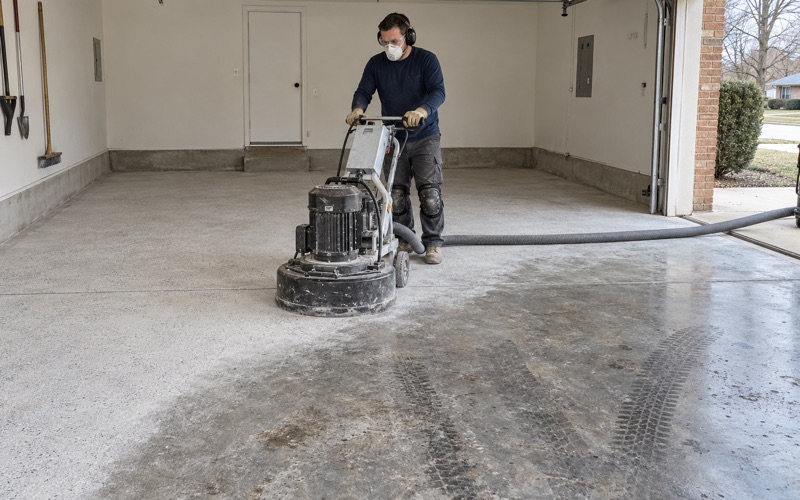
For a cold room inside a working business, we plan the job around its hours, often overnight or across a weekend, with stock moved out before preparation begins. Grinding still comes first, and the dust is collected at the machine by vacuum instead of being washed toward a floor drain. Cracks, spalls and old coatings get mapped before the price is final, and if a cold-room slab is past the point where a coating makes sense, we say so.
Cold Floors at Home: Winter Garages and Basement Freezers
The same chemistry problem shows up at a smaller scale in River Forest houses. The village’s housing is old: about 42.2 percent of it was built before 1940 and about 68.8 percent before 1960, so prewar basement slabs and aging garage slabs are the norm here, not the exception. Owners occupy roughly 87.7 percent of occupied homes, which means most floor decisions are made by the people who will live on the result.
The unheated garage in deep winter
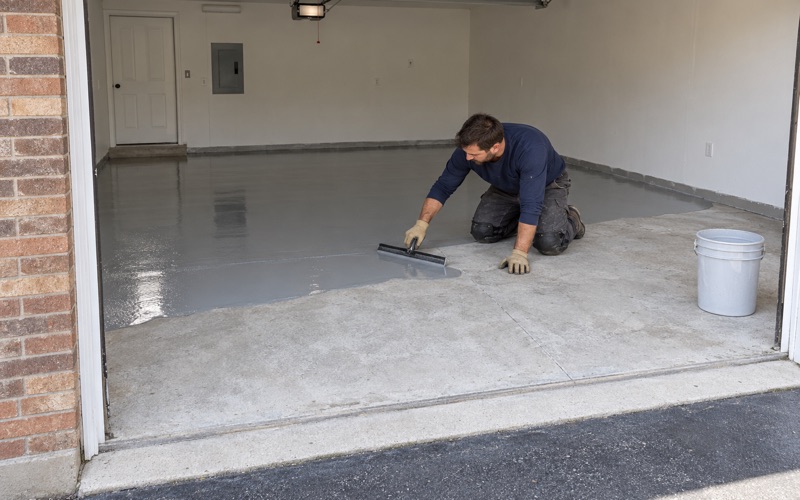
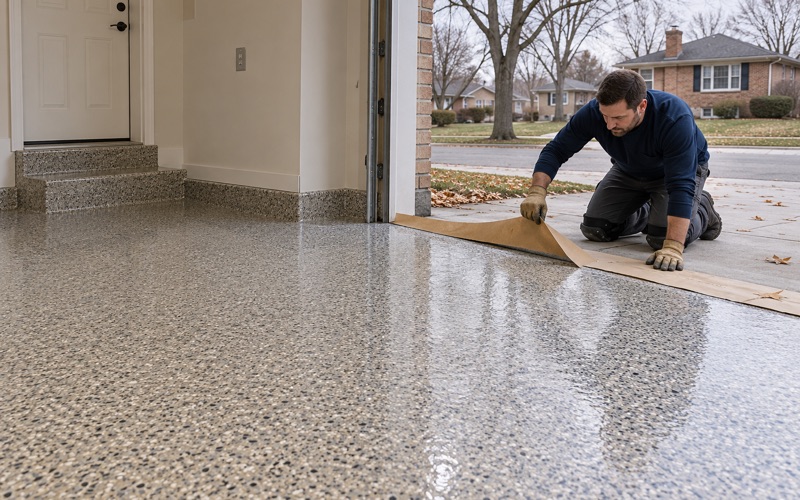
A detached garage with no heat can sit below 50 degrees for weeks. When the slab is that cold, we tell the owner to wait rather than push a conventional epoxy into conditions it is not rated for. The flammable, ventilation-heavy terms that make MMA workable in a commercial freezer are rarely a good trade for a one-car garage behind a house.
When the slab does warm up, the system is chosen for what a River Forest winter drags in on the tires. Rock salt and calcium chloride brine sit on a garage floor for months, so we lean toward a polyaspartic or polyurea topcoat over the base coat, with a vinyl flake or quartz aggregate broadcast for grip. A properly cured system also resists hot tire pickup, the lifting that happens when warm tires sit on a soft or underbuilt film.
The basement freezer corner
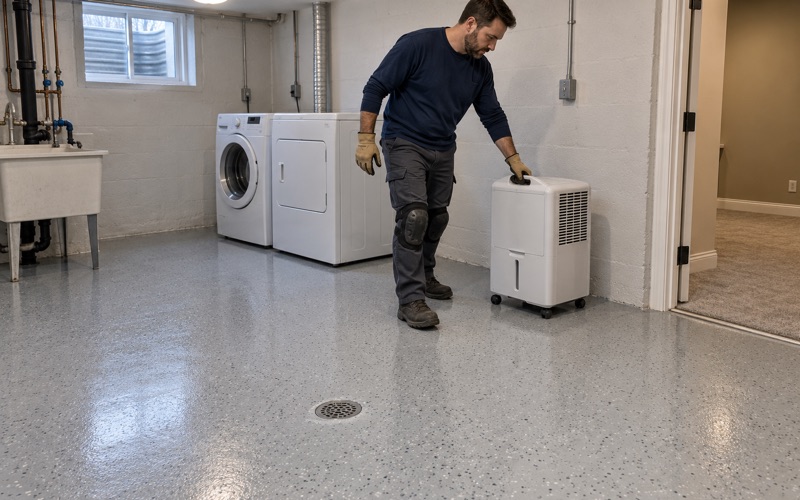
A chest freezer or a second refrigerator in the basement keeps a patch of slab cooler than the rest, and an old basement slab often carries a history of damp. We read the floor for past water before anything else, with an ASTM F2170 relative humidity probe or an ASTM F1869 calcium chloride test, because a coating does not stop seepage or sewer backup. Where moisture is present but manageable, a moisture-mitigation primer goes into the scope, and the warranty exclusions for vapor transmission and hydrostatic pressure are explained before the job is sold.
We also do not sell a basement coating as radon reduction, because in Illinois that is licensed mitigation work under IEMA. Home jobs above the state threshold get a written contract and the Home Repair: Know Your Consumer Rights pamphlet under the Illinois Home Repair and Remodeling Act before any grinding starts.
- 20+ Years on Concrete
- Moisture Test in Every Scope
- Free Written Estimates