Glenview Epoxy Flooring brings more than 20 years of epoxy flooring work to River Grove, and on this page we take up a question most coating quotes skip entirely: how much grip a floor should have. Grip is usually sold as a single dial turned all the way up. On a floor where people dance, lunge and turn, that approach solves half the problem and creates the other half.
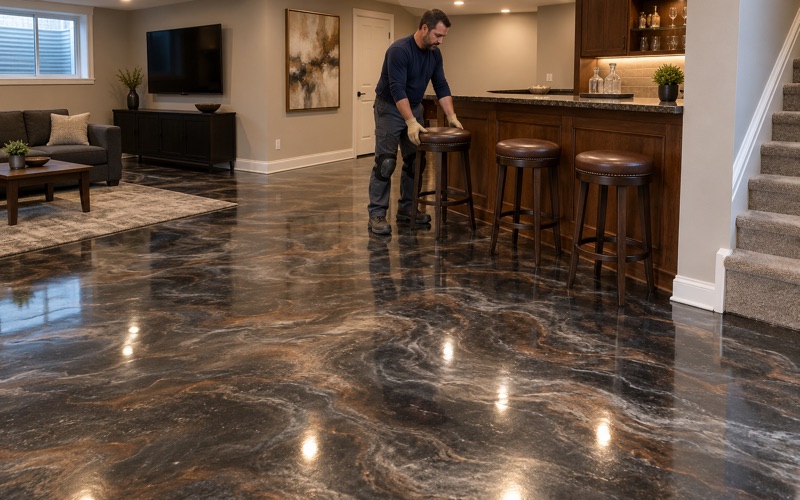
The floors we have in mind are movement floors. That means the basement exercise room, the garage workout corner and the multipurpose room where a class meets on a weeknight. Each one needs a surface that lets a shoe stop when it should and turn when it should, and the texture that does both is rarely the heaviest one available.
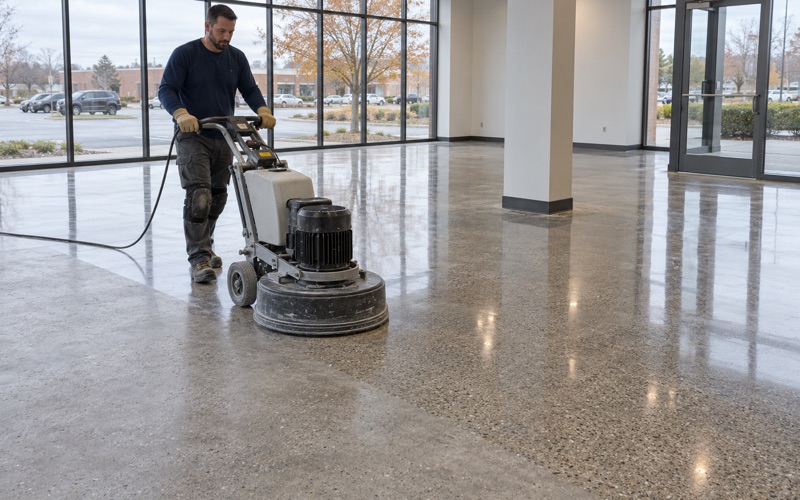
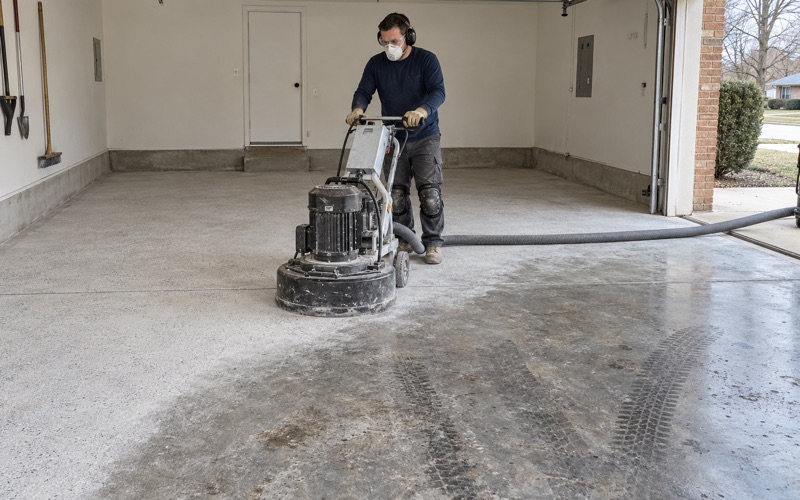
Below we explain what sports-floor standards say about slip resistance, why the broadcast that belongs on a ramp is a poor match for a pivoting foot, and how we choose texture by activity. Every one of those choices sits on the same preparation: a slab opened by a diamond grinder or a shot blaster rather than an acid etch, and a moisture test written into the scope before the price is final.
Zumba, Dances and a Floor That Has to Turn
Classes on Grand Avenue
River Grove’s Recreation Department runs a full calendar out of the American Legion Recreation Center at 8664 W. Grand Avenue. The village lists Zumba, Piloxing and PiYo fitness classes there, along with teen dances, daddy-daughter dances, movie nights and craft days. It is a room built around people on their feet, moving in every direction at once.
We have no relationship with the post or the village, and we have not seen that room’s floor, so we make no claim about what it is made of or how it is finished. What the schedule does show is the kind of use a movement floor gets in this village: a fitness class one evening and a dance the next weekend. That mix is the useful lesson for anyone setting up a similar space at home.
What a pivot asks of a surface
A Zumba routine is a string of quick stops, side steps and turns on the ball of the foot. Each stop needs traction, and each pivot needs the shoe to release and rotate a moment later. A surface that only does the first job turns every spin into a small fight with the floor.
Dancing makes the same demand at a gentler pace. A step that grips cleanly and then lets the foot swing through is what people mean when they say a floor feels right, even if they never stop to think about why. Piloxing and PiYo add slower, controlled turns and balance work, which asks for steady, predictable traction rather than a surface that grabs.
Why the home version is the common job
Most of the movement floors we coat are not halls. They are a corner of a basement with a weight rack and a mat, or one bay of a garage cleared for a bike trainer, a jump rope and a speaker. The stop-and-turn logic is the same at that smaller scale, and it is far easier to get right before the coating goes down than to correct after it has cured.
Looking for epoxy-flooring closer to Wood Dale? See Epoxy-Flooring Services in Wood Dale.
Slip Resistance Needs a Ceiling as Well as a Floor
What the sports-floor standards describe
Indoor sports floors are measured with a pendulum test, in which a swinging arm drags a rubber slider across the surface and records how strongly the floor resists it. As one testing lab describes ASTM F2772, the specification for indoor sports floors, a floor should achieve an average pendulum value between 80 and 110, with individual tests falling within plus or minus 4 points of that average. The same lab says the European standard EN 14904 is in agreement.
The lab’s stated reason is the part worth remembering. Players need enough traction to start and stop quickly, yet not so much that they cannot pivot rapidly. A specification with an upper end is a plain admission that more grip is not always better.
What that range is and is not
That 80-to-110 band is an indoor sports-floor specification, read through a testing lab rather than from the standard itself. It is not a rule for a community hall, a basement or a garage, and we do not promise a pendulum number on a home floor. We use it as a way of thinking about the job rather than as a target.
What it gives a homeowner is a better question to put to any contractor. Instead of asking how slip-resistant a floor will be, ask what the floor will be used for, and whether the texture being proposed suits a foot that has to turn as well as stop.
The trade-off in plain terms
With too little texture, a dress shoe or a sweaty sneaker skates across the coating. With too much, the sole holds while the body keeps rotating, and every turn feels abrupt and tiring. A good movement floor sits between those two, and the way to land there is to choose the texture on purpose rather than default to the coarsest grit on the truck.
Broadcast Texture: Right for a Ramp, Wrong for a Pivot
Where heavy grip belongs
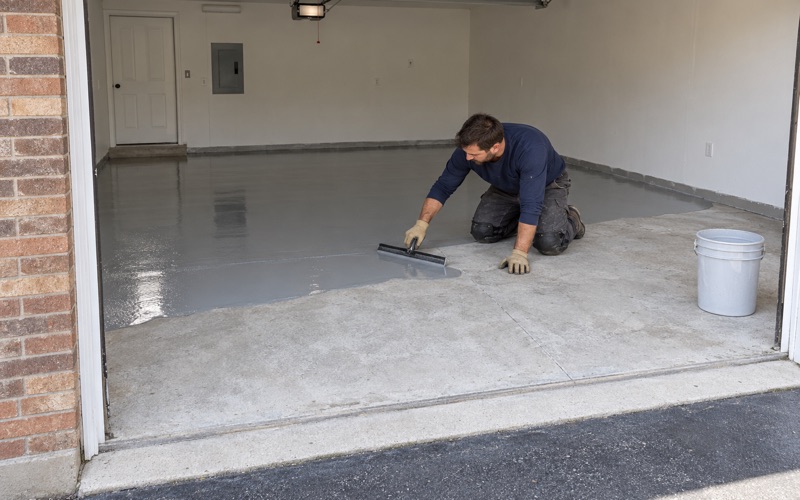
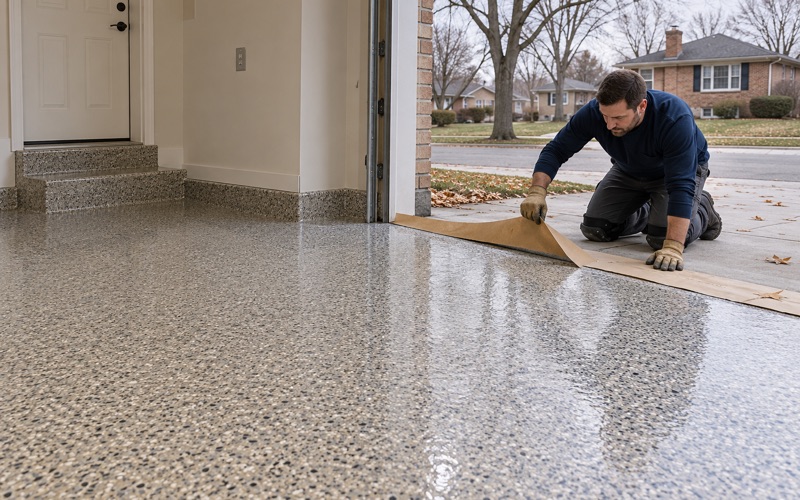
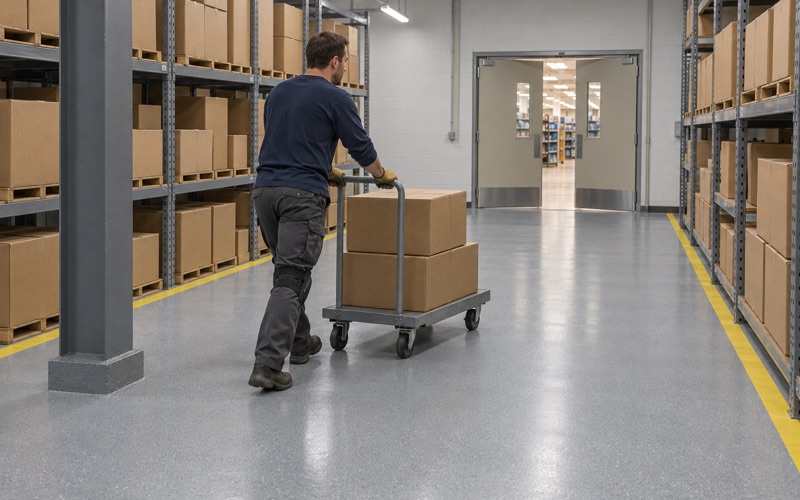
On a wet garage apron, a ramp or a slab that takes tracked-in brine all winter, aggressive texture earns its place. A full quartz aggregate broadcast or a dense vinyl flake broadcast, locked in under a polyaspartic or polyurea topcoat, gives a tire or a boot plenty to bite on. Our garage systems are chosen to stand up to the rock salt and calcium chloride deicers that ride in on tires, and that texture is part of the reason.
The catch is that the same broadcast can over-grip a twisting shoe. Coarse aggregate standing proud of the topcoat holds a rubber sole in place, which is exactly what you want on an incline and exactly what you do not want halfway through a turn.
Choosing texture by activity
For an exercise room or a dance corner we work through a short list of options. A fine grit mixed into the topcoat gives modest traction without coarse peaks. A matte topcoat over a flake floor takes the slickness off while leaving the surface easy to rotate on.
A plain gloss coat with no additive is the easiest finish to turn on, but it can be too slick in dress shoes or when the floor is damp. That makes it a fair choice for a dry room used mostly in athletic shoes and a poor one anywhere water or sweat collects.
Where a room serves two purposes, such as a garage that parks a car in winter and hosts workouts in summer, we can vary the texture by zone. The drive lane gets the heavier broadcast, and the workout corner gets the finer finish.
Written into the proposal
We specify slip resistance by the broadcast and topcoat we will use, never as a slogan. The proposal names the product line, the number of coats and the finished thickness, and the texture choice is listed right beside them. That way the floor can be checked against the quote once it cures, rather than argued about from memory.
Workout Corners in River Grove Basements and Garages
What the housing stock brings to the job
River Grove is a village of older homes. Of 4,573 housing units, 762 were built in 1939 or earlier and only 180 have been added since 2000, so most exercise rooms we plan here go into a basement or garage that has already had a long life. Census figures count 1,579 owner-occupied single-family detached homes, and those are the floors where a homeowner makes the call on what goes down.
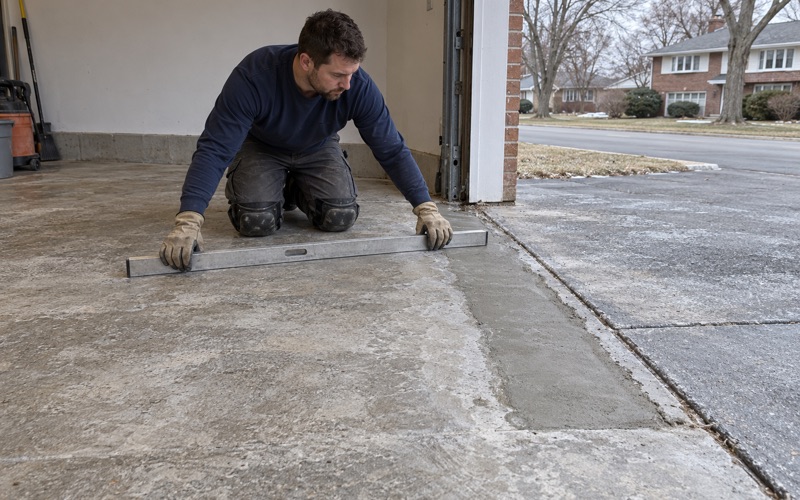
Older slabs carry old coatings, patched cracks and sometimes a history of water. We map cracks, spalls and earlier coatings first, and we say so plainly when a slab needs repair or replacement before it should be coated at all.
Water comes before texture
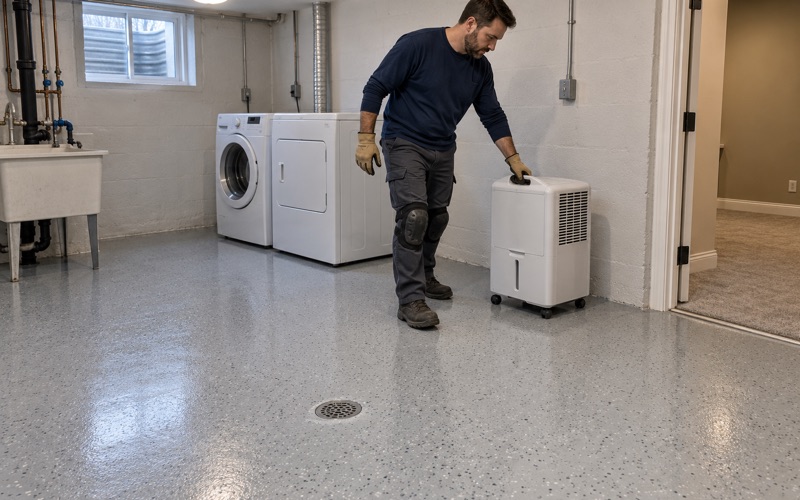
The village’s July 2020 newsletter warned that surcharged street sewers send water that will most likely end up in basements of homes without flood control systems. A coating does not stop sewer backup or seepage, so we read a basement for signs of past water before anything else. A floor that has already been wet is a different job from a dry one, whatever texture goes on top.
Moisture testing is in the written scope on basement and garage slabs alike, whether that is ASTM F1869 calcium chloride testing, ASTM F2170 in-situ relative humidity probes or an ASTM D4263 plastic sheet test. Where readings call for it, a moisture-mitigation primer goes down under the 100% solids epoxy. We also explain what the warranty leaves out before the job is sold, and moisture is the first exclusion we name.
Cure, permits and paperwork
A workout corner in an unheated garage is a winter question as well. Cure schedules follow slab temperature and the dew point spread at the surface, not the calendar, and an unheated garage in deep winter is told to wait. Rushing a cure in the cold invites amine blush and a soft topcoat, and no texture choice rescues that.
River Grove requires a building permit for any remodeling valued over $100, so we check with the village Building Department on Thatcher Avenue before a job is scheduled. On home jobs over the state threshold we provide a written contract and the Home Repair: Know Your Consumer Rights pamphlet before any grinding starts.
During prep, grinding dust is captured at the machine with a vacuum rather than rinsed toward a floor drain. When the work is done, the texture on the finished floor is the one the room’s activity called for, from the first stop to the last pivot.
- 20+ Years on Concrete
- Moisture Test in Every Scope
- Free Written Estimates