Glenview Epoxy Flooring has spent more than 20 years on epoxy flooring in Round Lake and the rest of the north suburbs, and the floors we think hardest about here are the ones that get cleaned several times a day. A veterinary exam room, a treatment area or a kennel aisle is wiped, mopped and disinfected far more often than a garage, and the way that cleaning is done should decide what the floor is made of.
This page is about that match between a cleaning routine and a coated slab. A floor with open cracks, bare pores or worn hollows fights the person cleaning it, and a seamless coat that sits flush and sheds water works with them. We walk through the published guidance a clinic follows, what it implies for the concrete under it, and what we do before a single coat goes down.
The same reasoning carries over to any room where something wet and organic has to come off the floor completely, from a grooming bay to a break room. The clinic case simply states it most plainly, because the people who wrote the guidance spelled out why each step matters.
How an Accredited Animal Hospital Is Told to Clean a Floor
Companion Round Lake, the dog-and-cat hospital at 415 North Wilson Road, describes itself as an American Animal Hospital Association accredited facility. The address sits inside the village on its Grant Township side, and the practice lists surgery, diagnostics and advanced care, open six days a week. We have not seen its floors and have no relationship with it; we name it because it shows the kind of building in Round Lake where a floor is judged by how it gets cleaned.
AAHA publishes infection-control guidelines that a practice like this can draw on. The 2018 AAHA Infection Control, Prevention, and Biosecurity Guidelines describe themselves as guidance and say outright that they are not an AAHA standard of care, so we treat them as a well-reasoned protocol, not a rule anyone is bound by. Their example cleaning protocol is still the clearest statement we know of what a clinic floor has to survive.
The order of the steps
The protocol says exam rooms and cages are cleaned and disinfected immediately following use, with a sign that the room is out of use until that is done. Surfaces are dry-cleaned first to lift loose organic material, then wet-cleaned with warm water and detergent. Only after that does disinfectant go on, at its labeled concentration, for a contact time the guidelines put at generally 5-10 minutes, followed by a rinse.
Why turnover pressure matters to a floor
A room that cannot be used until it is clean puts the floor on the clock between every patient. Any spot where debris lodges, water lingers or a mop snags adds minutes to that turnover. The guidelines also say a visibly sick pet should not enter the reception area, and that any waiting or exam spot it occupied is cleaned and disinfected before reuse, which spreads the same demand into the front of the building.
Looking for epoxy-flooring closer to Justice? See Epoxy-Flooring Services in Justice.
Why Pressure Washing Drives Organisms Into Cracks and Pores
The guidance is blunt on one point: high-pressure washing should be avoided. Its reasoning is that higher pressure can help remove stubborn organic debris but may also force debris and organisms into crevices or porous materials, from which they can later emerge. It adds that pressure washing aerosolizes what it hits and throws overspray across the room.
That sentence is really a description of a floor. Bare concrete is porous, and a slab that has been in service for years usually carries shrinkage cracks, open control joints, spalled edges and chips around anchors. Every one of those is a crevice in the guideline’s sense, and hand wet-cleaning is the method the protocol prefers partly because it does not push contamination down into them.
Hand cleaning on a sealed surface
On a properly built coated floor there is very little for a mop to push anything into. A 100% solids epoxy body coat fills the surface profile, and a polyaspartic or polyurea topcoat closes it into one continuous skin. Warm water and detergent can then lift what is on top instead of chasing it into the concrete. The coating also has to run continuously over the places concrete is weakest, such as the edges of old patches and the lines of saw-cut joints, because a seam left open there is the same crevice under a different name.
What a coating is and is not
We are careful about the claim here. A floor coating does not disinfect anything and does not kill organisms; the cleaning and the disinfectant do that work. What a sealed, seamless surface does is leave fewer places for debris to hide from them, which is a cleaning-time and access argument rather than a germ-killing one.
Standing Water, Worn Spots and the Disinfectant They Dilute
The second line worth reading closely is about drying. The guidance tells staff to allow the area to dry or to dry it by hand, because if excess water remains, subsequently applied disinfectants may be diluted to the point of inefficacy. A disinfectant only works at the concentration on its label, and a puddle left from the wet-clean quietly changes that number.
So a floor that drains its rinse water off evenly, or can be squeegeed and toweled dry in a single pass, supports the protocol. A floor with low spots, birdbaths or soft areas that hold a film of water works against it, because the step that comes next lands on a weaker solution than the bottle promised.
Patches that sink and wear that dishes
In our experience the puddles on an older floor rarely come from the original pour. They collect where a crack was filled with a soft patch that settled, where a section was cut and repoured slightly low, or where years of chair casters and cart wheels wore a shallow hollow through an old coating. Each of those becomes a spot where water sits after the mop has moved on.
Reading the floor before we price it
That is why we map cracks, spalls, patches and failing coatings before we quote, and we say so in writing when a slab needs repair or replacement before it should be coated at all. A coating laid over a low patch reproduces the low patch. Correcting the surface first, with a level repair material ground flush, is what keeps the finished floor from holding water where the old one did.
Texture that still dries
A wet floor in a busy room also has to be safe to walk on, and that pulls against easy drying. We specify slip resistance by the broadcast and the topcoat, typically a fine quartz aggregate locked under a clear coat, rather than promising grip as a slogan. The aim is a texture fine enough that a squeegee and a towel still clear it, so the rinse water leaves the surface before the disinfectant arrives.
Closing Cracks and Joints Flush Before a Nonporous Coat
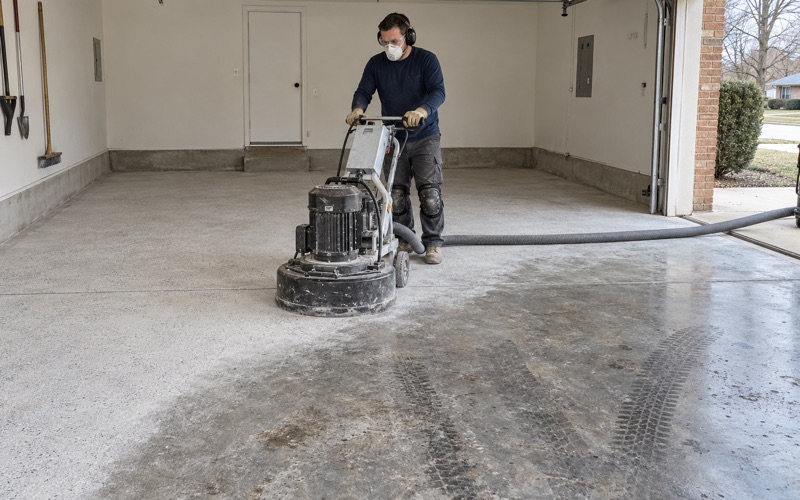
The floor that fits the protocol has two traits: nothing open to drive organisms into, and nowhere for water to sit. Both are decided before the first coat, during preparation. Every slab we take on is opened with a diamond grinder or a shot blaster rather than an acid etch, so the surface reaches a real concrete surface profile on the ICRI CSP scale and the repair materials and coatings have something to grip.
Filling cracks and joints
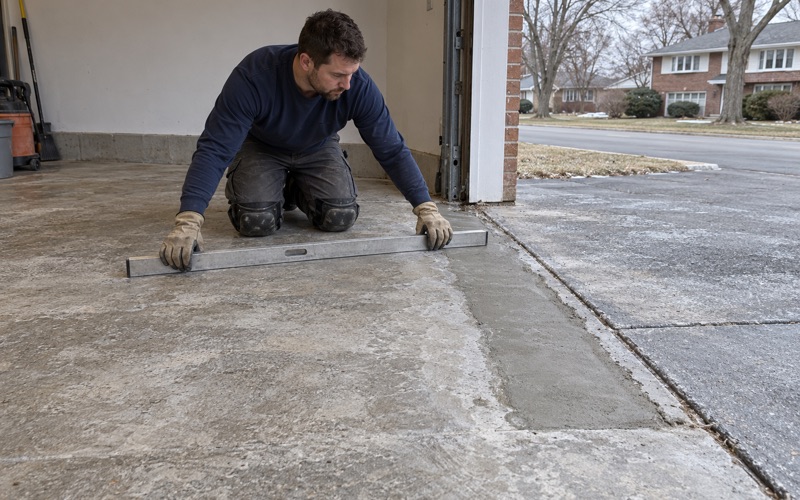
Once the slab is open, cracks are routed clean and filled, spalls are rebuilt, and joints are treated so the finished surface reads as one plane. The fill is ground back flush with the surrounding concrete, so the coating goes over a flat surface instead of bridging a dip. That flush fill is what removes the crevices the guidance warns about, and it is the step a fast job tends to skip.
Moisture before the coat
A moisture test is part of the written scope before our price is final. We use methods such as ASTM F2170 in-situ relative humidity probes or ASTM F1869 calcium chloride testing, and if vapor drive is high, a moisture-mitigation primer goes into the system. Moisture is also the first exclusion we name when we explain what a coating warranty leaves out, because a floor that blisters from below stops being nonporous fast.
Scheduling around a working clinic
A hospital that keeps exam rooms in rotation cannot simply close for a week. We phase clinic and office floors around operating hours, using overnight and weekend windows, and we set cure times by slab temperature and dew point rather than by the calendar. Grinding dust is captured at the machine with a vacuum instead of being rinsed toward a drain, which matters in any building that is trying to stay clean while the work goes on.
Permits and which Round Lake applies
The name Round Lake covers more than one village, and a mailing address can mislead. Round Lake Animal Hospital, for example, lists a Route 134 address that the Census geocoder places in unincorporated Avon Township rather than inside the village. Building questions inside the village go to the Village of Round Lake Building Department on Cedar Lake Road, so we confirm which jurisdiction a property sits in before the job is scheduled. Our proposal then names the product line, the number of coats and the finished thickness, so the floor that goes down can be checked against what was promised.
- 20+ Years on Concrete
- Moisture Test in Every Scope
- Free Written Estimates