Glenview Epoxy Flooring brings more than 20 years of epoxy flooring work to Wauconda, and a good share of the questions we hear here are about a floor nobody will ever see. When a workout room is going to be finished in rubber, the resin often belongs underneath it rather than on top. The rubber is what people stand on; the resin is what keeps the slab’s moisture from undoing the rubber’s adhesive.
That changes the order of work compared with a garage coating. The slab is tested first, the result decides whether a resin layer is needed at all, and only then does anyone pick a membrane, a base coat or an adhesive. Jumping straight to product selection is how a rubber floor can end up lifting at the seams.
Below we walk through a lower-level fitness room in the village, what an in-slab humidity test actually measures, where a two-part resin membrane fits, and how the same reasoning applies to a basement gym at home.
A Lower-Level Fitness Room and the Test That Comes First
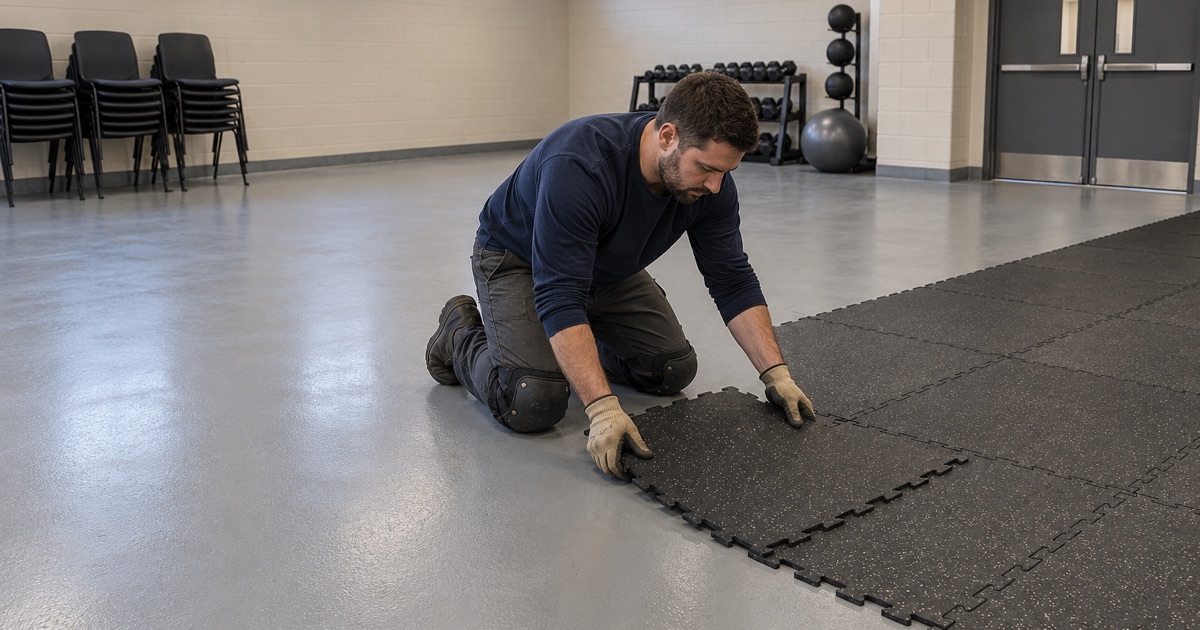
The Wauconda Park District runs Fitness First on the lower level of the Community Center at 600 N. Main Street, inside the village in Wauconda Township, Lake County. The district’s page lists it opening at 5:00 a.m. Monday through Friday and at 7:00 a.m. on weekends. We have not seen that room’s floor or any slab readings from it, and the district is not our customer; it is simply the clearest local example of the kind of space this page is about.
Why below grade changes the question
A slab on or below grade sits against the ground, and the ground supplies moisture vapor that moves up through the concrete. How much of that vapor reaches the underside of a floor covering depends on what is under the slab, how it was built and how it has been used. None of that can be read from the surface, which is why rubber-floor makers ask for a measurement instead of a judgment call.
One rubber tile maker’s 2023 installation instructions, from Roppe, put it plainly: moisture testing must be performed on all concrete slabs, regardless of their age or grade level. The same document says on-grade and below-grade substrates must have an effective vapor barrier meeting ASTM E1745, and where that condition does not exist, it recommends a moisture mitigation system before resilient flooring goes down. Those are a manufacturer’s requirements for its own product, not a building code.
What ASTM F2170 measures
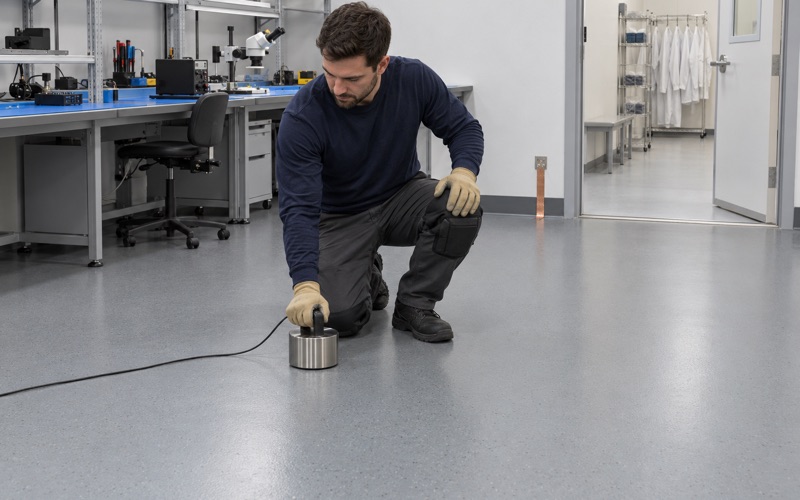
ASTM F2170 is the in-situ relative humidity method. Holes are drilled into the slab, probes are sealed inside and allowed to settle, and the reading reports the humidity within the concrete rather than at its face. That internal figure says more about what a covered slab will do than a surface check, because a rubber floor and its adhesive trap whatever is rising from below.
Roppe’s instructions require F2170 testing on all concrete substrates, at one test per 1,000 square feet with a minimum of three, and strongly recommend ASTM F1869 calcium chloride testing as well. A small fitness room still gets three probes; a larger lower level gets more. We write the test into the scope before the price is final, so the number of probes and their locations are agreed rather than improvised.
The readings are then compared against the adhesive the rubber will be set in. That maker lists adhesive RH limits running from 90% to 99.9%, depending on which adhesive is chosen. A slab that reads under the selected adhesive’s limit may need no resin layer at all, and we say so when that is the result.
Looking for epoxy-flooring closer to Winfield? See Winfield Epoxy-Flooring.
Resin Under Rubber: Membranes and Cured Epoxy Bases
When readings come in above the adhesive’s limit, or the slab has no vapor barrier under it, the resin’s job is to sit between the concrete and the rubber. There are two common forms, and they are related but not identical.
Two-part moisture-mitigation membranes
ASTM F3010 is the standard practice for two-component, resin-based, membrane-forming moisture mitigation systems used under resilient flooring. These are typically 100% solids epoxy formulations applied to a prepared slab at a specified thickness, sometimes in two coats, to form a continuous film that slows vapor on its way to the adhesive line. Each membrane maker publishes the RH ceiling its product is rated for, and that ceiling has to sit above what the F2170 probes found.
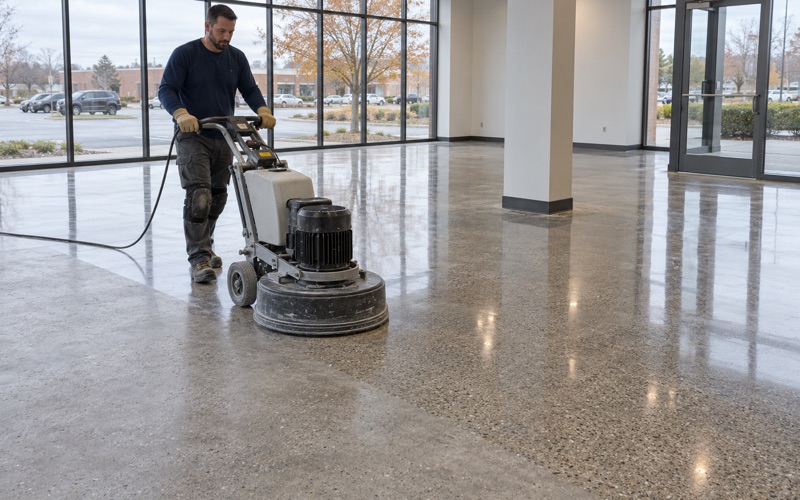
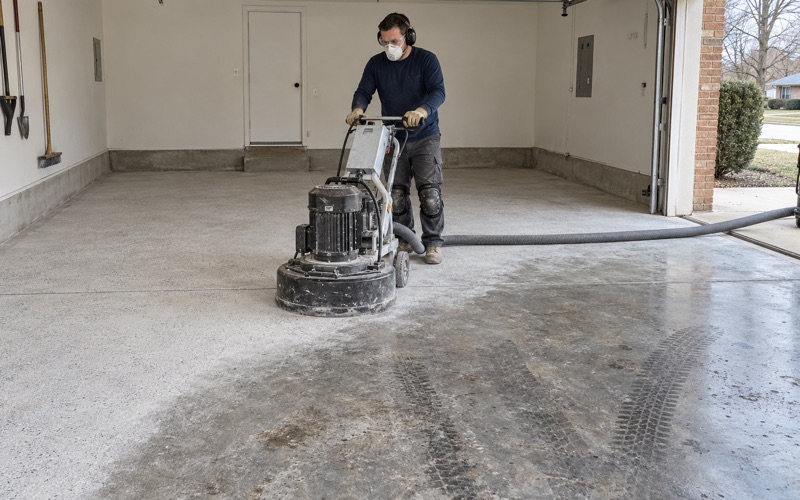
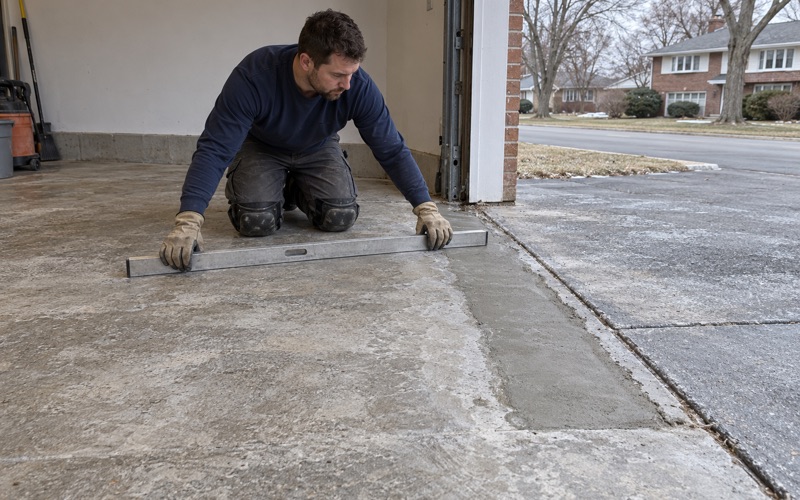
Preparation decides whether any of this works. We open the slab with a diamond grinder or a shot blaster to the ICRI concrete surface profile the membrane maker calls for, never with an acid etch, and the grinding dust is captured at the machine with a vacuum instead of being rinsed toward a floor drain. Cracks, spalls and any old coating or adhesive residue are mapped before the membrane goes down, because a film bonded to an unsound layer is only as good as that layer.
Cured epoxy as a base the rubber can bond to
Roppe’s instructions also allow installation directly over a resinous product, such as a urethane moisture barrier or an epoxy coating, provided that coating is dry to the touch and has cured. A cured resin film is treated as a non-porous substrate, which matters for the next decision. It also means the base has to be fully cured before the rubber crew arrives, so the schedule builds in that time instead of squeezing it.
Choosing an adhesive for a non-porous surface
Over bare concrete, some adhesives rely on the slab absorbing part of their moisture as they set. Over a resin membrane or cured epoxy that absorption is gone, so the rubber maker directs the installer toward an adhesive suited to non-porous substrates. We coordinate that with whoever is laying the rubber, so the base we leave is the surface their adhesive expects.
When the Coating Is the Floor and When It Is the Layer Beneath
Not every lower-level room should be rubber, and not every rubber room needs resin under it. The test result and the way the room is used decide together which way a job goes.
Coating as the finished floor
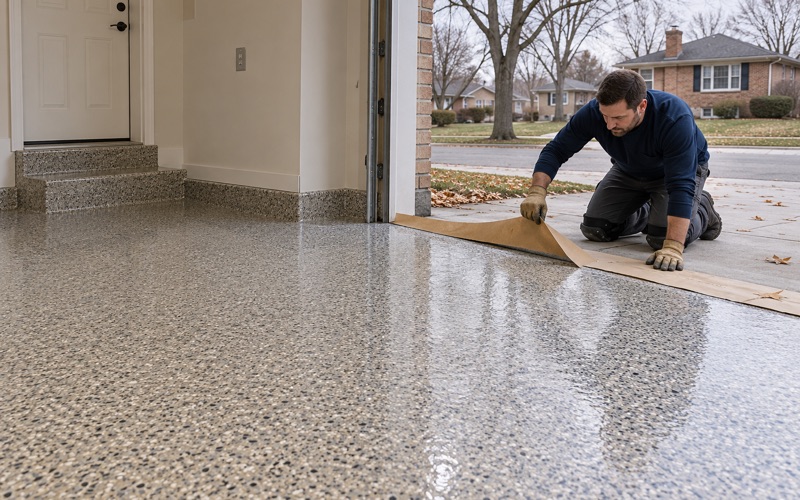
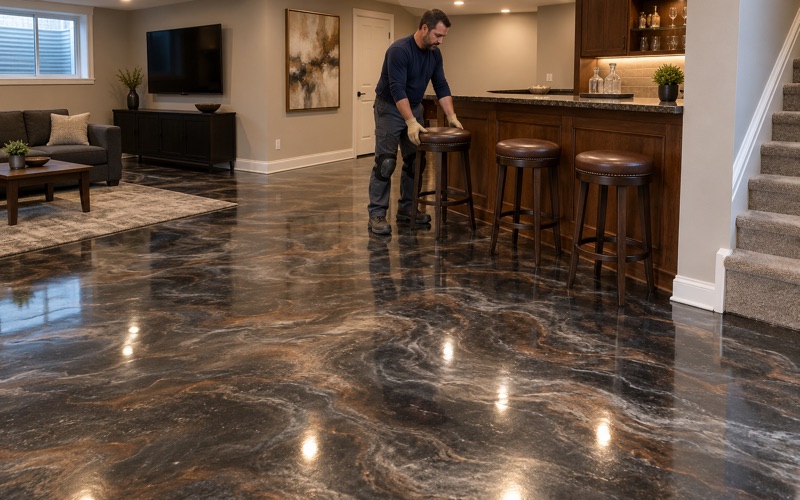
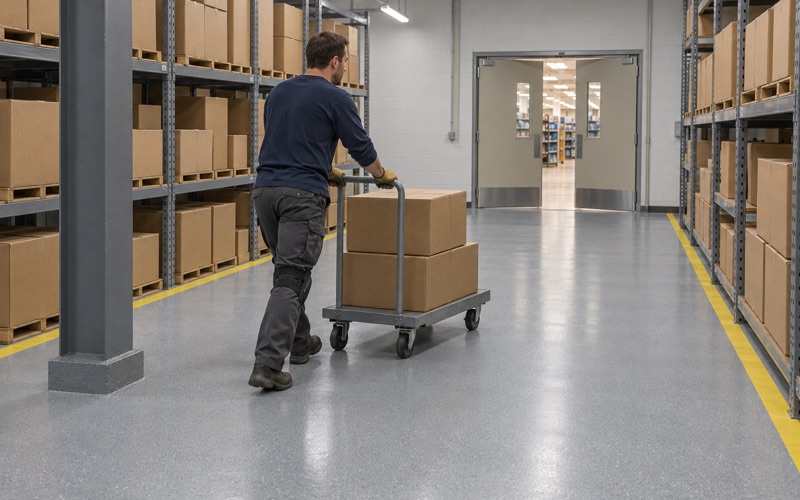
Storage rooms, mechanical spaces, corridors and service areas below grade are often better served by a coating that is itself the walking surface. There we may specify a 100% solids epoxy body coat with a quartz aggregate broadcast and a polyaspartic topcoat, and the slip-resistant texture comes from the broadcast and topcoat named in writing rather than from a promise. The proposal lists the product line, the number of coats and the finished thickness, so the floor that goes down can be checked against what was quoted.
Coating as the layer beneath
Where people lift, stretch and run cardio machines, rubber is the usual finish, and the resin becomes a base judged by its moisture rating rather than its looks. Nobody will ever see its color. The decision rests on the membrane’s published limits, its fit with the rubber adhesive, and a clean, profiled slab under it.
What a membrane does not do
A moisture-mitigation membrane controls vapor moving up through a slab. It is not waterproofing, it does not hold back liquid water from a leak or a wet foundation wall, and it offers no protection from a sewer backup or standing water. Coating warranties typically exclude moisture vapor transmission and hydrostatic pressure, and moisture is the first exclusion we name before a job is sold.
For a commercial room with early hours, phasing matters as much as product. A space that opens before sunrise can often only be worked overnight or across a weekend, and the membrane’s cure plus the rubber installation have to fit inside those windows. We lay out that sequence before the first probe is drilled.
Basement Gyms in Wauconda Homes
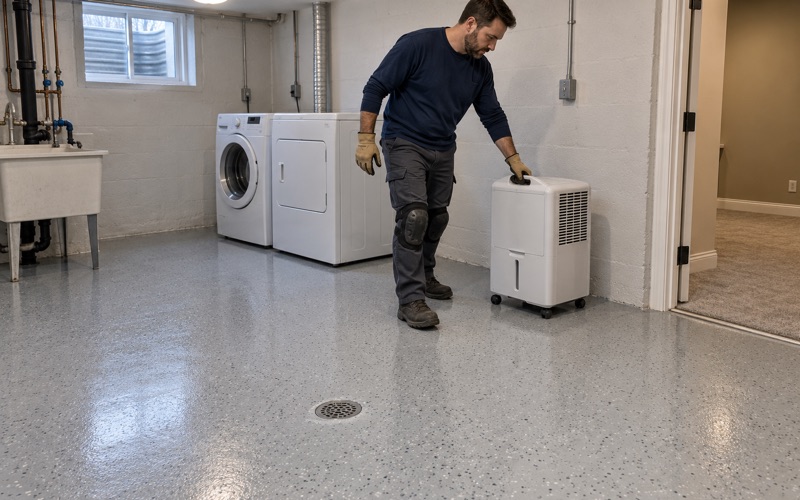
The same logic scales down to a house. Rubber tiles and rolled rubber are a popular finish for a home gym, and a basement slab is exactly the below-grade condition the rubber maker’s instructions were written for. About 76 percent of Wauconda’s occupied housing units are owner-occupied, and in an owned house the basement floor is the owner’s call to make.
Loose-laid tiles versus a glued floor
Interlocking rubber tiles are often loose-laid over a basement slab, while rolled rubber and many tiles are glued down. A glued floor brings the adhesive RH limit straight back into play, and loose-laid tiles still hold moisture against the concrete beneath them. For a glued floor we write an F2170 test into the scope, and an ASTM D4263 plastic sheet check can serve as a quick first look before the probes go in.
Reading the basement for past water
Before any moisture reading, we look for signs of past water: efflorescence along the walls, staining near a sump pit, tide lines on the slab, or old patching around a floor drain. A coating does not stop seepage or sewer backup, so a basement with a water history hears what a membrane can and cannot do before anything is priced. Sometimes the honest answer is that the slab needs repair, drainage work or replacement before it should be coated at all.
Paperwork, permits and the garage question
Home jobs over the Illinois threshold get a written contract and the Home Repair: Know Your Consumer Rights pamphlet before grinding starts, under the Illinois Home Repair and Remodeling Act. If the home gym is in an attached garage rather than a basement, standard compound rubber deserves a second look, since the same maker notes it is not designed for areas exposed to petroleum oils and lubricants. We check any permit questions with the Village of Wauconda before the job is scheduled, so the test, the resin base and the rubber finish all line up before the first day on site.
- 20+ Years on Concrete
- Moisture Test in Every Scope
- Free Written Estimates