Glenview Epoxy Flooring has spent more than 20 years on epoxy flooring, and in Westchester one request we take seriously is the one where the honest answer is partly no. Families ask whether a coated basement or garage slab can double as a place for a child to dance. It can serve as the base for one, but it cannot be the dance floor itself.
The reason is mechanical rather than a matter of taste. A resin coating seals a slab, makes it easier to clean and gives it a finished look, yet it leaves the concrete exactly as stiff as it was the day it was poured. Every jump, landing and shuffle still meets a surface that does not give.
So the work we describe below is the part a coating crew can actually do well: a slab that is clean, dry, flat and sealed, ready for a proper dance system or a portable practice board to sit on top. Where a project really needs a dance-floor maker rather than us, we say so before anything is quoted.
Ballet, Tap and Tumbling on Mannheim Road, and Why Concrete Cannot Be the Floor
Panda Dance Studios, at 1913 S Mannheim Rd, teaches children from age 3 through the teen years, and its own description says a one-hour class covers ballet, tap and tumbling. That combination is a useful way to think about floors, because the three disciplines ask different things of the surface under them. Ballet and tumbling are about landings, while tap is metal striking the floor again and again through a class. The studio has not published what its floor is built from and we have no connection to it; we mention it because it is where many local children first learn what a dance floor should feel like.
Concrete does not flex
Dance-floor suppliers are blunt about slabs. One studio flooring guide puts it simply: “Concrete does not flex, so dancers absorb the full impact of every landing in their joints.” That is vendor copy rather than a study, but nothing about a coating changes the stiffness it describes.
The same guide calls laying marley straight onto concrete “the single most common and most costly mistake studios make,” and says marley or hardwood laid directly over a slab “is one of the fastest ways to see shin splints and stress injuries climb.” We repeat those lines as a supplier’s warning, not as a medical finding. The point for a homeowner is narrower: a surface layer, whether vinyl, wood or resin, does not turn a slab into a dance floor.
What a coating does and does not change
A 100% solids epoxy or a polyaspartic topcoat is hard by design. That hardness is why it resists hot tire pickup in a garage and shrugs off a dropped wrench, and it is the same reason it gives nothing back under a jump. A coated slab is as rigid under a landing as a bare one, so we never describe any resin system as cushioned or as something that softens impact.
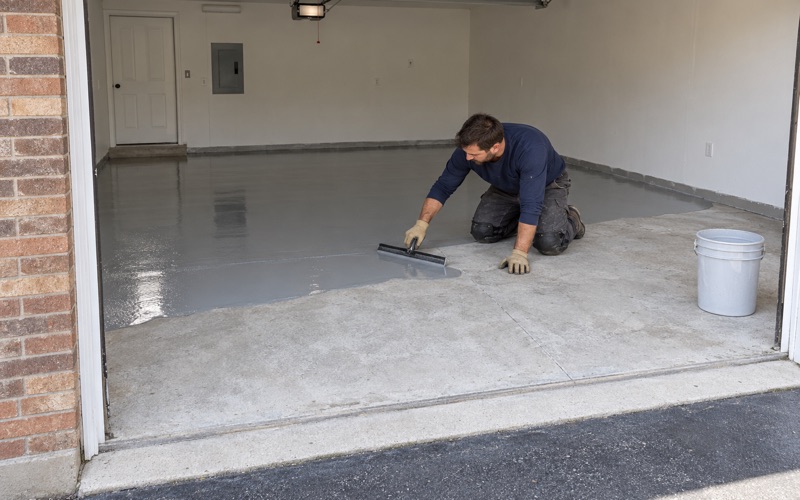
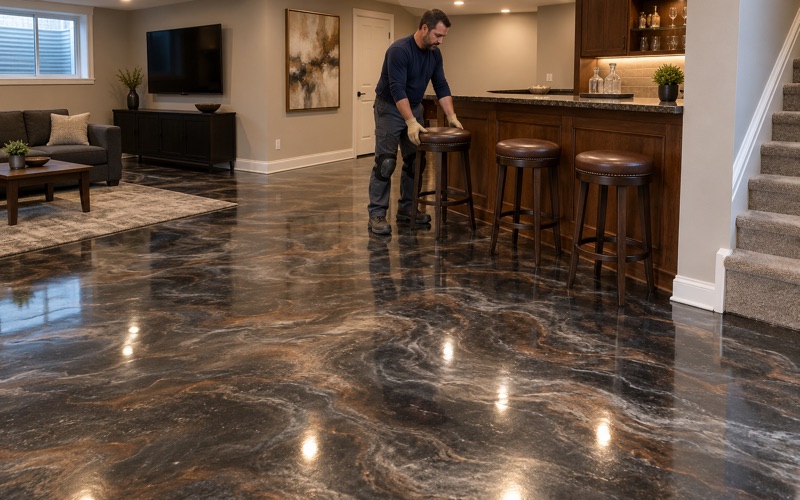
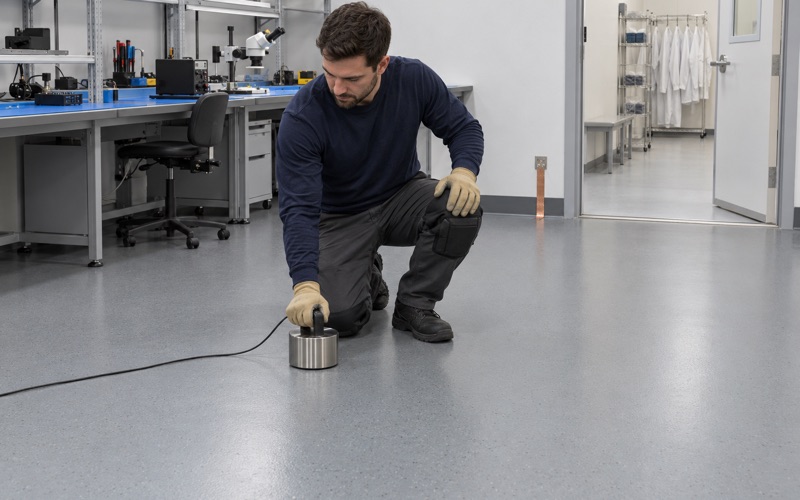
What a coating does change is the condition of the base. It locks down dusting concrete, closes the pores that hold dirt, and leaves a level, easy-to-clean surface that a panel system or practice board can rest on without grit working into its underside.
Looking for epoxy-flooring closer to La Grange Park? See Epoxy-Flooring in La Grange Park.
Sprung Subfloors, Marley and Portable Tap Boards
The same supplier guide draws the line that matters most: “A sprung subfloor, not the surface layer, is what protects joints.” A sprung or semi-sprung subfloor is a built layer, usually panels on resilient supports, that deflects slightly under a landing and returns. A floating subfloor rests over the slab without being fastened to it. Either one comes from dance-floor makers, not from a coating crew.
Where marley fits
Marley is the vinyl performance surface rolled out over that subfloor for ballet and similar work. It gives dancers the surface feel they expect, but on its own it adds no give, which is why the guide warns against rolling it straight onto concrete. In a home setting the order is slab, then subfloor, then marley, and our part of the job ends at the slab.
Tap boards for home practice
For tap, a full sprung floor is not the only route. Stagestep, a dance-floor maker, sells a transportable tap board in 2-by-4-foot and 3-by-4-foot sizes for practice at home, and Randy Swartz of Stagestep has said tap dancers “need a surface that can withstand the pounding of metal taps.” A board like that needs a flat, stable, clean surface underneath so it does not rock or creep, and that is where a well-prepared slab earns its place.
Swartz also noted that “a wood floor over carpet or a rubber base would only provide a dull thud,” and that “plywood, Masonite and laminate flooring are easily damaged and cannot be repaired.” Those are a maker’s comments about the dance surface itself. They are a fair warning that a practice floor improvised from leftover building materials rarely works, and that a coating is no substitute for the right board either.
Metal Taps Against a Thin Coating
A tap shoe carries metal plates at the toe and heel, and a thin film coating is the wrong thing to strike with them. Roll-on and thin-build systems are measured in mils, and repeated metal impact chips and scratches them, leaving dull pits that hold dirt and can start peeling at the edges. Even a thicker flake system under a polyaspartic or polyurea topcoat will scuff under steady tapping, because it was formulated for tires and shoes, not percussion.
Keep the board down every time
If a child is going to tap in a coated basement or garage, we recommend the board goes down for every session without exception. The coating then protects the slab from water, oil and road salt, and the board takes the metal. That division of labor keeps both surfaces looking right for years, instead of a scarred patch appearing exactly where practice happens.
The finish we specify underneath
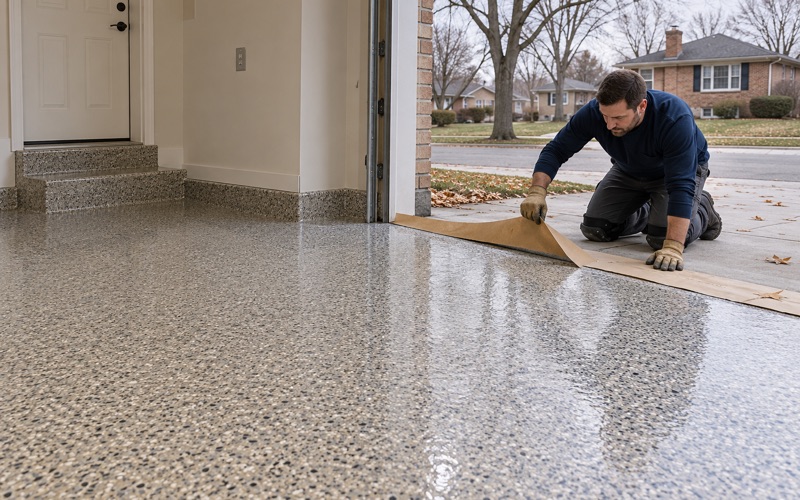
Under a tap board or panel system, a smooth or lightly textured topcoat is the practical choice, so the board sits flat and the floor sweeps clean. Our proposal names the product line, the number of coats and the finished thickness, so you can check what went down against what was quoted. Ballet and tumbling belong on the dance surface as well, never on the bare coating, for the same reasons the suppliers give.
Practicing at Home in a Westchester Basement or Garage
Westchester is a village in Cook County and a western suburb of Chicago, and its housing is heavily postwar: the 1950s alone supplied 48.4 percent of homes. Georgians, ranches and split-levels went up around a handful of earlier English-style houses, so most slabs we would prepare for a practice corner are now about seventy years old. Old concrete can be perfectly sound, but it has to be read before anything is put on it.
The basement
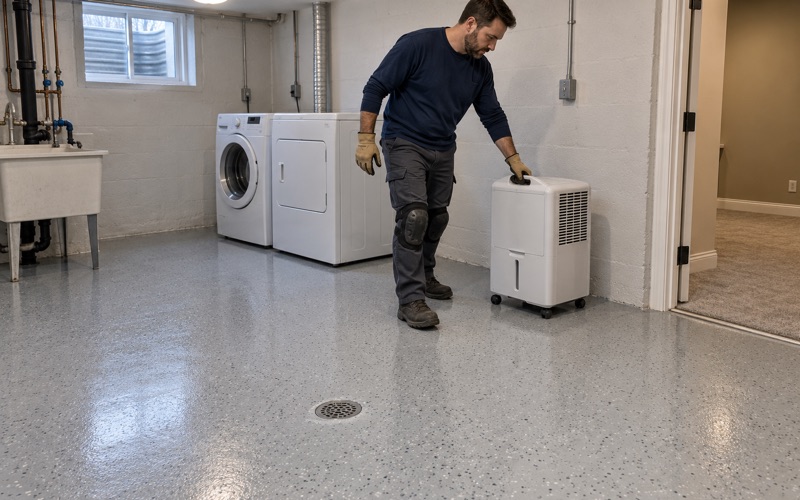
The village’s Requirements for Residential Basement Build-out sheet measures from the finished floor: wall outlets at least 18 inches above it, and the top edge of the storm basin 2 inches above it, with a floor drain required in the same room as the water heater. A thin coating leaves those heights where they are. A built-up floor does not, so a permanent sprung subfloor or platform has to be checked against both before it goes in, and the drain in the water-heater room must stay open with the floor still falling to it.
Basement bedrooms are not permitted under that sheet, so a finished basement here is a recreation, laundry or storage space, which is exactly where a practice board tends to end up. Before we price that floor we look for signs of past water, because a coating does not stop sewer backup or seepage, and a moisture test is written into the scope. The sheet does not say whether coating alone needs a permit, so we confirm with the Village of Westchester Community Development and Building Department before scheduling.
The garage
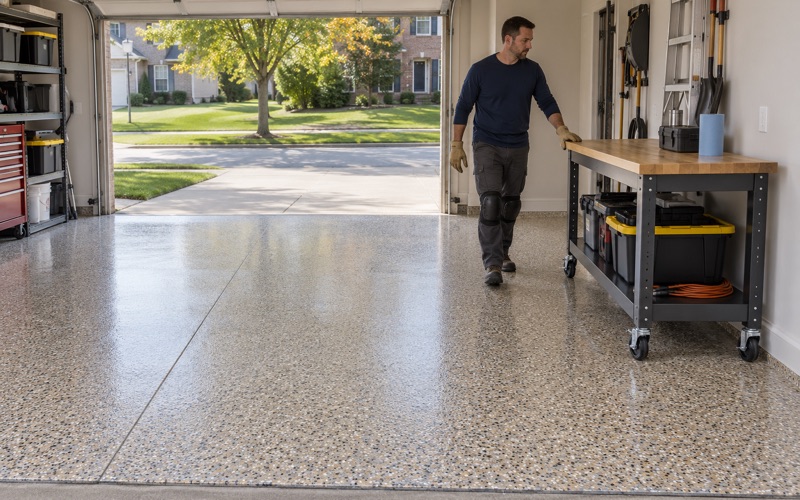
A garage practice corner has its own conditions. The village’s detached-garage sheet calls for a slab sloped to the front and premolded isolation joints at the apron, and both have to survive the coating: no ponding at the back wall, and the apron joint kept open as a movement joint rather than filled like a crack. Rock salt and brine ride in on tires all winter, so the system is chosen for that first and practice second.
How we prepare the slab
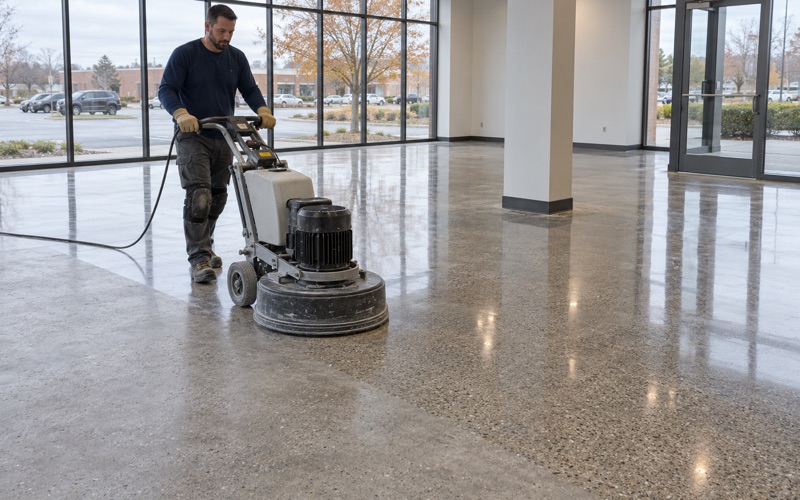
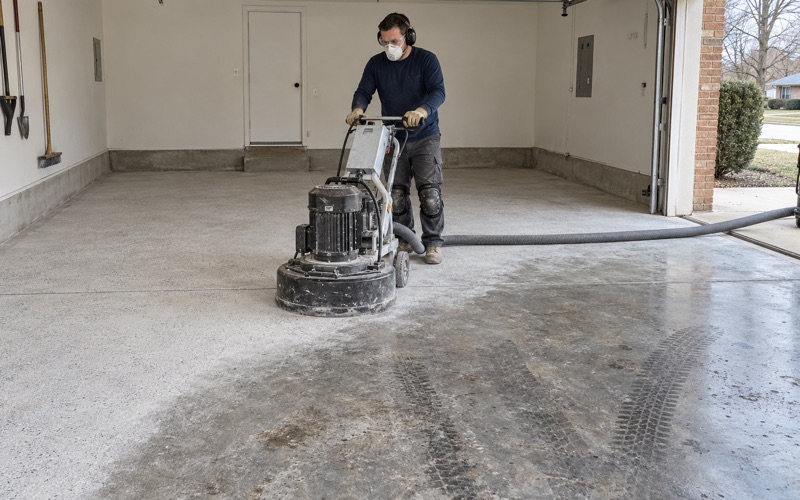
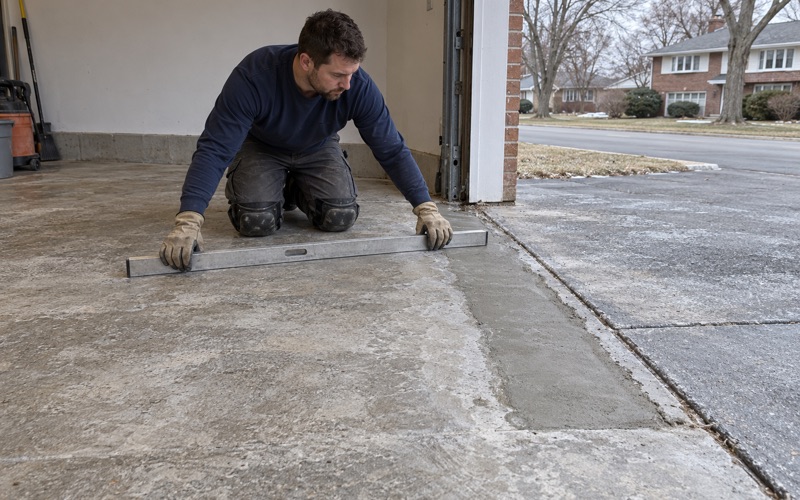
Every slab is opened with a diamond grinder or shot blaster, never an acid etch, so the coating has a real ICRI CSP profile to grip, and the dust is captured at the machine by vacuum. Cracks, spalls and old coatings are mapped before the quote, and we say plainly when a slab needs repair first. Cure timing follows slab temperature and the dew point spread rather than the calendar, and we explain what the warranty leaves out, starting with moisture, before the job is sold.
- 20+ Years on Concrete
- Moisture Test in Every Scope
- Free Written Estimates