Glenview Epoxy Flooring brings more than 20 years of work to epoxy-flooring in Wood Dale, and on warehouse jobs the question we ask first is where the floor stops being flat. A receiving ramp and the slab beside it carry the same forklifts and pallet jacks, but they ask very different things of a coating. We zone the two separately, so grip goes where wheels climb and brake and the rest of the floor stays easy to sweep.
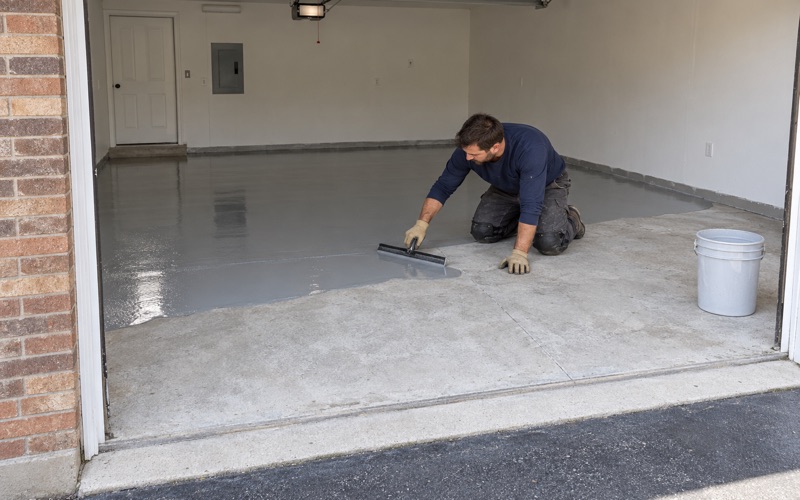
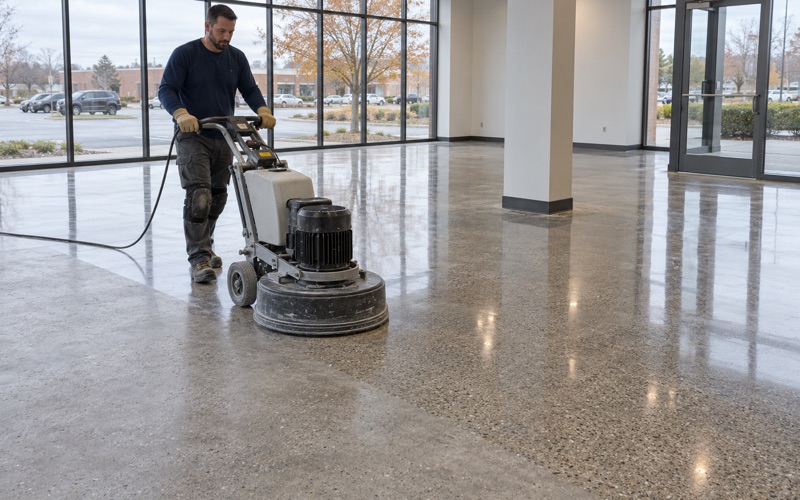
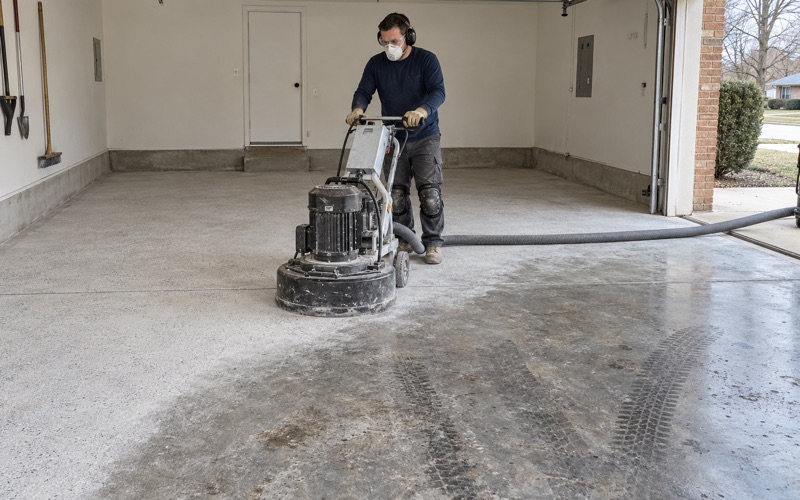
Every slab we coat is opened with a diamond grinder or a shot blaster rather than an acid etch, which gives the resin a real profile to hold. A moisture test sits inside the written scope before the price is final, and the proposal names the product line, the number of coats and the finished thickness, so the finished floor can be checked against the paper.
Warehouses rarely get to close for a floor. We phase the work around shipping hours and use overnight and weekend windows when a dock has to keep moving, and we say plainly when a slab needs repair before it should be coated at all.
A Bonded Warehouse on AEC Drive and Its Receiving Ramp
Wood Dale is a city in Addison Township, DuPage County, with a 2020 census population of 14,012, and its largest employers run to laboratories, manufacturers and logistics firms. One building shows the ramp problem clearly. American Lamprecht Transport, at 929 AEC Drive, describes an attached 5,000-square-foot warehouse that is Customs bonded and TSA certified, with multiple dock-high receiving doors, a receiving ramp, forklift and liftgate capability, and rack storage.
We have no relationship with Lamprecht, and its own description does not say how steep that ramp is, whether it sits inside the building or at an exterior door, or what its surface is. We use it because it is a plain, published example of a layout common in small logistics buildings: freight comes off a truck at dock height, and some of it moves up or down a slope to reach the floor.
What a forklift does on a slope
On the flat, a forklift rolls, turns and stops on a level contact patch. On a ramp it is climbing under load, braking on the way down, and carrying the load tilted back, which shifts weight toward the rear wheels. Braking force concentrates in the same few feet of the slope every trip, and that is where a smooth, glossy coating uses up its traction margin first.
Wet tires off a truck
Tires that come in off a wet trailer floor or a rainy yard carry water onto the first surface they meet. On a flat floor that film spreads out and dries. On a sloped coated surface it sits exactly where the wheels are braking, which is why we treat the ramp as its own zone rather than as more of the warehouse floor.
Dock-high doors and mixed traffic
A building with several dock-high receiving doors and a ramp usually sees two kinds of arrivals: trailers that back to dock height and smaller vehicles or carts that need the slope. That puts forklifts, pallet jacks and people on foot through the same few yards of floor at the foot of the ramp. A coating plan for a building like this starts with a walk of those routes, so the texture, the wear coat and the markings land where the traffic actually runs.
Looking for epoxy-flooring closer to Northlake? See Northlake Epoxy-Flooring.
What OSHA’s Grade Rule Asks of the Driver
The federal rule for powered industrial trucks, 29 CFR 1910.178(n)(7), speaks directly to ramps. Grades are to be ascended or descended slowly. When a grade is in excess of 10 percent, loaded trucks are driven with the load upgrade, and on every grade the load and forks are tilted back where that applies and raised only as far as needed to clear the surface.
Load upgrade, in practice
Driving with the load upgrade means a loaded forklift goes up a steep ramp forks first and comes down it in reverse, with the load always on the high side. That keeps the load against the mast, but it also means the driver is often looking over a shoulder on the descent while braking. The floor under those wheels is doing its work at the same moment the driver has the least view of it.
Loose objects and grit
A neighboring provision, 1910.178(n)(14), says running over loose objects on the roadway surface should be avoided. On a ramp, shrink-wrap scraps, pallet splinters and broken aggregate become exactly that. A coating that sheds its texture under braking turns into a source of loose grit, so the wear rating of the topcoat matters as much as the first-day grip.
Where the coating fits
These rules govern how a truck is operated, not what the floor is finished with. OSHA does not call for a textured ramp, and no coating makes a ramp safe on its own. What we can do is give a well-run operation a surface whose traction holds up on the slope where the rule already expects drivers to slow down.
That is also why we ask about the grade before we quote. A ramp in excess of 10 percent puts loaded trucks into the load-upgrade pattern every trip, with more braking on the descent, and that changes how coarse a broadcast we recommend and how thick the wear coat should be.
Broadcast Texture on the Slope, Smooth on the Flat
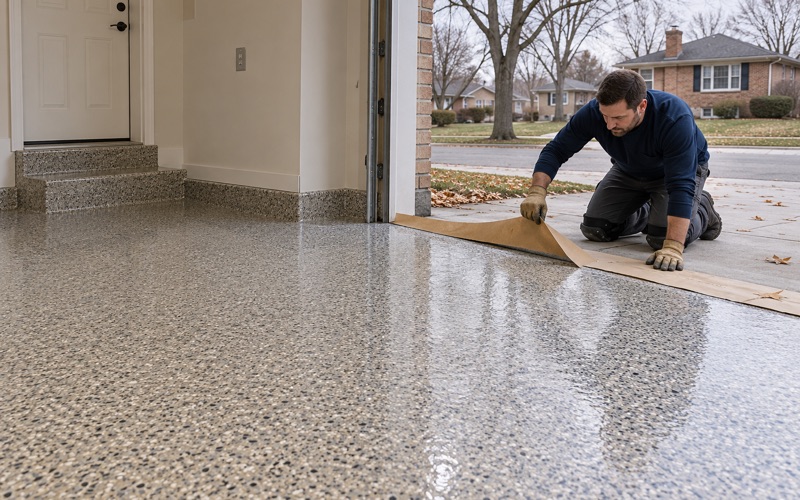
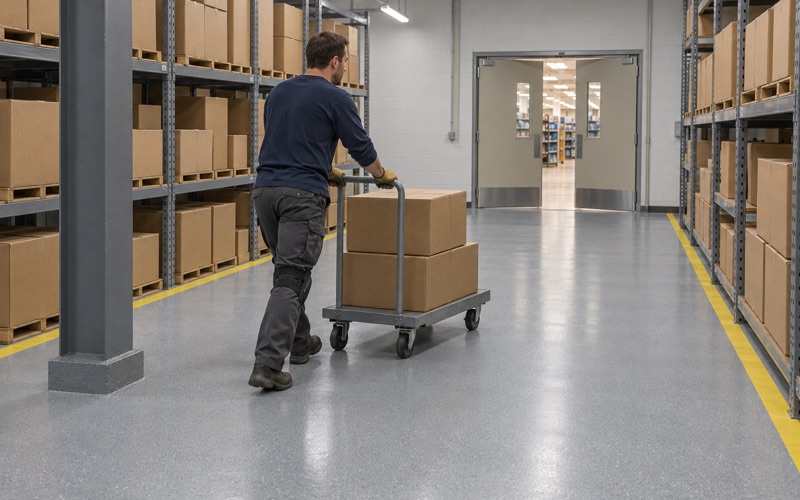
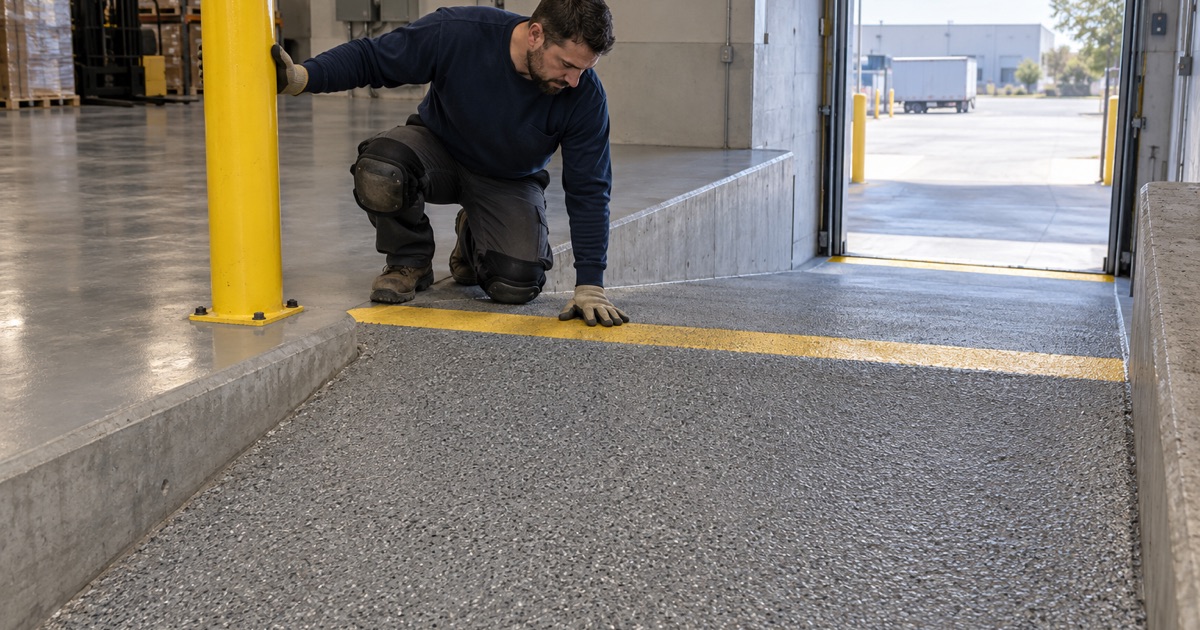
A slip-resistant floor is something we specify by material, not something we promise. On a ramp that means a broadcast of quartz aggregate into the base coat, locked in by a wear-rated topcoat, with the grit size and coverage written into the proposal. On the flat floor next to it, the same system is finished smooth enough that a sweeper or a dust mop clears it in one pass.
Profile before texture
Texture only lasts if the coating underneath stays bonded. We grind or shot blast the ramp to an ICRI concrete surface profile suited to the system, then lay a 100% solids epoxy base. Slab moisture gets the same attention here as anywhere: we test with ASTM F2170 in-situ relative humidity probes or an ASTM F1869 calcium chloride test, and moisture is the first warranty exclusion we name before a job is sold.
Why the ramp gets a tougher topcoat
Braking scrubs the same strip of a ramp every trip, so the broadcast there is topped with a polyaspartic or urethane wear coat rather than a thin gloss coat. A softer finish polishes off the peaks of the aggregate and returns the slope to smooth within a season of heavy traffic. The flat floor sees rolling wear instead, and its topcoat is chosen for cleanability and abrasion rather than grip.
Keeping the flat floor sweepable
Rough texture across a whole warehouse floor holds dust, chews up cleaning pads and makes pallet jacks harder to push. Aisle lines are a special case: striping guidance advises against aggregate on drive-aisle lines because it gives tires something to grind. So the texture stays where the slope asks for it, and the open floor stays smooth.
Reading an existing ramp first
Many ramps we see already carry a coating that has worn through in the wheel paths or lifted at the edges. We map cracks, spalls and old coatings before anything is priced, and a failed prior coating comes off by grinding rather than being buried under a new one. If the concrete itself is broken up at the slope, we say so and recommend repair before any resin goes down.
Marking the Top and Bottom Where Wheels Change Angle
The two most demanding lines on a ramp are where it begins and ends. At the bottom, a forklift tips back onto the incline and the load shifts; at the top, the front wheels go light for a moment as the truck levels out. Those are the places a driver and a pedestrian both need to see that the floor is about to change.
A color or texture change you can read
We mark each transition with a contrasting color band, a change in texture, or both, laid as part of the coating system so it reads at a glance from a forklift seat. The band also tells a pedestrian on the flat floor that they are stepping into a forklift lane on a grade. Where a ramp meets an aisle line, the two are laid out together so one does not cut across the other.
Lines that survive braking
Paint laid on top of a finished floor wears off first in a braking zone. We lay transition bands and safety lines in epoxy and then encapsulate them under the clear wear coat, the practice warehouse contractors use so colored lines stand up to abrasion and cleaning. A line that is still visible after a year of tow-motor traffic is the whole point of marking it.
Pallet jacks at the transition
A manual or powered pallet jack has small, hard wheels that catch on any lip where the coating ends or the slab changes level. We feather the coating edges at the top and bottom so there is no raised step for a wheel to strike, and we keep the broadcast fine enough near the transition that a loaded jack still rolls. The goal is a change the eye notices and the wheels barely feel.
Scheduling and paperwork in Wood Dale
The City of Wood Dale requires every contractor to be registered with Community Development before a permit issues, with a certificate of insurance carrying $2,000,000 in public liability coverage naming the city. We sort that out before the job is on the calendar. Cure times follow slab temperature and the dew point spread at the surface rather than the clock, so a ramp near an open dock door is scheduled for conditions that let the coating set properly, and grinding dust is captured at the machine instead of being washed toward a drain.
- 20+ Years on Concrete
- Moisture Test in Every Scope
- Free Written Estimates